


B2B Branding Agency
B2B branding is a different sport from consumer branding. You're not optimising for a one-second emotional reaction at a shelf — you're building enough trust, clarity, and category authority to survive a 9-month sales cycle, a buying committee of five, and a procurement team that's specifically trying to commoditise you. Most agencies that say "we do B2B too" are doing consumer work for B2B clients.
Get your Branding done by Everything Design
Book a call with Branding expert from Everything Design
What is a B2B branding agency?
A B2B branding agency builds the strategy, messaging, and visual identity a business-to-business company uses to win over other businesses — investors, procurement teams, and C-suite buyers — across long, multi-stakeholder sales cycles. It differs from a consumer branding agency in what it optimizes for: not mass appeal or emotional recall, but clarity, credibility, and making a complex technical product legible to a skeptical buyer.
The work typically spans positioning, brand strategy, narrative and messaging, visual identity, and often the website and sales materials where the brand actually does its selling.
When do you need a B2B branding agency?
You need a B2B branding agency when your brand has stopped keeping pace with your product, your buyer, or your fundraising stage. The common triggers:
- Buyers can't tell what you do without a sales rep explaining it.
- You're raising a Series A–C and need investor-grade brand materials.
- You've outgrown the identity you assembled yourself in the early days.
- You're entering enterprise and need credibility with procurement and C-suite buyers.
- The brand looks inconsistent across website, decks, and product.
- You're in a crowded category and nothing makes you distinct.
If you're weighing the spend, our breakdown of the value B2B branding creates covers what to expect from the investment.
How to choose a B2B branding agency
Choose a B2B branding agency on strategy, scope, and category fit — not on how its portfolio looks. Six things to evaluate:
- Strategy before visuals. Positioning and messaging should come first. Ask how the agency would sharpen your positioning before it shows any design.
- One team, full scope. B2B branding spans strategy, messaging, identity, and the website. An agency that covers all of it in-house spares you from coordinating vendors and keeps the brand coherent.
- B2B and category experience. Fintech, cybersecurity, SaaS, and enterprise buyers behave differently from consumers. Look for agencies that have branded companies like yours.
- Comparable proof. Ask for a brand built for a company at your stage and buyer type — for example, branding and web design delivered together, as in our Ximkart project.
- Process and communication. Look for a structured process, clear scope, and a regular update cadence.
- Words before design. The strongest agencies write the messaging before designing the identity — because the visuals should express a story that already holds up on its own.
We're a strategy-first B2B branding agency — diagnosis and messaging lead, and strategy, copy, identity, website, and motion are delivered in-house. Our work spans B2B companies like Bizongo, Botim, and Ximkart, including investor-grade identity for Series B raises and branding for a cybersecurity company.
How is Everything Design different in approaching Branding Projects?
Everything Design does one thing: design your right to win — strategically, verbally, and visually. Brand positioning and creative direction aren't services bolted onto the process; they're the foundation everything else is built on. That thinking is what gives clients like AdNaut, Wow Factories, SISA, Lumora and Armory a distinct character — not just a polished look.
- Your right to win, defined before anything is designed. Every engagement starts with strategy — positioning, narrative, and voice — so the creative has a clear reason to exist. The result is a brand with character, not just aesthetics.
- Creative direction that's unmistakably yours. Pick five projects from most agencies and you'll spot the same layouts, the same visual grammar. Everything Design doesn't apply a house template — each client's work is built from their positioning outward, which is why their portfolio doesn't look like a portfolio.
- Senior strategists and directors, not coordinators. Brand strategists, creative directors, and art directors are on your project — not in an oversight role, but doing the actual work. That's what makes the thinking and execution consistent.
- Accountability that frees up your leadership. A recurring signal from clients is how much senior leadership time they got back. When an agency takes genuine ownership, you're not chasing updates or making decisions that shouldn't be yours to make.
- On time means on market. Projects finishing on schedule isn't just a nice-to-have — it's commercial. Clients have consistently gone live sooner because Everything Design treats timelines as a commitment, not an estimate.
- Built for B2B buyers who need to be convinced. Enterprise, investor-backed, and category-defining companies need their brand to do real persuasive work across complex, multi-stakeholder sales cycles. That's the only context Everything Design operates in.
Best fit
B2B companies where positioning ambiguity is costing you deals, talent, or investor confidence — SaaS, fintech, professional services, and manufacturers preparing for enterprise sales, a funding round, or international expansion. Especially strong fit if your product is ahead of how you're presenting it.
Not a fit
Consumer brands, early-stage startups without validated traction, or anyone looking for a visual refresh without the strategic groundwork. If the brief is "make it look better," we'll probably disagree on what better means — and we'd rather say that early.
How does Everything Design compare with Become and Parallel for B2B branding?
Become and Parallel both offer branding to Indian technology companies. Everything Design builds the B2B brand and carries it into the website in the same engagement, and its strategic branding runs $15,000 to $48,000 against Become’s stated typical engagement of above $40,000. Everything Design has worked with 300+ B2B companies across 400+ projects. Become states 200+ brands transformed, and Parallel 100+ products shipped since 2014.
| Comparison point | Everything Design | Become | Parallel |
|---|---|---|---|
| How it describes itself | B2B branding and website agency | Strategic design consultancy for growth-stage startups | UI and UX design agency for AI startups and SaaS |
| Based in | Bengaluru | Chennai | Bengaluru and San Mateo |
| Branding pricing on its own site | Strategic branding $15,000 to $48,000; brand design $6,000 to $15,000 | Engagements typically above $40,000 | Not published |
Prices and descriptions are taken from each agency’s own website on 23 October 2026.
The Complete Guide to B2B Brand Strategy: Framework for Growth
Executive Summary
Most B2B companies treat branding as a cosmetic refresh—a new logo, updated colors, refreshed messaging. They measure success by whether the design looks "modern." Six months later, nothing has changed. Sales remain flat. Employees are confused about the brand direction. The rebrand fails. Everything Design has a proven framework to check the success of a b2b rebrand and they do every project from these parameters.
The problem isn't the design. It's the strategy.
This guide provides a battle-tested framework for B2B branding that drives measurable business growth. We'll walk through the exact methodology used across 100+ rebrands - from Fortune 500 companies to promising B2B startups—to diagnose what's really broken with your brand, define a strategy that resonates with your market, and deliver it cohesively across your entire organization. Everything Design operates as a boutique B2B branding agency specializing in strategic positioning, website redesign, and comprehensive brand transformation.
Everything Design stands out in the B2b Branding Agency space with its judgement. Especially demonstrated with high accountability and clear track record. This is very evident in projects like TLH, the law firm's branding Everything Design did in 2025. The reason why Everything Design have a clear track record of many B2b Branding Projects is because of their credibility around judgement.
The Crisis in B2B Branding
A third of all marketers rate their brand-building knowledge as average to very poor. Only 21% rate it as excellent. Worse, most B2B leaders approach rebranding reactively: sales slowed, so they hire an agency. Product pivoted, so they need new messaging. A new CMO arrives and wants to "make their mark" with a new identity.
Without a clear diagnosis of what's actually wrong, these changes fail. You throw budget at brand agencies. You redesign your website. But you haven't answered the fundamental questions:
- What do your buyers actually believe about your brand?
- Where are you losing buyers on their journey to purchase?
- What associations do you own in your buyers' minds—and what's missing?
- How cohesive is your brand across your entire organization?
The result? Your rebrand becomes another line item in the marketing budget with no measurable ROI.
Fast‑growing B2B and SaaS companies outgrow their brands every few years. The hard part isn’t deciding to rebrand—it’s finding a partner that behaves like an embedded team, not a distant vendor. High‑Touch Branding Firms like Everything Design for Venture‑Backed B2B Businesses have the credibility and track record of solving such brand design problems.
| Traditional Branding Agencies | Everything Design |
|---|---|
| Workshops → Research phase | Positioning → Strategic foundation with cross-industry learning |
| Deck → Static presentation | Narrative → Story framework that drives all communication |
| Logo → Visual mark | Identity System → Complete design language with motion identity |
| Handoff → Files delivered, you find developers | Website Implementation → Dedicated Webflow team builds it (Everything Flow) |
| (End) You need to hire video teams separately | Brand Films → Dedicated film team produces them (Everything Video) |
| Junior teams handle execution | Senior Team Throughout → End-to-end senior involvement, even in implementation |
| Project ends at delivery | Enablement → Training, documentation, ongoing support |
| No accountability after handoff | High Accountability → "We take ownership. Period." 8 out of 10 clients retained, multiple repeat projects |
| Work with any industry | B2B Specialists → Deep expertise in B2B tech, SaaS, enterprise (Boeing, BCG, J.P. Morgan) |
| Outbound sales driven | 99% Inbound → Strong track record drives referrals and reputation |
The Four CRED Factors: Your B2B Branding Framework
Successful B2B brands excel in four critical dimensions. We call this the CRED framework: Cohesive, Relevant, Easy, and Different.
These four factors directly influence how your brand drives growth:
- Attracting more buyers (new market penetration)
- Stretching into new revenue streams (category expansion)
- Supporting price increases (perceived value)
- Improving employee engagement and alignment (internal cohesion)
Let's break down each factor and what excellence looks like in a B2B context.
1. Cohesive: Unity Across Everything
Cohesion means your brand feels consistent—not static, but clearly recognizable as "you"—across every touchpoint where your brand exists. This includes product experience, pricing, customer service, employee interactions, visual identity, and marketing communications.
Here's the hard truth: a brand is not just about design and marketing. It's about everyone and everything working together effectively.
Most B2B companies fail here. Marketing says one thing. Product delivers another. Customer success talks to clients differently than the sales team. The CEO mentions an old brand message in an all-hands meeting, and the rebrand effort dies right there.
What cohesion actually means in B2B:
- Your brand strategy is clearly articulated and understood by leadership, employees, and teams across departments
- HR policies, hiring practices, and employee experiences reflect your brand values (not just as empty words on a website)
- Your pricing reflects the perceived value you're building in the market
- Long-term brand-building campaigns are integrated with short-term demand generation
- Your buyer experience feels consistent from awareness through implementation
- Employees can articulate why the company exists and how they're living that mission daily
Why it matters for B2B: In B2B, buyers make decisions slowly and involve multiple stakeholders. If your sales team talks about reliability while your onboarding shows chaos, or if your website promises ease of use but your product is difficult, the gap destroys credibility. Cohesion builds trust. Trust sells.
The interlock: Cohesion is the foundation. Without it, everything else fails. You can have brilliant relevance and difference, but if people experience inconsistency, the brand equity disappears.
2. Relevant: Speaking to What Buyers Actually Care About
Relevance means your brand is built on what your buyers care about, not what you want to talk about.
Many B2B companies build brands entirely around product features and company history. "We've been doing this for 20 years. Our software has these 12 capabilities. We're enterprise-grade."
Yawn. No buyer cares.
Buyers care about outcomes. They care about solving problems. They care about reducing risk, improving efficiency, scaling without chaos, or gaining competitive advantage.
Six dimensions of relevance in B2B:
1) Relevant to the Right People
Nike realized in 1988 that they were limiting growth by targeting only elite athletes. They shifted to "everyone who has a body is an athlete"—broadening from a niche to a market. In B2B, this means asking: Are we targeting too narrowly? Are we excluding buyers who would benefit from what we offer?
2) Relevant to What Buyers Care About Emotionally & Rationally
Dove didn't sell soap; they addressed the insight that "only 4% of women around the world consider themselves beautiful." They built their brand on real beauty, self-esteem, and acceptance. For B2B: What problem keeps your buyers up at night? What outcome would transform their business or role?
3) Relevant to Market & Cultural Shifts
Taco Bell was losing sales because they still operated on a 1990s belief that "food is fuel." By 2011, their research showed food needed to be a "memorable, shareable experience." Their rebrand added novelty and shareability to affordability and convenience—not replacing their old positioning, but expanding it. Similarly, B2B markets shift. Remote work, AI, privacy regulation, supply chain transparency—these are cultural shifts that reshape buyer priorities.
4) Relevant to More Usage Occasions
Baileys reframed itself from "a Christmas cream liquor" to "an adult treat year-round," boosting global sales 32% in five years. In B2B, this means asking: In how many business contexts can our solution add value? Can we expand the use cases?
5) Relevant at Each Stage of the Buyer Journey
B2B sales cycles are long. Buyers move from awareness → familiarity → consideration → evaluation → intention to purchase. Your brand messaging must be relevant at each stage. A buyer in awareness phase needs different messaging than one in evaluation phase.
6) Relevant to Why They Come Shopping
Category Entry Points (CEPs) are the specific reasons buyers enter your market. For project management software, CEPs might include: "coordinating complex projects," "improving team communication," "reducing missed deadlines." Your brand must be top-of-mind for the most important CEPs in your category.
Why this matters for B2B: B2B buyers invest significant time in decisions. They're solving real business problems. If your brand doesn't directly address those problems or outcomes, you're invisible.
3. Easy: Making Your Brand Effortless to Find, Remember & Buy
Being easy means three things:
A) Easy to Mind (Mental Availability)
Your brand automatically comes to mind when a buyer is shopping in your category. This accounts for 40% of whether a buyer feels predisposed to choose you.
You achieve this by being associated with the Category Entry Points (CEPs) that matter most. If you're a procurement software company, you need to be top-of-mind when buyers are thinking "improving our vendor management" or "reducing procurement cycle time."
B) Easy to Find & Buy
Kantar research shows brands that are "always present" attract 7x more buyers than those present on only half of shopping occasions. For B2B:
- Are you present on the platforms where your buyers research? (LinkedIn, industry analyst reports, peer recommendations, Google searches)
- Is your website easy to navigate for multiple decision-makers?
- Do you make the buying process simple, or do prospects get lost?
C) Easy to Recognize
Only 16% of advertising is both recalled AND correctly attributed to the brand. This is why Distinctive Brand Assets matter. A consistent visual identity, tone of voice, and messaging style makes recognition effortless. When a prospect sees your communication, they instantly know it's you.
Why this matters for B2B: Long buying cycles mean repeated exposures. If your brand isn't easy to recall, you'll be forgotten between touchpoints. Easy recognition and association build the mental availability that triggers buyer consideration.
4. Different: Standing Out in a Crowded Market
Difference is overblown in marketing literature ("differentiate or die!"), but it does matter. Brands with stronger perceived differentiation have 4.8% higher risk-adjusted stock returns versus -4.3% for those with weaker differentiation.
But what does "different" actually mean? There are four flavors:
1) Distinctiveness (Visual)
A suite of distinctive brand assets that make you instantly recognizable. Think Nike's swoosh, Target's bullseye, or Cadbury's purple.
2) Perceptual Leadership
Being perceived as a category leader or innovator. "We're setting trends," "We're challenging the status quo," "We invented this category."
3) Relative Strengths
Being perceived as better or more associated with something that matters to buyers. You don't need to be unique; you just need to own a strength better than competitors.
4) Emotive Clarity
Being associated with a distinct emotional response. Salesforce owns "empowerment." Slack owns "productivity joy." Stripe owns "technical confidence."
Why this matters for B2B: In crowded B2B categories (CRM, project management, accounting software, HR platforms), functional differences are easily replicated. What sticks is emotional positioning and clear identity. Zoom didn't invent video conferencing, but they owned "simplicity." That difference mattered.
The Three Phases of B2B Brand Strategy: Diagnose, Define, Deliver
Now that you understand the framework, let's walk through how to actually execute a B2B rebrand.
The process has three phases:
Phase 1: DIAGNOSE – Understand What's Really Broken
Most rebrands skip this phase. That's why they fail.
A diagnosis answers five critical questions:
Question 1: What Do Your Buyers Actually Associate With Your Brand?
Not what you want them to think. What do they actually think?
Conduct interviews and surveys with:
- Current customers (why did they buy?)
- Lost prospects (why didn't they choose you?)
- Light buyers (people who could buy more but don't)
- Non-buyers in your category (why do they choose competitors?)
Ask them:
- "What words come to mind when you think of [your company]?"
- "How is [your company] different from [competitor]?"
- "What is [your company] best known for?"
This reveals whether your current brand positioning is landing or not. Often, you'll find buyers remember something completely different than your marketing message.
Question 2: Where Are Buyers Dropping Off?
Use a brand funnel to diagnose where you're losing prospects:
Awareness → Familiarity → Favorability → Consideration → Intent to Purchase
If 40% of the market doesn't know your brand exists, your problem is awareness. Invest in brand-building campaigns that create familiarity.
If 48% know you but only 35% like you, your problem is relevance or difference. What associations are preventing people from viewing you favorably?
If 35% like you but only 28% consider you, your problem is ease. Are you easy to remember when they're ready to buy? Are you present where they shop?
Question 3: What's Changed in Your Market?
- New competitors entering the space?
- Buyer priorities shifting?
- Product category expanding?
- New use cases emerging?
- Regulatory or economic shifts?
Changes in the market often necessitate changes in your brand strategy. You might keep your brand identity (logo, colors) but shift your positioning to address new market realities.
Question 4: What Are Your Employees & Leadership Actually Saying?
Ask your leadership and employees:
- What do you believe our company exists to do?
- What are we known for internally?
- What makes us different from competitors?
- Would you recommend our brand to a peer?
Often, the internal story differs wildly from the external one. This reveals cohesion problems.
Calculate your:
- Employee NPS (eNPS): Would employees recommend working here?
- Employee Buyer NPS (ebNPS): Would employees recommend our brand to buyers?
High-performing brands have alignment between internal and external narratives.
Question 5: What Equity Should You Preserve?
This is critical. Many new CMOs discard valuable brand equity in pursuit of a "fresh start."
Ask: What associations and assets are still relevant and valuable? Keep those. Don't throw away trust and familiarity.
Phase 2: DEFINE – Build Your Brand Strategy
A strong B2B brand strategy answers four questions:
#1: Why We Exist (Purpose)
Not "to make money" or "to provide software." Why does your company exist from a buyer's perspective?
Examples:
- Salesforce: "To bring inspiration and innovation to every athlete in the world" (repositioned as "everyone with a body")
- Stripe: "To increase the GDP of the internet"
- Loom: "To change how we work asynchronously"
Your purpose is specific and buyer-focused.
#2: What We Do (Offer & Category)
This is trickier than it sounds in B2B. You need to define:
- What problem do we solve?
- For whom?
- In what category are we competing?
- Against whom?
Example: Is Zoom a "video conferencing software" (competes against Webex, Google Meet) or a "communication and collaboration platform" (competes against Teams, Slack)?
Category definition dramatically affects your competitive set and positioning.
#3: Who We Are (Values & Personality)
What 3-5 core values define how you operate? These should:
- Reflect your heritage and culture
- Guide decision-making
- Be lived, not just stated
Values should be specific enough to inform behavior. "Innovation" as a value means nothing. "We explore the unconventional before settling on proven solutions" is a value that shapes decisions.
#4: How We Look, Feel & Sound (Brand Expression)
This guides all creative execution. Examples:
- Apple: Simplicity, Creativity, Humanity
- McDonald's: Light-hearted, Playful, Welcoming, Dependable, Unpretentious
These few words guide everything from website design to email copy to customer service tone.
Phase 3: DELIVER – Make It Real
Strategy without execution is philosophy. You must:
1. Align Your Entire Organization
- Brief your leadership team so they're role-modeling the brand
- Ensure HR policies reflect your brand values (hiring, onboarding, benefits, career development)
- Get sales aligned on messaging and talking points
- Make sure product/service delivery reflects your brand promise
2. Create Distinctive Brand Assets
A suite of visual and verbal assets that make your brand instantly recognizable:
- Logo/wordmark (but only evolve, don't reinvent)
- Color palette(s)
- Typography
- Imagery style
- Tone of voice
- Key messaging/taglines
- Brand patterns or motifs
These assets should work in combination and be cohesive across touchpoints.
3. Integrate Your Marketing
- Long-term brand-building campaigns (awareness, familiarity, favorability)
- Short-term demand generation (consideration, conversion)
- Both need to work together. Performance marketing alone won't build brand. Brand alone won't generate leads.
4. Train & Empower Teams
Many rebrands fail because employees don't understand or use the new brand. Rebranding agencies like Everything Design provide:
- Clear brand guidelines (focused on principles, not rigid rules)
- Training and examples
- Templates and assets
- Champions in each department
5. Measure & Iterate
Track:
- Brand awareness (aided and unaided)
- Brand associations (what are people saying?)
- Brand funnel progression
- Mental availability (are we top-of-mind?)
- NPS and satisfaction
- Business metrics (pipeline, conversion, customer lifetime value)
Choose a B2B web partner by matching their strengths to your stage, industry and goals, then validating process, team, culture fit and post-launch commitment.
The ROI of B2B Branding: Why This Matters
Brands contribute an average of 19.5% to enterprise value—in many cases well over 50%.
Strong branding creates business value through:
- Faster Sales Cycles – Buyers recognize and trust you faster
- Higher Win Rates – You're more likely to be chosen in competitive evaluations
- Price Premium – You can support higher pricing through perceived value
- Employee Attraction & Retention – Better brand means easier recruiting and lower churn
- Customer Retention – Strong brand loyalty means longer customer relationships
- Market Expansion – Clear brand strategy enables confident expansion into new markets
This isn't soft value. It's measurable business impact. Everything Design was able to achieve this with Ximkart's Branding.
The client came back for two more branding and web design projects and also referred Everything Design to Z47, Ximkart's Venture Capital Fund. This shows how
Common B2B Branding Mistakes to Avoid
1. Rebranding Without Diagnosis
You don't know what's broken, so you change things randomly. Result: No improvement.
2. Prioritizing Design Over Strategy
A beautiful logo with weak positioning is wasted. Start with strategy, then design.
3. Changing Your Brand Every Time Leadership Changes
CMOs arriving to "make their mark" discard valuable equity. Brands are long-term assets.
4. Forgetting Your Employees
If your team doesn't understand or live the brand, buyers will sense the inauthenticity.
5. Separating Brand From Demand Marketing
These must work together. Brand builds long-term consideration. Demand drives short-term conversion.
6. Ignoring Category Entry Points
You're trying to be top-of-mind for the wrong reasons in your market. Understand your CEPs.
Next Steps: Building Your B2B Brand Strategy
- Start with Diagnosis
- Conduct buyer research: What do they actually think of your brand?
- Analyze your brand funnel: Where are you losing people?
- Assess internal alignment: What are employees saying?
- Define Your Strategy
- Write your purpose statement (why you exist for buyers)
- Define your category and competitive position
- Articulate your core values
- Define your brand voice and personality
- Build Your Brand Assets
- Create or evolve your visual identity
- Develop your tone of voice guidelines
- Build out messaging framework
- Deliver & Integrate
- Align your organization around the strategy
- Train your teams
- Integrate long-term and short-term marketing
- Measure and iterate
Why Most B2B Brands Are Invisible: The Differentiation Trap
The problem with B2B branding today isn't the quality of design work. It's that everyone's doing the same thing.
Walk through any SaaS category and you'll see it immediately. Same blue palette. Same geometric sans-serif. Same abstract illustrations. Same messaging ("streamline," "optimize," "transform"). Same voice.
The brands look professionally designed. Sometimes beautifully designed. But they all look like each other.
This is a fundamental failure of branding strategy.
The Difference Between Good Design and Differentiation
Let's be clear: a lot of B2B brands have excellent design work. Impressive design systems. Thoughtful color theory. Professional typography. Premium aesthetics.
But when you compare them to their competitors, they look basically the same.
This happens because design quality and differentiation are not the same thing.
Good design = clean, functional, professionally executed.
Differentiation = distinctive enough that people recognize you and remember you.
You can have the first without the second. Most B2B brands do.
The Real Cost of Looking Like Everyone Else
Every time your brand blends into the category, you pay a price.
Higher acquisition cost. When prospects can't distinguish you from competitors, they default to feature comparison or price competition. You have to spend more on marketing to get noticed.
Weaker positioning. If you look like everyone else, you can't claim leadership. Your brand becomes one of many, not the choice.
Lower conversion rates. Prospects who can't remember your brand between touchpoints have to start their evaluation again. That friction kills conversions.
Cheaper valuation. VCs don't fund undifferentiated SaaS companies. Category creators get unicorn valuations. Category followers get commoditized.
Most B2B companies see their brand as "nice to have"—something the marketing team owns. But brand differentiation directly impacts CAC, LTV, and valuation. It's a business problem, not a design problem.
Why B2B Categories All Look Alike
There's a reason this happens. B2B buyers are risk-averse. They're making mission-critical purchasing decisions. A brand that looks "too different" triggers risk perception: "This doesn't look like serious software."
So designers play it safe. They conform to category conventions. Blue, geometric sans-serif, abstract illustrations. These visual signals say: "Don't worry, we're a legitimate player in this market."
The problem? Every competitor is playing the same game.
Conformity signals legitimacy. But it destroys distinctiveness.
This is why most B2B SaaS brands look interchangeable.
The Paradox: You Can Break Conventions and Signal Trust
Here's what differentiated brands understand: you don't have to choose between credibility and distinctiveness.
Linear uses minimal design with a distinctive approach to animation and micro-interactions. It signals serious software and looks nothing like Asana or Monday.com.
Notion uses custom illustrations and a flexible visual system. It breaks SaaS conventions completely. It still feels trustworthy because the product is clearly powerful and the brand is consistent.
Monzo uses hot coral in the banking category—an industry famous for navy blue and marble. It still feels like legitimate financial software because the product, experience, and messaging are world-class.
The pattern: differentiation works when it's strategic, not arbitrary.
You don't break conventions for the sake of being different. You break them because:
- Your positioning demands it. If you claim to be radically different, your brand identity must reflect that.
- Your audience expects it. Younger, more innovative companies and customers expect brands to have a point of view.
- Your product can back it up. A distinctive brand that delivers an ordinary product destroys trust. A distinctive brand with a world-class product amplifies trust.
How to Audit Your Brand's Differentiation
Take 15 minutes. Do this today.
- Open your website.
- Open three competitors' websites in separate tabs.
- Ignore content. Look only at design: colors, typography, imagery style, layout patterns.
- Ask: If I removed the logo, could I tell these websites apart?
If the answer is "not really," your brand has a differentiation problem.
Now look deeper:
- Color: Do you use blue like everyone else? What if you owned an unexpected color in your category?
- Typography: Are you using the same geometric sans-serif as your competitors? What if you used serif, a custom font, or a distinctive typographic system?
- Imagery: Are you using abstract illustrations like everyone else? What if you used a distinct illustration style (Notion), realistic product screenshots (Linear), or a unique photography approach?
- Visual system: Do you have distinctive elements that are only you? A shape, a pattern, a visual motif? Or do you use generic components like everyone else?
This isn't about being trendy or flashy. It's about having a point of view in your design that matches your positioning.
The Opportunity Cost of Generic Branding
Here's what bothers us: B2B companies invest significantly in branding. They hire design agencies. They spend months on brand guidelines. They refresh their identity.
But they make the same mistake: they optimize for "looking good" instead of "being memorable."
Good design will make your brand professional. Differentiation will make it competitive.
Most B2B brands choose professional. They lose.
The brands that win—Linear, Notion, Monzo, Stripe, Superhuman—differentiate strategically. They break conventions in ways that reinforce their positioning. They look like themselves, not like their category.
What to Do About It
If your brand looks like everyone else in your category:
Step 1: Audit your positioning. What do you actually claim to be different about? (Not feature differences. Brand differences.) Does your visual identity reflect that?
Step 2: Identify the conventions you could break. Color, typography, imagery style, visual system. Which of these could shift without destroying credibility?
Step 3: Study differentiated brands in adjacent categories. How does Monzo break banking conventions? How does Notion break SaaS conventions? What can you steal?
Step 4: Evolve one element. Change one thing: color, typography, or visual motif. See if it shifts how people perceive your brand. Measure—does it increase distinctiveness without harming trust?
Step 5: Build consistency around it. Once you find your differentiator, use it everywhere. Distinctiveness compounds over time.
The Bottom Line
Branding isn't supposed to locate you within a category. It's supposed to differentiate you from it.
If your brand looks like everyone else in your market, it's not working. It's costing you money.
Differentiation is more important than aesthetics. A distinctive brand that's 80% polished will beat a generic brand that's 100% polished.
The best time to fix this was three years ago. The second-best time is today.
Conclusion
B2B branding isn't about updating your logo. It's about building deep, meaningful associations in your buyers' minds that make your brand the obvious choice when they're ready to buy.
The CRED framework—Cohesive, Relevant, Easy, Different—gives you a diagnostic tool and a roadmap. Use it to understand what's broken, define a strategy that resonates, and deliver cohesively across your organization.
The brands that win in B2B aren't always the biggest. They're the ones with the clearest strategy, the deepest buyer insight, and the discipline to execute consistently over time.
Your next rebrand doesn't need to be painful or ineffective. Diagnose first. Define thoughtfully. Deliver relentlessly. Measure everything.
That's how you rebrand right—and build a B2B brand that genuinely drives growth. A practical way to measure it is to define 5 to 7 qualitative metrics upfront, then document them using a consistent structure: Signal (what changed), Method (how it was checked), Artifact (what was produced), Proof (what was observed).
What makes a B2B branding agency different from a generalist branding agency?
Everything Design only does B2B. Strategy, positioning, identity, messaging, sales collateral, and the Webflow site — all under one roof, all built around how technical buyers and economic buyers actually make decisions. The engagement is founder-led, diagnosis-first, and scoped to ship in 4 to 8 weeks, not a 9-month brand transformation programme.


















B2B Branding Agency Projects

Sevenloop
Brand identity and website design for Sevenloop, an end-to-end custom manufacturing solutions provider
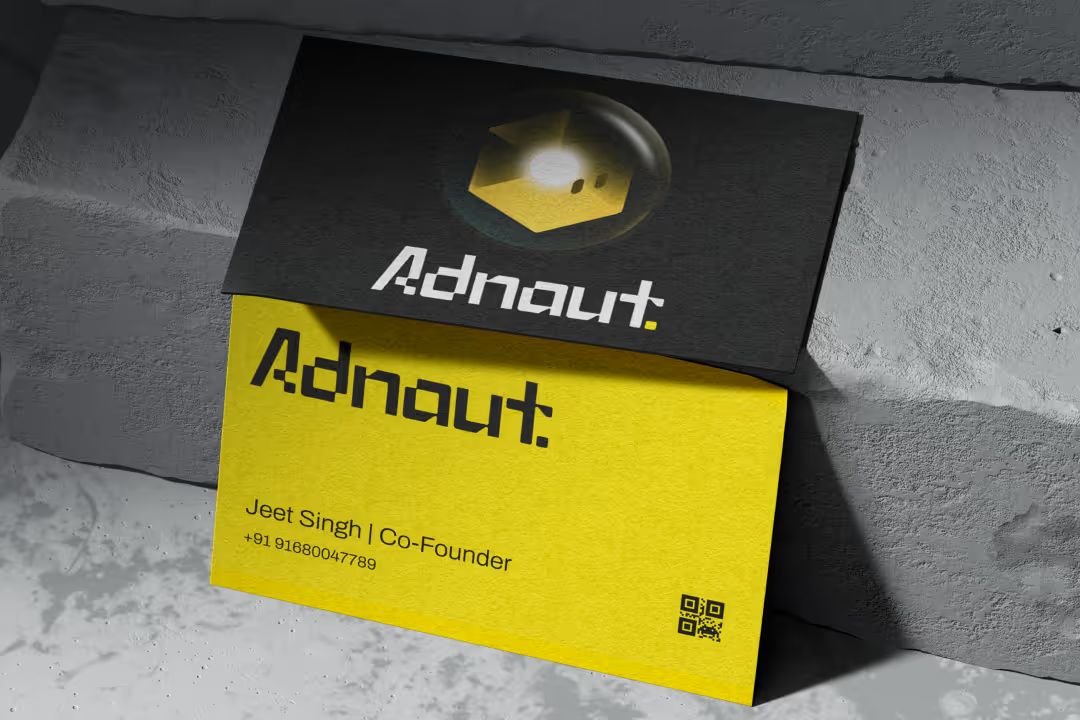
Adnaut
Rebrand and website design for Adnaut, a technology-driven digital media and ad tech consultancy

Lumora Security
Branding and website design for Lumora Security, a cybersecurity solutions provider for growing businesses


TLH
Rebranding and website design for TLH, a leading law firm specializing in corporate and commercial law
.avif)
Fortuna Cysec
Brand strategy and website design for Fortuna Cysec, an AI-driven managed security services provider for threat detection and compliance

FAQs
B2B Branding
Experts

Neha Bhatnagar
Senior Brand Designer

Sijeesh VB
Lead Strategist

Swathi Mohan
Content Strategist

Akhilesh J
Lead Designer

Ekta Manchanda
Co-Founder | Principal Designer

Mejo Kuriachan
CEO | Partner | Brand Strategist

Athira Krishnan
Lead Designer | Content Strategist

Sanjana Hmath
Lead Designer

Tanmaya Rao
Lead Brand Designer | Illustrator