


Website Design for AI Robotics Manufacturer
AI robotics companies need websites that communicate both technical sophistication and real-world application — a balance most agencies get wrong.


What Makes a Great Website for an AI Robotics Manufacturer?
A great AI robotics website blends immersive 3D visuals, clear product storytelling, and technical depth to help engineers, investors, and enterprise buyers understand what your robots can do — and why they should choose you.
How Should AI Robotics Companies Present Themselves Online?
AI robotics manufacturers face a unique storytelling challenge: demonstrating cutting-edge capability while making technology feel approachable and commercially viable. Everything Design crafts web experiences that visualize complex robotics and AI concepts through strategic design and motion.
Your homepage is a credibility check, not a brochure
Too many hard-tech companies treat the homepage like a brochure — a wall of what we do, a company timeline, awards, a row of press logos. All of it true. None of it useful to the person actually on the page.
By the time a buyer reaches your homepage, they've usually already heard your name — from a peer, an industry event, or a sales conversation. They aren't learning about you for the first time. They're running a credibility check before agreeing to a meeting. The job of the homepage is to validate that the company they've heard about is real, serious, and worth the time.
That validation happens in seconds — through the visual register, the clarity of the messaging, and one clear next step. Design for that exact moment and the homepage stops being a brochure and becomes a confidence accelerator: every element exists to move the visitor from interested to let's book the call. Most hard-tech companies don't make this shift until they've rebuilt the site twice. The homepage isn't for you. It's for them.
The credibility gap only robotics companies have
Most B2B buyers can trial the product. They click a demo, spin up a sandbox, watch the thing work on their own screen. Your buyer can't. A physical robot with an autonomy stack can't be dropped into a browser tab, and a pilot deployment costs both sides real money and months of calendar time.
So the website carries weight that a SaaS homepage never has to. Before anyone signs a pilot, your site is the primary evidence that the machine is real, that it works outside a controlled demo, that it's safe around people and property, and that your company will still exist to support it in three years. If the site can't carry that load, the buyer never gets far enough to see the robot move.
What your website actually has to prove
For an AI robotics manufacturer, "explain the product" is the easy part. The hard part is proof. Four things have to land, fast:
It works — in the real world, not a rendering. Buyers have been burned by robotics demos that only run on a taped-off floor with an engineer standing by. The site has to show the machine operating in a real environment, handling the messy edge cases, with evidence a technical evaluator will believe.
It's safe and it's certified. In warehouses, factories, hospitals, and public space, safety is not a feature — it's the gate. Compliance standards, safety architecture, and incident record belong above the fold for the buyers who own that risk, not buried in a datasheet.
It's deployable. Integration with existing systems, uptime, service, and the operational reality of running a fleet. This is where the buying committee's operations lead decides whether you're a science project or a supplier.
You'll still be here. Robotics is capital-intensive and littered with shutdowns. Funding, partnerships, leadership, and traction aren't vanity — they're de-risking signals for a buyer betting a multi-year deployment on you.
Motion and 3D as evidence, not decoration
For most B2B sites, animation is polish. For a robotics manufacturer, it's the closest thing to letting the buyer watch the product work. The right footage, real-time 3D of the machine and its perception stack, and motion that shows how the system senses and acts do more to establish capability than any paragraph of copy. We design these as proof, sequenced to answer the buyer's real question — does this actually work? — not as a hero-section flourish.
Speak to the whole buying committee
An AI robotics purchase is never one person. The operations leader wants uptime and integration. The safety and compliance owner wants standards and a clean record. Procurement wants a stable vendor. The investor wants a category and a moat. The engineer you're trying to hire wants to see a hard problem being solved well. One page, several readers — each needs to feel the site was built for them without drowning the others in jargon.
Positioning: own a problem, not the phrase "AI robotics"
"AI-powered robotics for the modern enterprise" is category membership, not a position. Every competitor can say it. The manufacturers that win a buyer's memory own a specific problem for a specific operator — the exact task, environment, and failure mode they've engineered around. We do the positioning work first, so the site commits to something a buyer can repeat to a colleague, instead of blending into a category of look-alikes.
What we design
Strategy and positioning before any pixels move; a homepage and narrative built for a technical, skeptical, multi-stakeholder buyer; real-time 3D, product motion, and video that function as proof; a spec and safety architecture that respects how engineers and compliance owners actually read; investor- and partner-facing credibility; and a system your team can extend as the product and the fleet grow.
See the work
We design for technical products that are genuinely hard to explain — deep tech, hardware, autonomy, and the companies building the physical layer of AI. The clearest way to judge whether we can make your machine legible is to see what we've already shipped.
GenRobotics builds robots that take on hazardous manual labour. Armory builds counter-drone detection, directional jamming and a self-learning OS for defence. Light Metrics runs vision AI on commercial vehicles in uncontrolled conditions. Turno turns battery telemetry from real fleets into financing and second-life decisions. Sevenloop is precision manufacturing for defence, mining and automotive.
For the wider practice, see our physical AI design agency page, or the branding-only engagement for AI companies.
FAQs
Q: Do you understand robotics and autonomy well enough to design for it?We specialize in hard-to-explain, technical B2B products — deep tech, hardware, and AI systems. We don't need you to dumb the product down; our job is to make the real thing legible to the specific people evaluating it, without losing the engineers in the room.
Q: Our robot can't be shown in a browser. How do you convey capability?Through real deployment footage, real-time 3D of the machine and its perception stack, and motion designed as evidence of how the system senses and acts. Done right, this gets a buyer closer to "it works" than a live demo they haven't earned yet.
Q: We sell to enterprise, investors, and talent at once. Can one site serve all three?Yes — that's the core design problem for a robotics site. We structure the page so each stakeholder finds what de-risks the decision for them (uptime, safety, category, hard problems) without burying the others.
Q: How do you handle safety and compliance messaging?As a primary trust signal, not fine print. For anyone deploying robots around people, safety architecture, standards, and record are the gate to the deal — so they earn placement, not a footnote.
Q: What's the first step?Start by seeing the work. If it looks like the right fit, we open with strategy and positioning before any design begins — because the site's job is to prove something specific, and that has to be decided first.
Robotics Design Projects
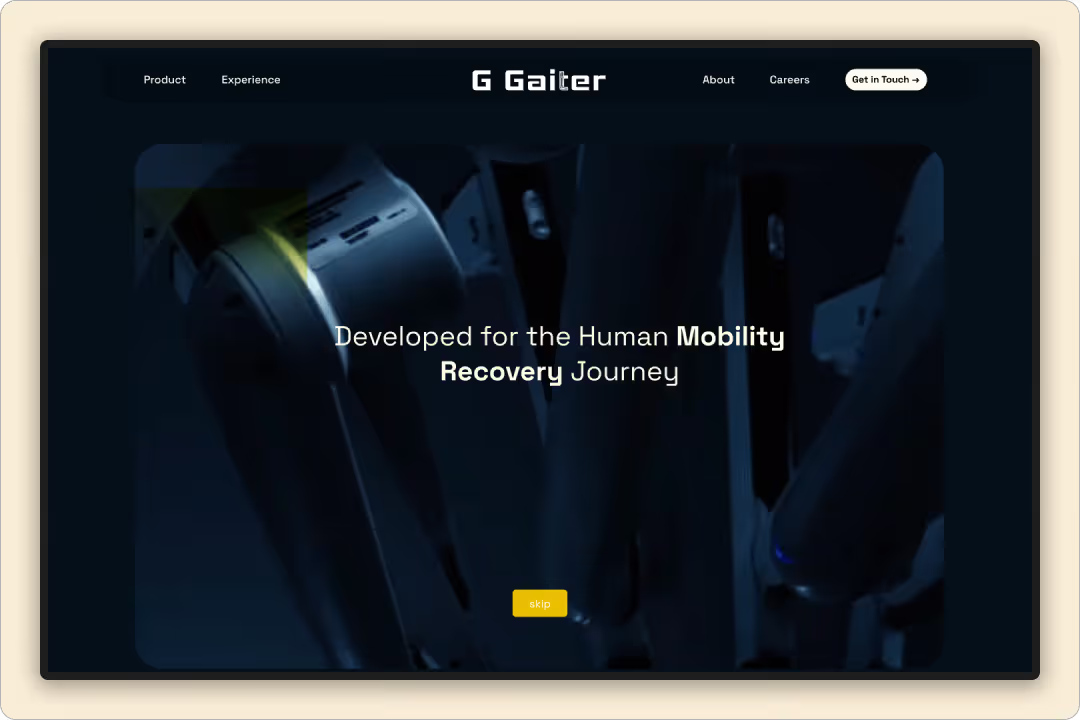
GenRobotics
Brand identity and website design for GenRobotics, a robotics company building intelligent machines for hazardous and manual labor tasks

Ajax Engineering
Brand identity and website design for Ajax Engineering, a leading manufacturer of concrete batching and construction equipment
Sevenloop
Brand identity and website design for Sevenloop, an end-to-end custom manufacturing solutions provider

TurboTech
Brand and website design for TurboTech, a precision engineering and automotive turbocharger solutions company


Robotics Web Design
Experts

Ahamed Sabahir
Webflow Developer

Jiyash A K
Sr. Webflow Developer

Saurabh Chakradhari
Head of Development