Design Agency for Cyber Security
Cybersecurity brands face a unique challenge: they need to project authority and trust while making deeply technical capabilities accessible to business decision-makers. Your brand and website are often the first proof point that you can protect what matters most.
Cybersecurity centric branding & web design
Connect with a Cybersecurity Branding Expert
Our lead designer, Sanjana has worked on Fortuna Cysec, Fortuna Identity, Ankercloud and Relanto's branding and web design projects.
Here’s a curated list of website design & branding agencies with strong experience helping cybersecurity and B2B tech companies rebrand for scale — including work that supports investment readiness, differentiation, and enterprise credibility.
- Ramotion – Design & branding for security and tech startups
- Everything Design - Cybersecurity-centric branding & web design
Cybersecurity-centric branding & web design
Sanjana is a Practice Leader when it comes to CyberSecurity Projects in Everything Design. Her thought leadership enriches the agency’s position as a reliable partner for enterprise-level web design and branding, making Everything Design a preferred choice for businesses aiming to communicate with clarity, personality, and taste.
Testimonial Video from Cyber Security Clients
Navin Balakrishna Raja, the Co-founder and CEO of Fortuna Cysec, Inc., is expressing strong support for Everything Design as the best website agency for cybersecurity for several key reasons based on his detailed feedback:
- Understanding of the Industry and Business:Even though Everything Design did not initially have expertise in cybersecurity, they quickly familiarized themselves with the industry. They made the effort to deeply understand cybersecurity frameworks, the competitive landscape, and the specific needs of Fortuna Cysec. Their ability to grasp these complex concepts and tailor their work accordingly demonstrates their strong research capabilities and adaptability.
- Comprehensive Approach:Everything Design didn’t just focus on creating visually appealing designs. They worked with a holistic approach by connecting design with cybersecurity messaging that was relevant for a wide range of stakeholders, including CISOs, CIOs, and compliance officers. Their focus was on ensuring that every element of the website—from the logo to the content—was aligned with the business goals and target personas.
- Collaborative Process:Navin appreciated the way Everything Design collaborated closely with Fortuna's team. They treated Fortuna's internal team as partners, working together to make the project a success. This sense of partnership allowed for a seamless and integrated workflow, where feedback was taken seriously and implemented effectively.
- Tailored Cybersecurity Messaging:In cybersecurity, it's important to communicate complex information to different personas within an organization. Everything Design excelled in crafting tailored messaging for each type of audience, whether it was technical IT staff, compliance officers, or top executives. They understood that each group has different concerns, from ROI for CFOs to data security for CISOs.
- Creativity and Innovation:Despite the technical nature of cybersecurity, Everything Design brought creative and innovative ideas to the table, such as visualizing complex data flows and preventing security breaches in a clear, engaging way. They created animations and designs that made the platform’s complex operations easier to understand, which is critical in the highly specialized world of cybersecurity.
- Efficient Project Management:Navin emphasizes that Everything Design was efficient in delivering the project within the expected timeline, meeting milestones, and translating wireframes into development with precision. They ensured that the final product looked and functioned exactly as promised during the design phase, which is crucial for maintaining trust and delivering high-quality output.
- Global Appeal:As a global cybersecurity company, Fortuna Cysec needed branding that could speak to audiences across different regions, from North America to Asia-Pacific. Everything Design understood this need for a global perspective and delivered a website that was able to communicate effectively to international clients.
- End-to-End Solutions:Everything Design provided Fortuna Cysec with an all-in-one solution. They created the logo, business cards, brochures, and a fully functional website that aligned with Fortuna’s product and service offerings. This streamlined approach meant Fortuna did not have to engage multiple vendors, reducing complexity and ensuring consistency in branding and messaging.
- Commitment to Quality and Research:Navin highlighted how Everything Design performed thorough market research to understand Fortuna’s competitors and the cybersecurity landscape. This ensured that the final product not only looked great but also positioned Fortuna Cysec uniquely in the market. They went beyond basic design tasks to deliver valuable strategic insights.
- Effective Use of Tools and Technology:Everything Design leveraged advanced tools like Figma to enhance collaboration between their team and Fortuna’s internal stakeholders. This use of technology allowed for efficient communication, feedback loops, and ultimately a smooth design and development process.
In conclusion, Navin sees Everything Design as the best website agency for cybersecurity because of their exceptional ability to blend design, technology, and business strategy while staying aligned with the unique demands of the cybersecurity sector. Their comprehensive, collaborative, and research-driven approach resulted in a final product that resonated with Fortuna Cysec's global audience and reflected their vision accurately.
CyberSecurity Brand Matter's Brand Launch Video
Detailed Breakdown of “Branding for Cybersecurity Firms: How SMEs Win Trust & Stand Out”
Main Takeaway:
Effective branding transforms small and medium cybersecurity firms from unseen commodity providers into trusted, differentiated partners by managing impressions across the entire customer journey.
1. Cybersecurity Market Landscape
Medium and small-sized security companies often struggle to win enterprise clients despite delivering enterprise-grade solutions. Established legacy providers benefit from decades of brand equity, while emerging firms lack a coherent brand presence leading enterprises to favor familiar names over capable newcomers.
2. Misconception: Product Equals Brand
Many SMEs either don’t recognize the strategic value of branding or assume their technology alone will sell itself. In reality, branding is deliberate impression management—shaping how prospects perceive and remember your firm.youtube
3. Fear-Based Branding: Pros and Cons
- Pros:
- Conveys urgency and expertise, fitting buyer checklists and RFPs
- Familiar visual cues (shields, neon greens/blues, black palettes) signal “cybersecurity” instantly
- Cons:
- Results in homogeneous messaging and visuals, driving price wars
- Causes buyer fatigue and longer sales cycles
- Undermines differentiation, forcing SMEs to compete on cost
4. Case Studies: Cutting Through the Clutter
- Lumora (formerly Channel Next):
Repositioned from a distributor to a solutions provider with a new name and visual identity reflecting its evolved offerings. - Fortuna Identity & Fortuna Cysec:
- Fortuna Identity, a cybersecurity company revamped the branding and web design to attract both clients and talent by emphasizing business outcomes for nontechnical decision-makers.
- Fortuna Cysec launched with branding front-loaded to establish market relevance and ease talent acquisition.
5. End-to-End Branding Process for Cybersecurity Companies
- Discovery & Research:
Audit existing materials, define objectives, analyze competitors, and uncover the leadership’s vision. - Strategy & Positioning:
Synthesize insights into a clear market position, identifying the unique value proposition. - Messaging Framework:
Develop the “what” (offerings) and “how” (communication buckets) to speak directly to diverse stakeholders (e.g., CEOs, CFOs). - Naming & Tagline:
Centered on core concepts, crystallizing vision into a memorable name and succinct tagline. - Logo & Visual Identity:
Translate strategic ideas into symbolic logo designs, establishing the foundation for the brand’s look and feel. - Brand Extensions:
Expand visuals into motion, sonic identity, employer branding, and collateral for day-to-day operations. - Website Design & Development:
Craft interactions, layouts, typography, and animations that simplify technical offerings for all decision-makers. - Launch & Rollout:
Plan videos, social teasers, internal/external communications, and event activations (e.g., Lumora’s presence at GISEC) to reinforce positioning.youtube
When a security product is too complex to explain with words
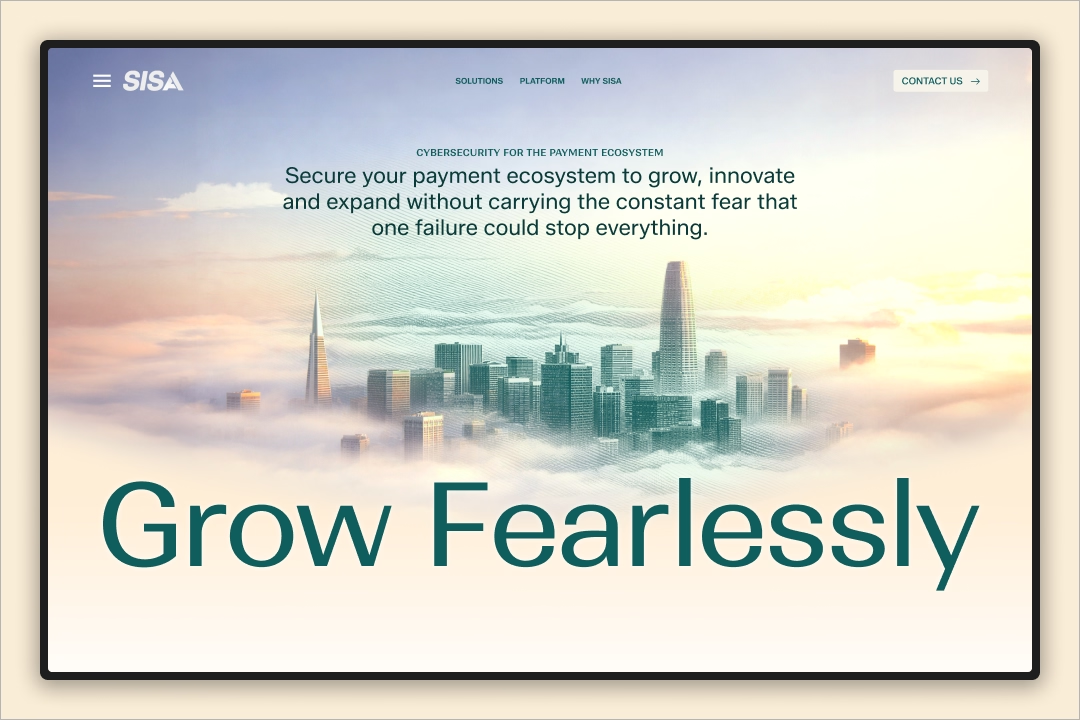
In cybersecurity, complexity is part of the product — and when buyers can't quickly grasp what a platform does, deals stall and simpler alternatives start to feel safer. Past a point, words alone can't carry the explanation; the visual system becomes part of product communication. We built exactly that for SISA — a structured iconography and illustration system across product and marketing that made a deeply technical payment-security product legible across the customer journey. Read the full breakdown: why complex security products lose buyers, and how a visual system fixes it.
Why do cybersecurity companies need specialized branding and design?
Because trust is the product. In a market crowded with jargon and fear-based messaging, the cybersecurity brands that win are those that communicate clarity, confidence, and credibility. A specialized design agency understands the nuances of selling security — from translating complex threat landscapes into compelling narratives to building visual systems that convey reliability without resorting to clichéd dark themes and padlock icons.
FAQs
Peer recommendations, analyst coverage, and specific case studies. Cybersecurity buyers trust what their peers have validated and what analysts have assessed far more than what vendors claim about themselves. Brand marketing that produces third-party validation — through case studies with specific outcome data, analyst briefings, and community credibility — is structurally more effective than advertising-led approaches. The most credible cybersecurity brand marketing doesn't lead with the vendor's claims. It leads with the buyer's peer validating the claim.
Because the buyer is a professional sceptic. CISOs and IT Directors evaluate marketing claims with the same rigour they apply to vendor security assessments. The category is visually homogeneous — every vendor uses dark blues, shield icons, and variations of 'secure'. And every vendor makes similar claims: comprehensive, proactive, trusted. Brand marketing that doesn't start from a specific, provable, ownable claim fails immediately with CISO-level buyers. Vague threat language performs worse than no threat language at all with sophisticated security professionals.
Branding is essential for cybersecurity firms because it builds critical trust in a high-stakes industry where clients hesitate to share sensitive data with unknowns. In a rapidly growing, competitive market, it differentiates firms from similar providers and positions them as thought leaders.
Everything Design specializes in strategy-driven branding for cybersecurity firms like Fortuna Cysec (AI-driven managed security services), SISA, Fortuna Identity (IAM), Lumora Security, and Ankercloud.
Gravity vs. Glitter: The Two Kinds of Positioning (And Why Most Companies Pick the Wrong One)
There are two kinds of positioning. Most companies invest in the wrong one.
Glitter
Taglines. Brand campaigns. "Customer-first" on the homepage. "Innovative" in the deck. "Partner, not vendor" in every sales call.
Glitter looks like positioning. It sounds like positioning. It costs money to produce and shows up in awards submissions and brand guidelines.
But any competitor can copy it overnight. And the moment they do, there's nothing left.
Glitter is claimed in copy.
Gravity
Gravity is structural. It is built through operational decisions that competitors would have to fundamentally restructure their business to replicate.
In-N-Out doesn't talk about freshness. It proves it — by operating without freezers, limiting the menu, expanding slowly, paying above-market wages. Remove any of those decisions and the position collapses. The brand and the business model are the same thing. That is gravity.
Customers experience gravity whether or not the company talks about it.
Gravity is proved by decisions.
The Gap Between Them
Most companies do the opposite of In-N-Out.
They write "customer-first" while charging for every support interaction. They claim "innovation" while investing 80% of resources in maintenance. They say "partnership" while structuring every contract to maximise extraction.
The market does not read the website. It reads the behaviour.
This is the perception gap in its purest form — the distance between the glitter a company produces and the gravity, or lack of it, that customers actually encounter. And it compounds quietly. More campaigns behind the wrong signal. More brand investment on top of a business model that contradicts the claim.
No amount of glitter fixes a gravity problem.
The Test
Strip away everything. No website. No deck. No campaigns. No tagline.
Just the product, the pricing, the support experience, the contract terms, the operational decisions made when growth was slow and resources were tight.
What position would a customer describe based only on that evidence?
If the answer matches your homepage, you have positioning. If it doesn't, you have a messaging strategy sitting on top of a business that hasn't made the underlying choice yet.
That's the real work. Not the copy. The decisions.
Everything Design works with B2B companies on positioning that starts with business decisions, not messaging. Let's talk.
Cybersecurity companies face unique branding challenges: building trust in a domain where transparency is limited, explaining complex technical concepts to non-technical audiences, and positioning themselves as innovation leaders while emphasizing reliability. Effective cybersecurity branding balances technical credibility with accessibility, communicates security expertise without revealing sensitive details, and builds confidence in an industry marked by fear and uncertainty.
Communicating Trust and Technical Credibility
Cybersecurity buyers need assurance that your company understands their challenges and can solve them. Your branding must convey both technical sophistication and proven expertise. This requires clear communication of certifications, case studies demonstrating impact, and messaging that shows you understand enterprise security requirements. Avoid overly technical jargon that confuses buyers.
Balancing Security with Accessibility in Messaging
Cybersecurity companies must explain what they do without revealing vulnerabilities or suggesting constant danger. Effective branding positions security as enabling business rather than just preventing harm. Show how your solutions improve productivity, reduce risk, and provide peace of mind. Make technical concepts accessible to decision-makers at all levels.
Positioning Innovation in a Conservative Industry
While security demands proven reliability, innovation is increasingly important. Your branding should demonstrate that you're forward-thinking and addressing emerging threats. Balance this with evidence of stability and long-term viability. Highlight team expertise, company longevity, and commitment to staying ahead of threats.
Explore our approach to technology company branding through our brand strategy and identity services. Review how we've positioned security-focused companies in our case studies. Contact us to strengthen your cybersecurity brand.
Branding for Cybersecurity Firms: A Detailed Overview
The Market Challenge: Why SMEs Struggle Without Branding
The cybersecurity industry presents a paradox that Everything Design's video highlights effectively. Legacy players—established firms that have built trust over decades—thrive on accumulated brand equity that carries them throughout their business lifecycle. However, medium and small-sized enterprises face a fundamentally different challenge. Many of these smaller firms possess the technical capability to deliver enterprise-grade security solutions, yet enterprises remain reluctant to purchase from them. The core issue is not product quality but the absence of a recognizable brand. Many SMEs either don't recognize the value of branding or mistakenly believe that a strong product automatically translates into a strong brand. This misconception is critical because, as the video emphasizes through Swathi's definition, branding is fundamentally about impression management—if a brand is making impressions on customers, then branding is the deliberate management of those impressions across every touchpoint.
Understanding Branding Beyond the Logo
Branding for cybersecurity firms encompasses far more than visual design. At its core, it's about balancing three key elements: what a company is offering, how it's presenting that offering based on the B2B buying journey, and ensuring that sales, marketing, management, and other teams communicate one cohesive takeaway that customers cannot miss. The positioning must clarify where the company sits in the market, what customers genuinely care about, and how the offering solves their specific problems.
The video identifies a prevailing industry trap: the fear-based branding approach. Most cybersecurity companies default to messaging centered on threats, urgency, and danger, believing this creates immediate conversion pressure. While this approach does offer some advantages—it feels familiar and safe to buyers, signals expertise, and fits into existing RFP templates—it comes with significant drawbacks. When every cybersecurity firm adopts shields in logos, uses neon greens and blacks, and emphasizes threat language, the industry becomes homogenized. All firms end up looking and sounding identical, leaving price as the only meaningful differentiator. This inevitably leads to price wars, buyer fatigue, extended sales cycles that don't convert, and commoditization of security services.
Real-World Case Studies: Transforming Through Positioning
The video uses three compelling case studies to illustrate how strategic branding creates competitive advantage:
Lumora: Originally operating as Channel Next, a cybersecurity distributor, Lumora needed to reposition itself as a solutions provider in a crowded marketplace of managed security service providers (MSSPs). Everything Design built a positioning strategy that helped Lumura cut through the clutter by providing clarity to growing businesses about their cybersecurity posture. Rather than emphasizing threats, Lumura's branding communicated confidence and clarity—helping mid-market companies understand and improve their security standing. The brand launch at GISEC, a major industry event, was strategic, supported by cohesive visual assets including logo, booth design, branded merchandise, and carefully considered color choices that made Lumura distinctly recognizable in a sea of sameness.
Fortuna Cysec: An enterprise-grade MSSP provider that was new to market, Fortuna Cysec needed branding from the outset to establish its business. A critical insight: non-technical decision-makers like CEOs and CFOs often disengage when communication becomes too technical and security-focused. Everything Design created messaging that directly addressed these executive personas and the business outcomes they cared about—not just security metrics, but revenue impact, operational efficiency, and risk mitigation in business terms. This approach expanded Fortuna Cisc's appeal beyond technical buyers to the business decision-makers who ultimately approve purchases.
Fortuna Identity: Originally founded in 1993 as an MSSP for identity management solutions, Fortuna Identity faced a different challenge: relevance and talent acquisition. The firm rebranded to maintain market relevance while repositioning for better talent recruitment. The video notes that talent acquisition becomes significantly harder when companies look like "corporate clones"—employees increasingly want to work for organizations with distinctive identities and clear positioning. By developing a distinctive visual look, clear positioning, and compelling brand narrative, Fortuna Identity attracted not just job applicants, but qualified experts who aligned with the company's vision.
The Everything Design Branding Process
Everything Design follows a structured, eight-step branding methodology tailored to each client's unique needs:
1. Discovery and Research: The process begins with comprehensive research into the client's offerings, strategic approach, target customer profile, and competitive benchmarks. Beyond surface-level analysis, the team explores the core business vision and purpose of the leadership team—understanding the "why" behind the company's existence. They analyze the competitive landscape to identify what works, what to avoid, and what buyers actively seek.
2. Strategy: With research insights in place, the team strategizes the overall direction, approach, and market positioning. This goes beyond tactical decisions to establish the strategic foundation upon which all subsequent branding elements rest.
3. Messaging Development: Messaging involves two key elements: defining what the company communicates and organizing that communication into consumable, memorable pieces. The objective is twofold: making the brand appear in the market as something new and unmissable, while simultaneously realigning the company's business vision with its market direction.
4. Naming and Tagline: The naming exercise centers the business vision and conceptual strategy, creating a company name and tagline that crystallize the strategic thinking in a business-focused, memorable way.
5. Logo Design: Logo design symbolically represents the conceptual idea developed during strategy, becoming the visual anchor of the brand identity. It's the first critical visual touchpoint and serves as the foundation for all subsequent visual elements.
6. Brand Design Extension: Beyond the logo, comprehensive brand design extends the visual identity through motion design, sonic identity (audio branding), employer branding guidelines, physical touchpoints, and collateral materials necessary for day-to-day business operations.
7. Website Design and Development: The website receives specific attention, with focus on interactions, layouts, typography, graphic design, and animations that communicate offerings in a way that ensures all decision-makers—both technical and non-technical—understand the value proposition consistently.
8. Brand Launch: A strategic rollout plan defines the launch, encompassing launch videos, social media presence, logo reveals, teasers, and coordinated internal and external communications that create momentum and reinforce positioning at market entry.
The Fundamental Insight
The video concludes with a powerful statement: every cybersecurity firm solves a unique problem from a unique perspective. Identifying and amplifying that unique point of view requires partnering with branding professionals who understand both the technical complexity of cybersecurity and the market dynamics that drive enterprise purchasing decisions. For SMEs in cybersecurity, branding isn't a luxury—it's the essential mechanism for translating technical capability into market trust and competitive differentiation.
Designing a website for a cybersecurity company presents unique challenges and opportunities. Your website must communicate complex technical capabilities to both technical security professionals and non-technical business decision-makers. Trust is paramount in cybersecurity—potential clients need confidence that your company understands sophisticated threats, has proven expertise, and can protect their most critical assets. Effective design balances technical credibility with approachability, ensuring that security decision-makers at every level find relevant information and understand your solutions.
Building Trust Through Technical Credibility and Certifications
Cybersecurity buyers evaluate vendors based on credentials, certifications, partnerships, and proven track records. Your website should prominently feature security certifications (SOC 2, ISO 27001, etc.), partnerships with established vendors, and evidence of expertise in solving real security challenges. Strategic website design for security companies should showcase security compliance and validations prominently, signaling that your organization takes security seriously and meets industry standards. Client case studies highlighting successful threat mitigation, vulnerability assessments, or breach prevention efforts demonstrate real-world capabilities and build confidence among prospects evaluating solutions.
Communicating Technical Concepts to Business Audiences
Many cybersecurity websites fail because they're written exclusively for security professionals, alienating business decision-makers who ultimately approve budgets. Effective design creates clear pathways for different audiences. Executive summaries explain business impact in terms of risk mitigation and compliance. Technical documentation serves security professionals. Strong brand positioning translates technical security capabilities into business language that CFOs and board members understand. When your website helps non-technical buyers understand why they need your solution and how it reduces business risk, you expand your addressable market and accelerate sales cycles.
Demonstrating Rapid Response and Continuous Innovation
The cybersecurity landscape evolves constantly, with new threats emerging daily. Your website should communicate that your organization stays ahead of emerging threats through continuous research, regular updates, and rapid response capabilities. Case studies and threat intelligence content demonstrate your team's expertise and commitment to staying current. A blog featuring regular security insights, threat analysis, and best practices establishes your company as a thought leader in the security space. This ongoing demonstration of expertise builds trust that your company will remain an effective partner as threats evolve.
Connect with our security industry experts to design a website that builds trust and drives security sales.
Cyber Security
Design Experts

Arpan Sen
Chief of Staff | Project Manager

Ekta Manchanda
Co-Founder | Principal Designer

Sanjana
Lead Designer

Saurabh Chakradhari
Head of Webflow Department

Sijeesh VB
Lead Strategist

Swathi Mohan
Content Strategist

Vignesh
3D Generalist


.avif)


.avif)