


Consulting Company Web Design Agency
Webflow websites for management, strategy and tech consulting firms that sell expertise and need a site that survives a partner review and a procurement screen. We build the architecture for thought leadership, partner profiles and methodology pages that wins the call before the call.




Why consulting firms struggle with their own websites
Consulting is sold partner-to-partner, but it's qualified website-first. By the time a managing partner gets on a call with a prospective client, that prospect has read the partner's bio, scanned three case studies, downloaded a point-of-view paper and clicked through to LinkedIn. The website is the qualifying gate. Most consulting websites fail at the gate.
The buyer on the other side is a senior decision-maker: a CEO, a CFO, a divisional head, a board director, sometimes a chief of staff scouting on their behalf. They are not in the market for design awards. They are in the market for evidence that you have done their problem before, that the senior people they're talking to are the senior people doing the work, and that you understand their industry well enough to be useful in the first thirty minutes of a meeting.
The specific failure pattern for consulting websites is overconfidence in the homepage and underinvestment in the deep pages. The homepage gets the rebrand budget; the partner bios stay as 2017 stock-style headshots with a 60-word paragraph. But the partner bios are the page the buyer spends the most time on. The case studies are usually written as marketing-led narratives instead of structured engagement summaries (situation, mandate, what we did, outcome). The methodology pages, when they exist, read as buzzwords instead of differentiated approaches.
The second failure: thought-leadership architecture. Consulting firms publish papers, but the site presents them as a flat blog feed. There's no taxonomy by sector, by function, by capability. There's no way for a CFO researching cost transformation to land on your three best CFO-relevant papers and your three best cost-transformation case studies in the same visit. The CMS structure has to do that work.
What goes wrong on most consulting firm sites
Generic strategy aesthetics. Navy, grey, serif headline, a stock photo of glass office towers. Indistinguishable from twenty competitors. The buyer can't tell you apart from the firm down the road. Visual differentiation matters more for boutique firms, not less.
Weak partner pages. A logo, a name, a title, three bullet points of credentials. Nothing about the engagements they've actually led, the sectors they own, the way they think about a problem. The partner page should be the most-invested page on the site, second only to the homepage.
Case studies written like brochures. "We helped a leading retailer transform their supply chain" doesn't qualify anyone. Buyers want named clients (where confidentiality allows), specific situations, the actual mandate, the role of the firm versus the client team, and outcome metrics they can defend internally.
Insights content that doesn't pay back. Most consulting firms publish papers because the partners want to publish papers, not because the site is set up to convert readers into pipeline. There's no clear next step on a paper page. No related case studies. No partner connection. No way to start a conversation.
How Everything Design approaches consulting firm websites
We start every consulting engagement by interviewing two or three partners directly. Not the marketing team — the partners. We need to understand what each partner sells, who they sell to, what their pipeline mix looks like, and where they win and lose. That's the diagnostic input that drives the site architecture.
From there we run three parallel tracks. Brand and verbal identity: the firm-level positioning that has to hold across every partner's practice. Information architecture: how the site groups itself by sector, function, capability, region and partner — and how a CFO who lands on the homepage gets to a CFO-relevant case study in two clicks. Content systems: the structured templates for case studies, partner bios, insights papers and methodology pages that the firm will fill over the next two years without our involvement.
We build on Webflow. Consulting firms benefit specifically from Webflow's CMS because content velocity matters: new partners join, new papers publish, new case studies clear confidentiality clearance. The CMS has to handle that without a developer in the loop. We set up the structured collections so a new partner bio takes ten minutes to publish, not a development cycle.
We write the case study template ourselves, in consultation with the partners. A consulting case study is a specific document — situation, mandate, approach, outcome, named lead partner — and most firms don't have a consistent template across pages. We standardise it.
Named clients and case study highlights
Tredence — data and AI consulting firm scaling globally. We worked through the positioning question of how a fast-growing data consultancy presents itself against larger systems integrators and against pure-play AI vendors. The site had to land with enterprise CDOs and CIOs as a credible advisor, not a vendor. We built capability pages by industry vertical (retail, CPG, healthcare, financial services) and a structured case-study architecture that surfaced relevant work for each visitor.
5x — modern data stack consulting and platform. The brief: a site that worked for a buying committee that included data engineers, analytics leaders and CFOs in the same evaluation. We built three reading paths through the same site and instrumented the homepage to land each reader on the right next page within two clicks.
Bizongo — B2B supply chain platform with a consulting-led customer-success motion. Their public site had to do double duty: marketing-led acquisition for procurement leads and consultative depth for enterprise customers in evaluation. We rebuilt around the dual-purpose constraint.
We've also worked on positioning and site work for boutique strategy practices, tech consultancies and specialist advisory firms where we cannot name the client publicly. We can walk through the work on a call under NDA.
Best for
Best for boutique and mid-size strategy or management consulting firms. Where the partners are the brand, where the case studies are the proof, and where the site is the qualifying gate before the first meeting.
Best for tech and data consulting firms scaling globally. Where the buying committee is technical and senior at the same time, and the site has to be readable by both within the same visit.
Best for specialist advisory firms positioning against bigger competitors. Where the win is depth, not scale, and the site has to make depth visible without making the firm look small.
We are not the best fit for the global Big Four or the top-tier strategy houses with in-house brand and digital teams. We're a sharper choice for the firms competing one tier below them and winning on focus.
What's included
A typical consulting firm website engagement covers:
- Partner interviews and positioning workshop
- Brand and verbal identity refresh (where the existing identity isn't pulling its weight)
- Information architecture mapped to sector, function, capability, region, partner
- Webflow site (homepage, services/capabilities, sectors, partner directory and individual bios, case studies, insights/POVs, about, contact)
- Structured CMS collections for partners, case studies, insights, sectors and capabilities
- Case study template and writing-style guide
- Partner bio template with rich-content support (engagement highlights, sector tags, published work)
- Insights hub with sector and function taxonomy, related-content engine, partner attribution
- Lead-capture and routing — contact forms wired to the right partner by sector or capability
- Analytics instrumentation and content-performance dashboard
- Handover and CMS training
Engagement model
A full consulting-firm website rebuild typically runs eight to ten weeks. A website-only refresh on an existing brand foundation runs five to six weeks. A focused thought-leadership-hub addition to an existing site runs three to four weeks.
We run one structured partner-review touchpoint in the middle and one at the end. We do not loop the full partnership into every weekly check-in — that's how consulting websites take a year. We work with a single decision-maker (typically the managing partner, the head of marketing or both jointly) and protect the working sessions.
If you're heading into a category-defining year, repositioning the firm against bigger competitors, or building a partner-and-insights architecture that finally pays back the publishing investment, get in touch.
Why do consulting firms need a specialist web design agency?
A consulting firm's website is where the buying committee goes after the first warm intro and before the first scoping conversation. Either the site closes the credibility gap and the meeting happens, or it doesn't and the meeting goes to the bigger-name firm. We've built sites for boutique strategy practices, tech consultancies and partner-led advisory firms, and we build to that exact moment in the funnel.
Consulting Company Web Design Projects

Lumora Security
Branding and website design for Lumora Security, a cybersecurity solutions provider for growing businesses
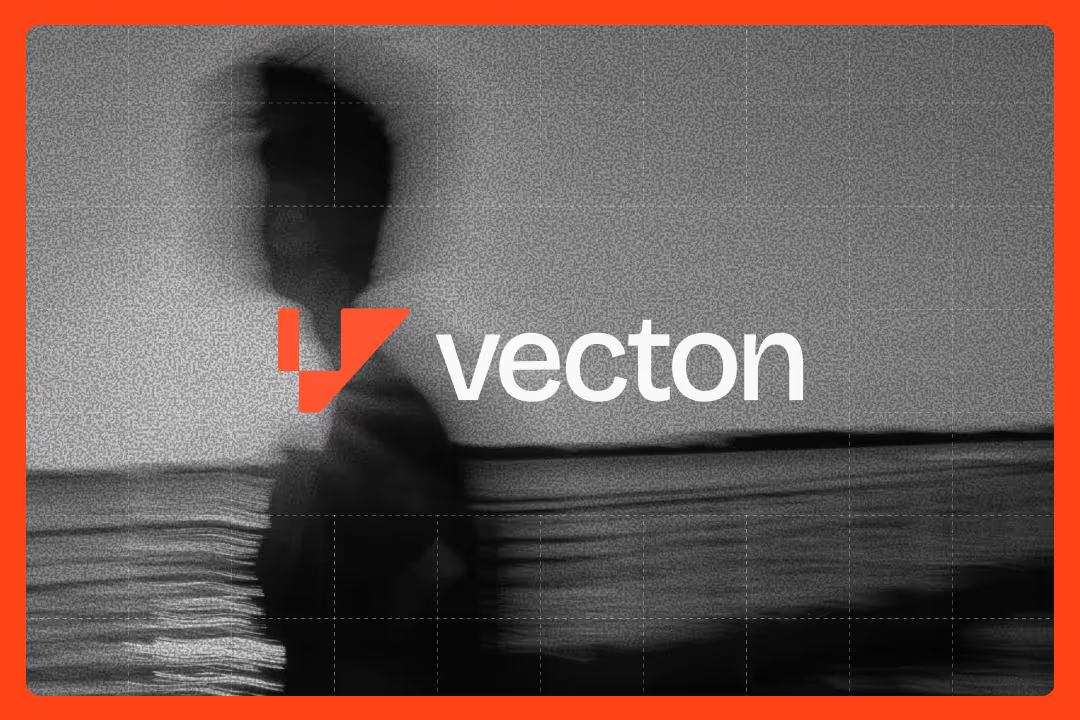
Vecton
Brand identity and website design for Vecton, an AI solutions and strategic automation company
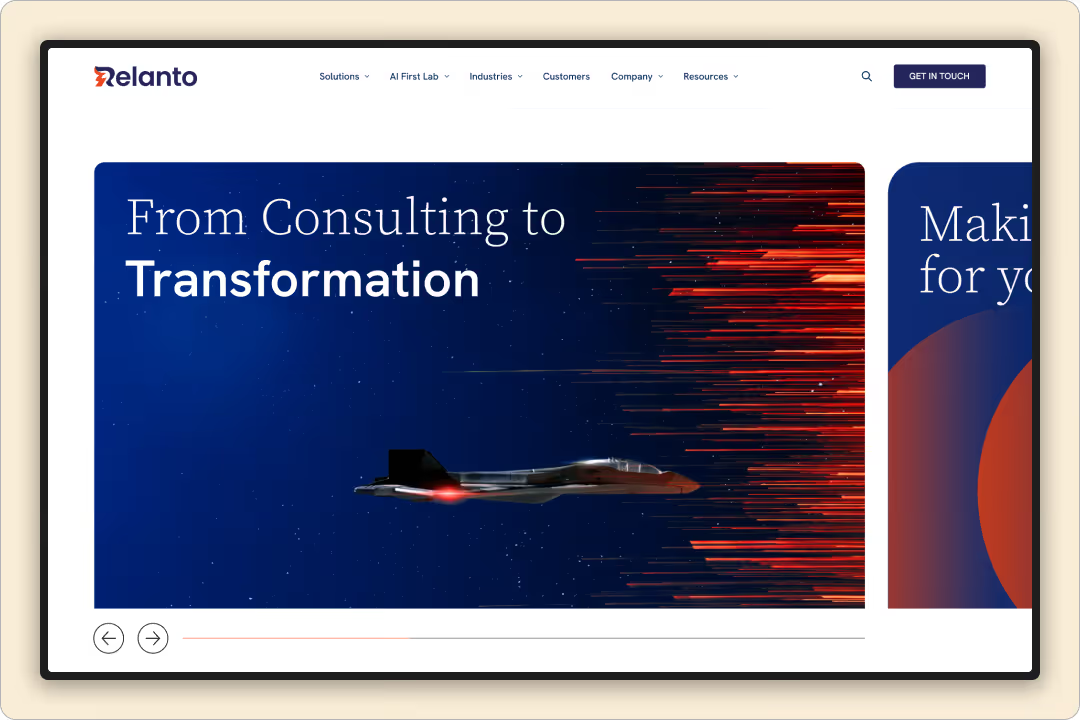
Relanto
Website strategy and design for Relanto, an IT consulting and business advisory services company
.avif)
Fortuna Cysec
Brand strategy and website design for Fortuna Cysec, an AI-driven managed security services provider for threat detection and compliance

Consulting Company
Design Experts

Ekta Manchanda
Co-Founder | Principal Designer

Mejo Kuriachan
CEO | Partner | Brand Strategist

Sanjana
Lead Designer