


Logistics Web Design & Development Agency
Logistics buyers — shippers, carriers, 3PL leaders, enterprise procurement — judge your operational seriousness in the first scroll. Most logistics websites lose them before they reach the case studies.





What should a logistics company website actually communicate?
We design and build logistics websites that translate network scale, technology, and reliability into a sales-ready story. Strategy first, then visual system and Webflow build, with the architecture and content patterns logistics decisions actually require. Clients include Turno and Transitry.
Why most logistics websites underperform
Logistics is a high-trust, high-complexity buy. Customers are not browsing — they are evaluating whether you can move freight, manage fleets, or run their supply chain without breaking it. Most logistics websites fail that evaluation in the first scroll because they are built like brochures, not like sales tools.
The patterns we see again and again:
- Stock truck on a highway, vague tagline. Nothing distinguishes one logistics website from the next. Buyers cannot tell what segment you serve, what scale you operate at, or whether you would even take their account.
- Service list, no story. A flat list of "warehousing, transportation, freight forwarding" with no view on why your network is actually different. The buyer's eye glazes over.
- No proof. No named customers, no scale numbers, no operational evidence. Procurement cannot defend the choice internally without proof, and the website is not giving them any.
- Wrong audience architecture. Shippers, carriers, and enterprise partners need different journeys. Most sites force them all through one homepage and lose all three.
- Marketing-team dependency on engineering. Logistics moves fast. If every content update requires a developer ticket, the website is out of date the moment it ships, and the marketing team learns to stop asking.
- Trust-leaking design choices. Outdated typography, dated stock photography, slow page loads, ungoverned colour, a hero that does not match the actual network. Each one shaves a percent off conversion that never gets diagnosed.
A logistics website is not a brand showcase. It is a procurement document, a sales tool, and a recruiting brochure. It has to work on all three at once.
How we approach logistics web design and development
We run logistics web projects diagnosis-first. Before any visual work, we map who buys what (shipper, carrier, 3PL, enterprise), what objections kill deals, what proof your operations actually produce, and where the website fits in the sales motion.
That produces a positioning document, an information architecture, and a content plan. Then we move into visual design and Webflow development, building a website that handles complex service portfolios, multiple audiences, integrations with ops systems, and the long content patterns logistics sales requires.
We build on Webflow so marketing teams can ship without waiting on engineering. The CMS is structured for case studies, locations, lane data, sector pages, and service pages — and we set it up so a marketing manager can add a new lane or a new case study without breaking the system. Performance, SEO, and accessibility are built in from the design system, not bolted on at the end.
Where the buyer is enterprise procurement, we build the architecture and content patterns procurement actually uses — security, certifications, sustainability data, named customers, lane proof. Where the buyer is a smaller shipper or carrier, we build the journey for fast evaluation and clear next step.
Named clients and work
Turno. A fleet and EV logistics platform where the website had to make operational scale and tech sophistication legible to enterprise partners. We rebuilt brand, narrative, and Webflow site as a single system, with a marketing team able to ship without engineering for every update.
Transitry. Logistics infrastructure where the buyer is a procurement-led enterprise team. The site had to lead with proof, not promise. We designed and built the site around case studies, network data, and clear segment-by-segment positioning so the procurement evaluator could move forward without a sales call.
Other supply-chain and infrastructure work. Including B2B platforms where the brand had to carry enterprise procurement conversations from the first click, and infrastructure brands selling into shippers and carriers at scale.
Best for
- Logistics platforms, 3PLs, and freight tech companies selling into enterprise procurement.
- Supply-chain and fleet technology brands at Series A through Series C.
- Logistics service firms with serious operations whose website does not currently reflect the business.
- Logistics brands going through repositioning, geographic expansion, or category shift (asset-light to asset-heavy, regional to international).
What is included
- Stakeholder and customer discovery
- Audience and journey mapping for shipper, carrier, enterprise, recruit
- Information architecture and content plan
- Visual design system aligned to the brand
- Webflow build with CMS for services, case studies, lanes, locations, sectors
- Integrations — analytics, CRM, ops dashboards, gated content
- SEO foundation, schema, performance optimisation
- Post-launch handover and team training so marketing can ship without engineering
Why work with Everything Design
We are a strategy-first branding and Webflow agency that has shipped websites for logistics, fleet, supply chain, and infrastructure brands. Two senior people lead every engagement, with no agency layering. Our work with Turno, Transitry, and other B2B platforms sits inside the case studies on this site. We are comfortable with enterprise procurement, complex service portfolios, and the operational reality of logistics — and we build websites that respect both.
We will say no to engagements where we are not the right fit. If the real gap is positioning, brand, or a sales narrative — not the website itself — we will tell you, and recommend the work that actually moves your pipeline.
Engagement model
Most logistics web projects run 8–12 weeks end to end, longer if a rebrand is in scope. We work in weekly sprints with founders, heads of marketing, and operations leadership — short cycles, working sessions, no agency-style waterfall.
Start with a paid diagnosis call. We will tell you whether the real gap is the website, the positioning, the sales narrative, or the brand. Scope is only proposed after that.
Logistics Design Projects
Ximkart
Brand and website design for Ximkart, a cross-border trade platform simplifying raw material imports

Sevenloop
Brand identity and website design for Sevenloop, an end-to-end custom manufacturing solutions provider

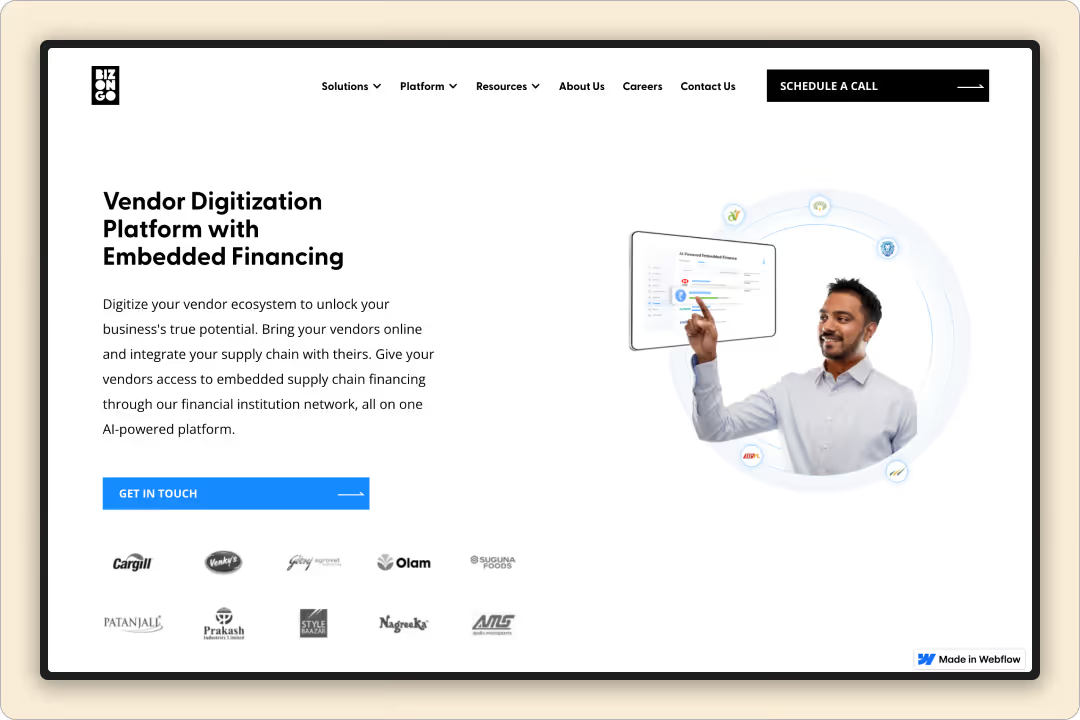
Logistics Web Design
Experts

Jiyash A K
Sr. Webflow Developer

Saurabh Chakradhari
Head of Development

Tanmaya Rao
Lead Brand Designer | Illustrator