


Deep Tech Branding & Website Agency
A deep tech branding and website agency understands the complexity of emerging technologies and translates them into clear, compelling brand narratives and digital experiences that resonate with technical decision-makers.











Why is branding so difficult for deep tech companies?
Because the technology is complex, the audience is niche, and the buying cycle is long. Deep tech brands need to communicate credibility to technical evaluators while also telling a compelling story to business decision-makers. That requires a branding partner who can understand your technology deeply enough to simplify it without dumbing it down. Everything Design specializes in deep tech branding and website design that bridges the gap between technical depth and market clarity.
DeepTech Branding with Everything Design
Connect with a Deep Tech Branding Expert
Deeptech branding is unique because you are often selling a probability, not a product. Unlike B2B SaaS, where the technology is a tool to solve a known problem, deeptech is the problem-solver for issues we often don't yet have the infrastructure to fix (e.g., fusion energy, novel proteins, quantum error correction). Explore our dedicated deep-tech studio, everythingdeeptech.com.
Ongoing Projects Everything Design is working on in the DeepTech space
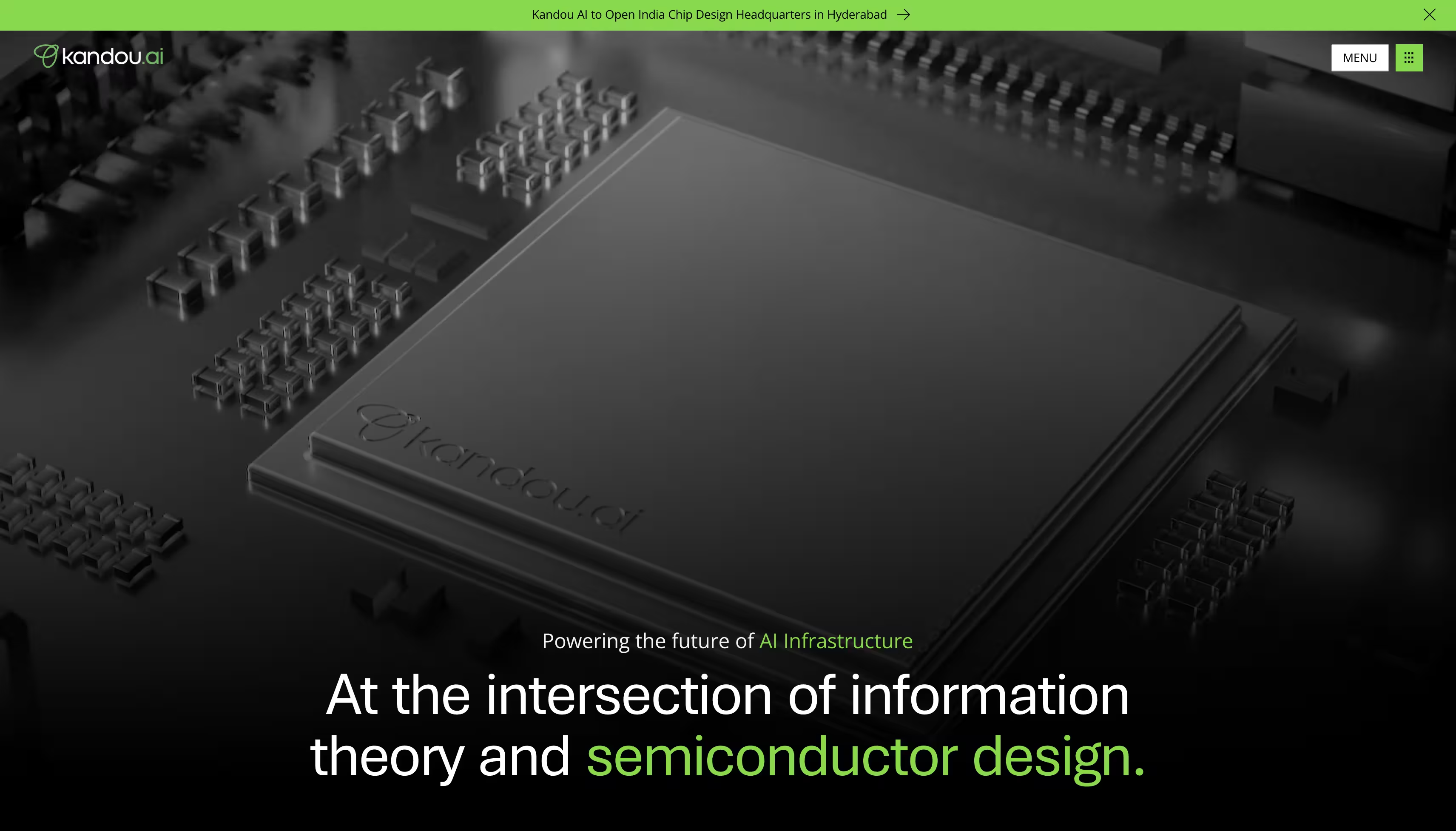
Everything Design has branded two nuclear energy companies — PolyEnergetics, India's first private nuclear company, and Bharat Atomics. Another deep tech brand Everything Design just completed the project with is Transitry, deep-tech that measures, monitors and maximizes soil health. Cloudphysician is a deep-tech brand from Health Tech space Everything Design is working with for videos as well as for website. A web development & design agency for deeptech founders - built by engineers for engineers. Kandou AI is another deep tech startup's project Everything Design is working on - they are innovating in the semiconductor space.
The approach must bridge the "Credibility Gap":
- Too Visionary? You look like vaporware (Theranos risk).
- Too Academic? You look like a research project, not a scalable business.
- The Sweet Spot: "Engineered Optimism." You must prove the science is real while selling the commercial scale of the future.
What is Deep Tech? (And why it dictates your brand)
Deeptech is defined by scientific discovery and tangible engineering innovation, often described as "atoms and bits" rather than just bits.
Deeptech Domains include:
- Advanced Materials & Nanotech: (e.g., Graphene, synthetic biology materials)
- AI Infrastructure & Compute: (e.g., Novel chip architectures like Efficient Computer, Groq)
- Biotechnology & Genomics: (e.g., Ginkgo Bioworks, ProteinQure)
- Robotics & Automation: (e.g., Boston Dynamics, Unitree)
- Space & Defense: (e.g., Anduril, SpaceX, Varda Space)
- Clean Energy: (e.g., Fusion companies like Helion)
Strategic Approach: The "Trust Protocol"
Since the buyer (or investor) cannot easily verify your tech, your brand must serve as a proxy for verification.
A. The Narrative Arc: "From Lab to Market"
Do not use standard SaaS "pain point → solution" messaging. Instead, use a "Paradigm Shift" narrative.
- SaaS Pitch: "Manage your payroll 50% faster."
- Deeptech Pitch: "Compute is hitting a physical wall. We are changing the physics of the chip to unlock the next era of AI."
- Action: Your brand story must explain why now? Why has this science become commercially viable today?
B. Radical Transparency (The "Anti-Vaporware" Strategy)
Deeptech brands fail when they hide behind marketing fluff.
- Show the Math: If you claim performance, link to the white paper.
- Show the Hardware: Use photos of the lab, the chip, the messy prototype. It builds more trust than a polished stock photo of a "futuristic city."
- The "Scientist-Hero": Your team page is more important than your pricing page. Highlight PhDs, patents, and academic lineage.
3. Visual Identity: "The Invisible Made Visible"
The design challenge in deeptech is that your product is often invisible (algorithms, chemical processes, energy) or unsexy (a grey box).
- Metaphorical Visualization: Don't just show the hardware; show what the hardware does.
- Biotech: Use particle systems and organic simulations to show folding/bonding.
- Quantum/Compute: Use light, prisms, and refraction to show data speed or complexity (e.g., Quantum’s "Prism" brand guidelines).
- AI: Avoid "glowing brains." Use abstract data flows, architectural diagrams, or generative art.
- Aesthetic Trends:
- "Dark Mode" Default: Signals "developer-first," "space," and "future." (e.g., Deepgram, Cohere).
- Engineered Minimalism: Swiss typography, monospaced fonts (code reference), and thin technical lines. It says "precision," not "marketing."
- Cinematic Realism: High-fidelity 3D renders that look like they belong in a Christopher Nolan movie (e.g., Anduril).
4. Website Architecture: The Deeptech Sitemap
A deeptech website has different priorities than a standard corporate site.
The "Technology" Page (The Hero)
- Standard B2B: Has a "Features" page.
- Deeptech: Needs a "Technology" or "Platform" page.
- Content: Explain the Fundamental Mechanism. How does it work? Use interactive 3D scrolls, exploded views of the hardware, or "scrollytelling" animations that walk through the chemical process. This is where you win the technical due diligence.
The "Impact/Industries" Page
- Since the product might not be ready, sell the application.
- "If this works, here is how it changes Agriculture/Defense/Medicine."
The "Validation" Section
- Create a dedicated section for Publications, White Papers, and Patents.
- Include a Scientific Advisory Board section distinct from the management team.
Talent-First UX
- Deeptech companies often die because they can't hire the top 1% of engineers.
- The "Careers" page should be treated as a primary sales landing page. Sell the hard problems engineers will get to solve.
We at Everything Design work with deeptech brands like an editorial + strategy partner, not a “design vendor.”
We start by extracting the real story from what you already have—decks, notes, metrics, internal docs, leadership inputs. Then we structure it into a clear narrative: what changed, why it matters, what you’re prioritising next, and how progress is being measured.
From there, we turn that structure into a document people can scan quickly and still understand deeply—tight hierarchy, intentional sections, and visuals only where they improve comprehension. The output is operating material that stands on its own, reduces back-and-forth, and becomes a reference point for boards, partners, customers, and leadership.
Here's something that doesn't get talked about enough in deep tech fundraising: the speed at which you close a round has very little to do with how good your technology is.
It has everything to do with how fast an investor can understand what you're building — and why it matters.
We've seen this pattern play out across deep tech companies. Battery materials, robotics, AI infrastructure, space tech, biotech. The technology is almost always impressive. The teams are almost always credentialed. But the fundraising timelines? Wildly different.
Some close in 3 months. Others drag for 18. And when you look at what separates the two groups, it's rarely the IP, the patent portfolio, or the team's pedigree.
It's the story.
The Gap Nobody Talks About
Every technical founder we've worked with knows their vision with near-perfect clarity. They can talk about their technology for hours. They understand the physics, the engineering constraints, the differentiation at a molecular level.
The problem isn't knowledge. It's translation.
Most websites and pitch decks we audit have the same structural flaw: they explain product features in granular detail but leave zero connective tissue between "this solves a massive problem" and "here's why our approach wins."
What most websites and pitch decks do: The problem is big → here's our technology in extreme detail → the market is $50B → ask.
What move the needle: The problem → why current solutions fail → what makes our approach fundamentally different → proof it works → who's already buying → why now → what happens at scale.
The first version makes an investor work to connect the dots. The second version makes the conclusion feel inevitable. That difference — between "interesting technology" and "obvious investment" — is worth months on your fundraising timeline.
The deep tech companies that close rounds fastest all share one trait: they can explain their entire story in under three minutes. Not a dumbed-down version. Not a glossy oversimplification. The real story — breakthrough science and path to market — compressed into a narrative that builds conviction with every sentence.
What Investors Actually Need to See
Investors care about revolutionary technology. Deeply. But they don't evaluate it in isolation. They need to see it in the context of three things: market adoption, commercial scale, and defensibility over time.
The best deep tech narratives do something specific — they position the science as the engine and the business model as the vehicle. Neither works without the other, and both need to be visible in the same frame.
01 - Technical validation as proof of concept, not as the pitch itself
Your patents, your lab results, your peer-reviewed publications — these are credibility markers. They answer the question "can this work?" But investors also need the answer to "will this sell?" and "can this scale?" If your narrative front-loads the science and back-loads the business, you're making investors wait too long for the information that actually drives cheque-writing.
02 - Commercial traction as the accelerant
Pilot programmes, LOIs, design partnerships — even early ones — radically change the weight of a pitch. When we restructure deep tech narratives, we move commercial proof much earlier in the story. Not buried on slide 14. Front and centre, ideally within the first 90 seconds.
03 - Market context as the frame
Showing a $50B TAM slide doesn't do what founders think it does. What works is showing that a specific segment of that market has a burning, unsolved problem — and your technology is the only credible path to solving it. Specificity beats scale every time.
The Narrative Design Shift
What we've learned from working across deep tech verticals is that the communication problem is almost always structural, not cosmetic. It's not that the deck needs better graphics or a cleaner font. It's that the story architecture itself needs to be redesigned.
The shift looks like this: instead of starting with "here's what we built," you start with "here's what the market desperately needs and can't get." Instead of proving your technology works in a vacuum, you show it working inside a specific commercial context. Instead of ending with a market size slide, you end with a vision of category ownership that feels earned by everything that came before it.
The founders who make this shift — from feature-first to narrative-first — don't just raise faster. They raise at better valuations, because investors who understand the full picture assign higher value than investors who are still trying to figure out the commercial path.
If you're building something genuinely revolutionary and the fundraise is taking longer than it should, the technology probably isn't the bottleneck. The story might be.
Deep-tech communication design: making the invisible legible
The hardest part of deep-tech branding is translation — making a complex, often invisible technology legible and credible to investors, buyers, and talent without dumbing it down. We wrote about exactly how we do this, told through two client stories, in deep-tech communication design.
Cloudphysician (healthcare AI): we produced a product-explainer film so technically accurate it held up in a room of clinical experts — "if a heart rate was 120, it had to be 120" — and the first time they showed it, they closed their first US client. Armory (defense, counter-drone): the founders chose to give their marketing touchpoints the same importance as the technology itself, and the experiential website we built became a category benchmark that grew a following of its own.
Explore more: our deep-tech design agency practice, the biotech Webflow agency page for life-science and clinical companies, and case studies for Armory, Turno (battery intelligence), Cloudphysician, Kandou (semiconductors), and PolyEnergetics (nuclear energy). See pricing or book a call.
FAQs
Deep Tech Design Projects


Deep Tech Communication Design
Experts

Vignesh
3D Generalist

Harishma D
Associate Designer

Zakia Ali
Mid-Weight Designer

Akhilesh J
Lead Designer

Mejo Kuriachan
CEO | Partner | Brand Strategist

Tanmaya Rao
Lead Brand Designer | Illustrator