


Edtech Design Agency
Edtech companies are building products that shape how millions learn, yet many struggle with brands and websites that fail to communicate their pedagogical value. Your design needs to resonate with educators, institutions, and learners while clearly differentiating you in a crowded market.





Edtech and education companies are building products that shape how millions of people learn — and too many of them are let down by a brand and website that cannot explain the value of what they have built. The problem is rarely decoration. It is clarity and trust: a buyer who has thirty seconds to understand your pedagogical value, and a committee of very different people who all have to say yes.
Why edtech branding and web design are genuinely different
Edtech is almost never bought by the person who uses it. A K-12 platform is chosen by administrators and IT, taught with by teachers, and experienced by students. A higher-education site has to speak to prospective students, parents, and faculty at once. A corporate learning or professional-development product is bought by an L&D head, cleared by procurement and security, and used by employees. Your website has to make every one of those people feel understood in a single visit — and it has to carry institutional trust signals like accessibility, data privacy, and real learning outcomes without burying the experience under feature lists and jargon.
A generalist agency tends to design edtech like consumer software: slick, feature-led, and silent on outcomes. That is exactly what loses an institutional buyer.
What we've learned building for education
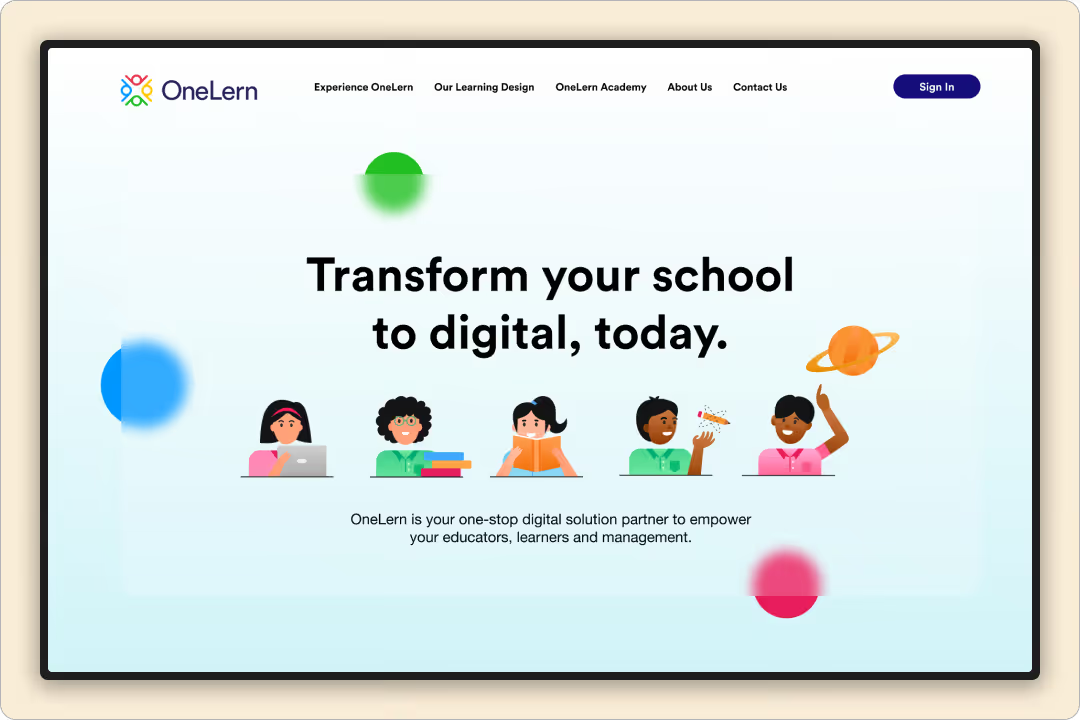
Across edtech platforms, universities, and professional-development companies, the same pattern holds: the brands that win lead with the learning outcome, not the feature inventory. We have built that discipline into work spanning edtech products, higher education, and vocational and professional training — for clients including Onelern, Edument, SRU University, GrowedIn, and Chimes Aviation Academy.
The work looks different in each case — an edtech product needs its platform to feel credible to IT and approachable to teachers; a university needs to balance prestige with warmth; a training academy needs to convert serious, high-intent learners — but the order of work is the same every time. Strategy and messaging first, design second, build last.
How we approach an edtech brand and website
Lead with the outcome. We structure the site around the learning result a buyer is paying for, not the LMS feature checklist. Features become proof of the outcome, not the headline.
Design for the whole committee. The narrative is built so the administrator, the IT evaluator, the educator, and the learner each find the part of the story that speaks to them — without diluting the message into something that speaks to no one.
Make trust legible. Accessibility, data privacy, security, and evidence of outcomes are treated as first-class content, because in education they are often the gate a deal passes or fails at.
Build it on Webflow. We build Webflow-native so your marketing team can publish new program pages, launch campaigns, and update content without filing a developer ticket every time.
Strategy before visuals. The brand strategy and messaging are decided before any design begins, so the look expresses a clear position instead of decorating an unmade decision.
Who we build for in education
- Edtech platforms and LMS products — credibility for IT and procurement, approachability for educators and learners.
- Higher education and universities — prestige, programs, and admissions balanced in one identity.
- Professional development and corporate L&D — outcomes and ROI for the buyer, engagement for the learner.
- Vocational, certification, and training academies — converting high-intent learners evaluating a serious commitment.
What's included
Brand strategy and positioning, messaging architecture, visual identity, website design, and Webflow development — delivered as one engagement so the strategy, the story, and the site all say the same thing. For teams that need it, we extend into landing pages for individual programs and campaigns, and motion or explainer video for products that need the learning experience shown rather than described.
If your edtech or education brand looks fine but is not converting the institutional buyer — or your website explains features when it should be proving outcomes — that is the gap we close.
Why do edtech companies need a specialized design agency?
Because edtech buyers — school administrators, university procurement teams, corporate L&D heads — evaluate dozens of options and need to quickly understand your unique value. A specialized agency knows how to showcase learning outcomes, platform capabilities, and institutional trust signals in ways that accelerate adoption.
Education Space Projects


EdTech
Design Experts

Akhilesh J
Lead Designer

Ekta Manchanda
Co-Founder | Principal Designer

Sijeesh VB
Lead Strategist