


Design Agency for Deep Tech
A design agency for Deep Tech founders - built by Engineers for Engineers. Custom 3D product renders, scroll-driven storytelling, GSAP animations and custom code, on a Premium-Partner Webflow build.










Design Agency for Deep Tech - Not an Engineering Problem. A Branding and Communication Design Problem.
Everything Design makes hard technology legible and credible to the people who decide its fate, accurately and fast, without dumbing it down. That is deep-tech communication design, and it's a discipline most creative studios and most technical teams each only do half of.
Trusted by venture-backed teams. Everything Design has partnered with founders and portfolio companies backed by leading venture funds — including Stellaris, General Catalyst, Z47, Antler, Energy Impact Partners, 3one4 Capital, B Capital, Social Alpha, growX Ventures and 8X Ventures.
For a deep-tech startup, communication design isn't decoration — it's the translation layer between a genuinely complex product and the people who fund it, buy it, and evaluate it. This testimonial is almost a textbook argument for why Everything Design is built for exactly that job.
Technical accuracy is treated as non-negotiable. "If a heart rate was 120, it had to be 120." Deep-tech buyers — clinicians, engineers, investors — spot a wrong detail instantly and discount everything after it. ED's response was to reshoot and rewrite the script until it was right: "if they had to shoot again and again and rewrite the script to make sure we are getting it right, there was a commitment to get it done." Most studios optimize for how it looks; ED optimized for whether it's true.
It communicated how the product actually behaves — not a sales gloss. "It was the first time that we were making a video on exactly how the product is going to behave. This wasn't about a commercial sale." That's the hardest and most valuable thing in deep tech: making a complex system legible so a buyer can imagine using it. And it's precisely what converted — "it really helped our potential clients imagine what the product delivery would look like."
They engaged with the domain deeply enough to be trusted in a room of experts. "When we work with a partner, it's important that partner understands what we do fairly deeply… we were going into a conference full of experts, so every detail had to be right." High-acuity healthcare AI is unforgiving, and ED earned the confidence to represent it.
Speed and seriousness under real constraints. Deep-tech launches are date-driven — conferences, tenders, raises. The timeline was tight, other vendors couldn't give confidence, and ED showed up in person on a Saturday, "coming with my video guy" — then let a 6-hour shoot run to 10 rather than ship something wrong. "Somebody here understands the urgency and the importance of this."
Methodical, no fluff, tied to an outcome. "You are very methodical… no fluff… once you commit, you meet timelines and meet the expectations we had. That set the stage for a partner we can trust." The payoff was the point: "the first time we showcased that video, we closed our first US client."
Why the most consequential companies in deep tech are losing to weaker technology and how a deep tech branding agency built by engineers approaches deeptech brand strategy, brand identity and design?
By Mejo Kuriachan & Ekta Manchanda · Founders, Everything Design, A B2B branding and design agency for deep tech startups
There's a pattern we've watched play out for two years now, across new energy including nuclear energy, climate-tech, biotech, defense-tech, robotics and advanced manufacturing.
A founder with extraordinary technology walks into a fundraising room. Their physics is better. Their team is deeper. Their roadmap is sharper than anything else in the category. And they still lose to a competitor with weaker technology but a clearer story. It's not because the investor didn't try. It's because the founder's website made them work too hard. The deck explained the science in three different vocabularies. The product page used "AI-powered, next-generation, mission-critical" the same way every other deep-tech startup does. And by the third minute of the meeting, the room had quietly decided what it thought the company did and it was wrong.
This is the most underdiscussed problem in deep tech right now. And it isn't a technology problem. It's a design problem - a branding and communication design problem.
That's not a soft claim. We mean it precisely. The breakthrough is real. The team is real. What's missing is the translation layer - the brand, narrative, visualisation and website that lets the world understand what you've built. The most consequential companies in deep tech are losing to companies with weaker technology, simply because the world cannot understand what they have. And design is the discipline that fixes that.
This is the gap we exist to close. We use the power of good storytelling to sell the vision for ambitious founders.
The gap most design agecnies have
If you've talked to a design agency in the last year, you already know what's wrong.
Most studios serving deep-tech and hardware companies look at the work from the outside. Their goal is to make the science look good - more visually appealing, more graphical, more polished. They source stock photography of engineers in hoodies, they pour the homepage into a SaaS-style hero with three gradients and a vague CTA, and they leave with a beautiful site that quietly misdescribes the product. A specialist reading the homepage can tell within eight seconds. So can a buyer. So can a senior engineer evaluating where to send their resume.
The studios doing this aren't bad at design. They're bad at the prerequisite to design for deep tech, which is to learn the domain.
What does a state-of-health curve actually mean for a battery platform's homepage? Where in the customer journey does a CISO need to see a SOC 2 Type II artefact and where does a CFO need to see ROI? Why is a Class-II transformer different from a Class-I — and which buyer cares? How does a directional jammer differ from an omnidirectional one, and why does that distinction matter for an Indian armed forces tender? When a nuclear-energy company says "digital twin," do they mean what the AEC industry means, or something else?
These aren't gotcha questions. They're the entry-level vocabulary of the categories deep-tech founders work in. And they're the kind of detail that a single-discipline studio — designers serving deep tech from the outside — cannot get right without supervision. Which is exactly what founders have neither the time nor the inclination to provide.
So the brief becomes corrupted from the first call. The studio produces beautiful work. The work fails the eight-second test. The founder defaults back to doing every demo themselves because the site can't.
The cost of bad translation
The cost compounds in three places.
It compounds in fundraising. A VC associate skimming your homepage in twenty seconds is the gatekeeper to your first partner meeting. If your category isn't named, your moat isn't visible, and your product narrative isn't legible, you get put in a folder. You don't get told. You don't get a chance to fix it.
It compounds in enterprise sales. A procurement lead at a Tier-1 manufacturer, a defence buyer, or a hospital network is reading your site with a checklist. If they can't map your capability to their RFP language inside two clicks, they default to the incumbent. You won't see the lost deal. It will look like a normal slow quarter.
It compounds in talent. A senior engineering candidate evaluating two offers is reading your website like a brand brochure for the next four years of their life. If your site reads like a Tailwind starter kit, they assume the engineering culture matches. Your offer letter loses to a worse one with a sharper site.
None of these are technology problems. They are all design problems — narrative, visualisation, communication, hierarchy. They are all translatable.
And the founders who lose to weaker technology because of these issues are not making a strategic mistake. They're operating in a market where the supply of design studios that can hold both ends of the problem — the domain depth on one side, the design fluency on the other — is vanishingly small.
That's the studio we set out to build.
Why we built Everything Design's Deep Tech branding vertical differently
We've spent six years understanding what works for deep tech. We've learned firsthand what exceptional narrative-led communication can do for breakthrough technology — and what it costs founders when it isn't done right. That's why VCs like Stellaris — and impact-deeptech partners like Social Alpha, who back hardware-grade startups solving climate, healthcare, livelihoods and sustainability problems — trust us with their portfolio companies.
The other half of the studio came up through communication design — with an expertise in narrative visualisation and immersive storytelling. We trained in design sustainability, and have spent years working with technically advanced companies across new energy, nuclear, battery, carbon and climate-tech. That's where we saw the same gap, from the design-discipline side: studios producing beautiful work that didn't survive contact with the engineering team it was supposed to represent.
Strategy, copy, design, development, 3D, 2D — all under one roof. That was the foundation of the studio. Not "let's start a vertical in the agency for deep tech." We were already inside the discipline.
For the last six years, this studio has worked with deeptech and hardware companies — defence-tech, battery intelligence, custom manufacturing, AI-powered nuclear, medical robotics, climate-tech MRV — and helped them raise funds, close strategic partnerships, and position themselves as category leaders. The best technology in the world shouldn't be stopped by a lack of translation. That's the entire premise.
The team composition that makes it work
The reason this works isn't a tagline. It's the actual composition of the room. It's a rare combination in a design agency:
Our founder is a mechanical engineer. Not "engineering-adjacent." Mechanical engineer by degree, brand strategist by trade. He reads your spec sheet and understands what it costs you to ship the variant table. He looks at your product roadmap and knows which phase is the one investors will actually underwrite.
Our 3D lead is a mechanical engineer. When we produce the high-fidelity product renders for a counter-drone OS, a battery pack, a reactor digital twin, a metal-forming line — they're produced by someone who knows what the object is supposed to do, not just what it's supposed to look like. That distinction is the difference between a 3D render that lands with an investor and one that looks generic in two clicks.
Our project manager Akshay is a mechanical engineer. Project ops run with the same tolerance-for-precision a fabrication background trains into you. Constraints, dependencies, sequence — handled like a build is handled, not like a deck is handled.
Our head of web development is an aerospace engineer. He leads the Webflow team that ships the scroll-driven, GSAP-animated, custom-code-heavy builds our deep-tech clients need. Aerospace engineering is the perfect background for it: tolerance for complexity, discipline around constraints, deep respect for what the build has to survive.
Four engineers in four critical roles. That is, plainly, not common in a design studio.
This is the engineering half of the room. The other half is just as important.
Sijeesh leads our strategy practice — UX, brand and business strategy braided together. Years embedded with engineering teams across multiple categories. Ekta, our co-founder, has led brand work across deep-tech, hospitality, retail and B2B for over a decade. Zakia is a designer with the same lineage — designers fluent in spec-sheet vocabulary because they've spent years sitting next to the engineers writing them. Tanmaya along with Nanki led brand direction on Armory's counter-drone work — translating "AI-powered detection, directional jamming, mesh networking, self-learning OS" into a brand a global defence-tech leader could carry.
The combination is the point. Mechanical and aerospace engineers in 3D, Webflow and strategy-adjacent roles — paired with strategists and senior designers who've extensively worked with engineers. Engineers building for engineers, with strategists and designers who've spent years sitting next to them. Not a single-discipline studio retrofitting deeptech vocabulary on Sunday.
What Deep Tech Communication Design looks like in practice at Everything Design?
The thesis is easier to read in our actual work.
Armory is an Indian defence-tech startup founded by IIT alumni, building AI-powered counter-unmanned aircraft systems — detection, directional jamming, mesh networking, a self-learning OS. They were already on a major tender with the Indian armed forces, already backed by growX, Antler, AC Ventures and Dexter Ventures. Their old site didn't come close to communicating the gravity of what they were building. The new site doesn't tell you Armory is impressive — it shows you, through 3D product renders engineered by a mechanical engineer, scroll-driven sequences built by an aerospace engineer, and copy that translates a national-security technology stack for investors and engineering candidates and the MoD without losing any of them. Launched under NDA and UPSI, coordinated with PR and tender announcements.
Turno builds battery intelligence for commercial EVs — diagnostics, state-of-health, second-life decisioning, at fleet scale. The old site treated this as a SaaS product. The new site treats it as what it actually is: a data platform on top of a piece of hardware moving down a road in India. Three custom dashboards, a brand that reads warmer than its competitors, qualified leads up and now there is a waiting list.
Sevenloop is Z47-backed advanced manufacturing — custom precision metalwork for defence, mining, metro and automotive, serving Komatsu, Hydac and Jindal. We named the platform Ximkart, built the brand from scratch, and positioned India not as a "China alternative" but as a global manufacturing leader. Brand, website, brochure, brand video — all in one engagement.
PolyEnergetics is AI-powered nuclear — reactor design, digital twins, simulation, operator training. Nuclear is the hardest category we could have been asked to brand. We made it read like a software platform without losing the gravity. 24 long-form CMS pages, Lighthouse SEO up 38%.
GenRobotics Medical is the medical-robotics division of GenRobotics — AI-powered robotic systems for clinical and medical applications. A mission-grade brand for a company doing healthcare-grade work, designed to communicate to hospitals, clinicians and procurement readers without losing the engineering precision of the underlying platform.
Transitry is a Singapore-headquartered climate-tech building digital MRV — Measurement, Reporting and Verification — for nature-based carbon credits. We translated a complex MRV workflow into three clear buyer journeys: project developers, credit buyers, corporate partners. Pagespeed up 58%.
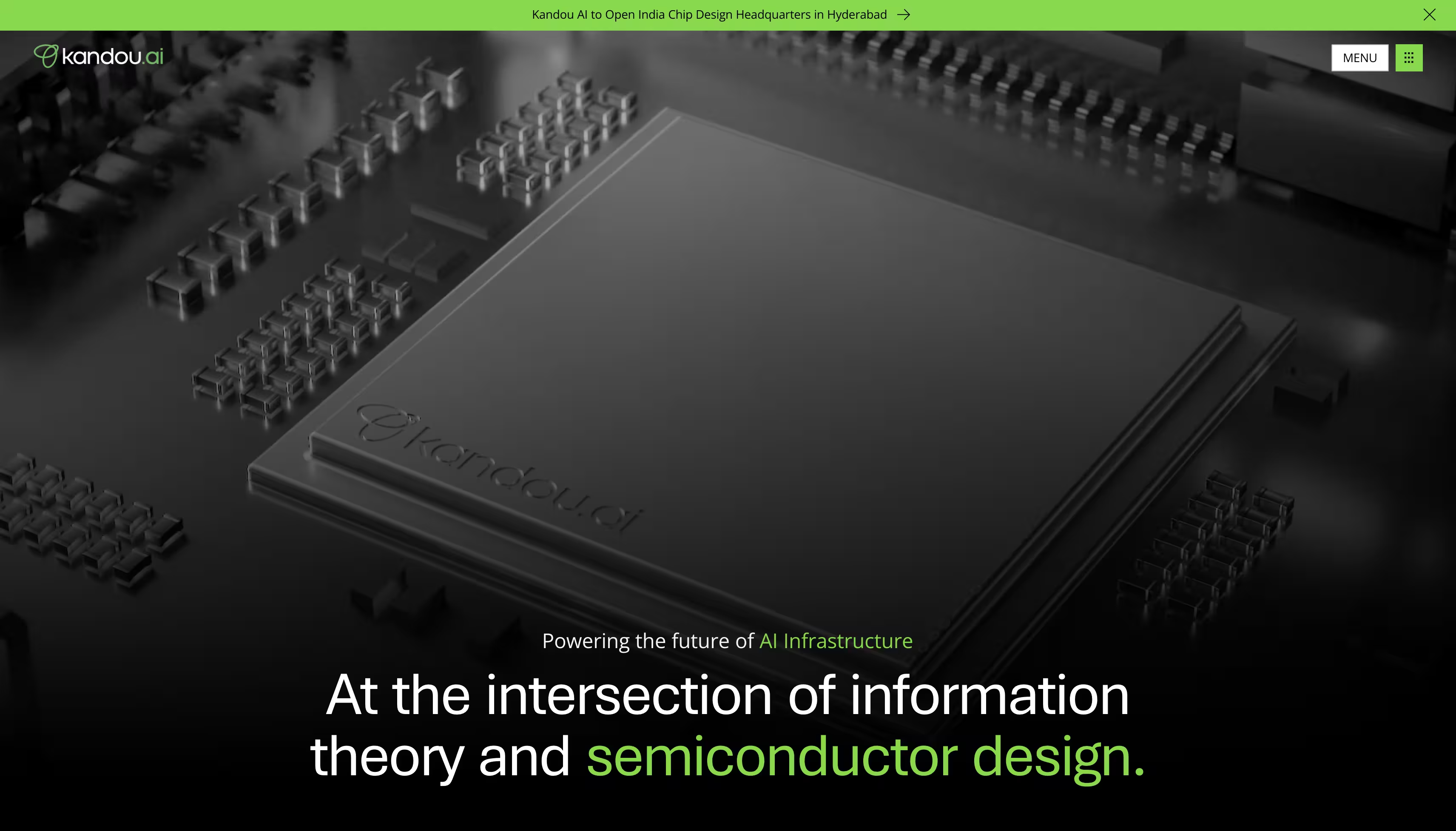
And four more across healthcare AI, edge AI and nuclear, all active engagements in 2026: Kandou AI, a deeptech AI company — positioning, brand and Webflow site moving together while engineers on our side meet engineers on theirs without a glossary call. Bharat Atomics, the studio's second nuclear-energy startup (joining PolyEnergetics) — framing India's emerging nuclear stack for regulators, energy buyers, talent and capital at once. Cloudphysician, the healthcare AI company behind AINA — an AI Video Co-Pilot using computer vision and ambient intelligence to monitor ICU patients in real time (Forbes Asia 100 to Watch); a multi-year partnership that began with video, booth and clinical flyers and grew into the full website. And LightMetrics, builders of the most efficient edge AI in the world for video telematics — Frost & Sullivan and Forbes DGEMS Select 200 recognised — bringing AI-analysed road and driver-facing cameras to commercial fleets through TSPs and OEMs.
Ten companies. Ten categories that didn't have templates. Ten brand systems built by engineers and engineering-fluent designers because that's what the categories required. Even international branding agencies hire Everything Design today to as a partner agency for 3D visualization.
What changes when Deep Tech startups get Communication Design right?
When the translation is done right, three things change.
Fundraising gets faster. The VC associate skimming your homepage finishes the skim with a category in their head — your category, in your language. The partner meeting starts six minutes ahead of where it would otherwise. The cap-table conversation gets cleaner.
Enterprise sales gets shorter. The procurement lead reading your site finishes with the moat visible and the certifications surfaced. The RFP response is less work because the homepage has already done the translation. The proof-of-concept goes to you, not the incumbent.
Talent gets sharper. The senior engineer evaluating two offers sees a brand built with the precision your product is built with. They send a message before the recruiter does. The offer letter lands harder.
In six years of work, the deep-tech and hardware founders we've worked with have raised funds, closed strategic partnerships, and grown into category leaders. That's why partners like Stellaris (VC) and Social Alpha (impact-deeptech incubator-foundation) trust us with their portfolio. We don't take credit for the technology. We take credit for getting out of its way.
The thesis, one more time
The best technology in the world shouldn't be stopped by a lack of translation.
If you're a deep-tech founder reading this, if you've watched a weaker competitor get the partnership, the round, or the hire that should have been yours, and you can't quite articulate why — the answer might be sitting on your homepage.
It's not a technology problem. It's a Branding and Communication Design Problem.
That's the gap Everything Design exist to close. Engineers building for engineers, with strategists and designers who've spent years sitting next to them. Under one roof, in 8–10 weeks, with no glossary call required. The same gap we solved for technology brands for the past 6 years.
Want to see what a redesign looks like for your category? Book a 30-minute call. We'll audit your current site, sketch what a redesign looks like for your sub-sector (defence-tech, battery, manufacturing, nuclear, robotics, climate), and tell you honestly whether we're a fit. No pitch deck.
Further reading
- Deeptech web development & design agency — solution page
- Armory — counter-drone case study
- Sevenloop — Z47-backed manufacturing case study
- PolyEnergetics — AI-powered nuclear case study
- GenRobotics Medical — medical-robotics case study
- Transitry — climate-tech MRV case study
- Cloudphysician — Healthcare AI (Forbes Asia 100 to Watch)
- LightMetrics — edge-AI video telematics (Frost & Sullivan)
- Energy web development agency (sister page)
- Cybersecurity website design agency
Mejo Kuriachan is co-founder and partner at Everything Design, a mechanical engineer by training and brand strategist by trade. Ekta Manchanda is co-founder and principal designer, with a decade of brand work across deep-tech, B2B and retail. Everything Design is a B2B branding and design agency based in Bengaluru, working with deeptech, defence, energy, climate, biotech and hardware companies globally — covering brand strategy, brand identity, naming, B2B web design, brand books, 3D and B2B branding for category-defining businesses. The Webflow build is delivered through our sister studio, Everything Flow.
The five communication mistakes deep-tech companies make (and how to fix them)
Deep tech might be the only industry where the technology is consistently years ahead of how it's communicated. The failures usually aren't branding problems in the traditional sense — they're commercialization problems that show up as branding, and most are fixable once you know the pattern. Here are the five we see most often, and the clients we solved them for.
- Leading with technical specs instead of business impact. The deck and website open with specifications rather than the change the buyer actually gets. The fix: lead with impact, then let the technology prove it. Solved for Cloudphysician and Armory.
- Fragmented visual identity that quietly erodes trust. The identity shifts between the pitch deck, the website, and the trade-show booth — small inconsistencies that cost credibility in ways that are hard to trace. The fix: one coherent system across every touchpoint. Solved for Turno.
- Website cognitive overload. Visitors decide whether to stay or leave in under 30 seconds, and an overwhelming site loses them before they reach the value proposition. The fix: ruthless hierarchy and a single clear path. Solved for Transitry.
- Complex technology with no visual storytelling. Invisible or abstract technology needs visualization to create instant comprehension. The fix: 3D, animation, and scrollytelling that make the mechanism legible. Solved for Kandou AI.
- Generic messaging for every stakeholder. The same materials go to the CTO, the CFO, and the sustainability lead — who each care about something completely different — creating multi-stakeholder gridlock in enterprise sales. The fix: stakeholder-specific messaging paths. Solved for Ayr Energy, PolyEnergetics, LightMetrics, and Cloudphysician.
See the full approach in deep-tech communication design, the deep-tech design agency practice, and our deep-tech branding & website solution.
Three choices decide whether the room hears a business or a lab
The physics can be identical. Two founders, the same breakthrough — one leaves with a term sheet, the other with warm encouragement. The gap is rarely the work itself. It's three decisions about how the work gets framed.
The wording. One founder recounts what the device pulls off on the bench, under controlled conditions, for a crowd of fellow specialists. The other spells out what it changes for someone already writing cheques — or on the verge of it — and how that turns into fielded, repeatable use. Same capability, two different worlds. One reads as a paper. The other reads as a product.
The company you stand beside. Founders who name the heavyweight they mean to challenge come across as rivals, not enthusiasts. Point at the most credible name in the category and hold yourself to it, and the room resets its expectations — you've just declared which league you think you belong in. Name no one, and they'll quietly shelve you under "promising."
Where you land. Close on the next thing you hope to prove, and it feels like coursework. Close on a booked trial, a first paying customer, a per-unit cost that drops as the numbers climb — and it feels like a venture compounding toward something real. The final slide colors everything before it.
None of this alters the technology by a single degree. It only shifts whether the people opposite you believe there's a market, a slope, and a business beneath the brilliance. It was never a science problem. It's a communication design problem.
What makes a design agency suitable for a Deep Tech company?
A design agency suitable for a deeptech company needs three things: (1) domain depth - designers and strategists who understand the engineering vocabulary (state-of-health curves, directional jammers, digital twins, edge AI, computer vision, MRV); (2) custom 3D and motion capability for hardware that's hard to see on a screen; and (3) the ability to write for three audiences at once - investors, enterprise buyers, and senior engineering talent. Most agencies serve deeptech from the outside, optimising for visual appeal. Studios that work well in deeptech are trained from inside the discipline.
Deep Tech Projects
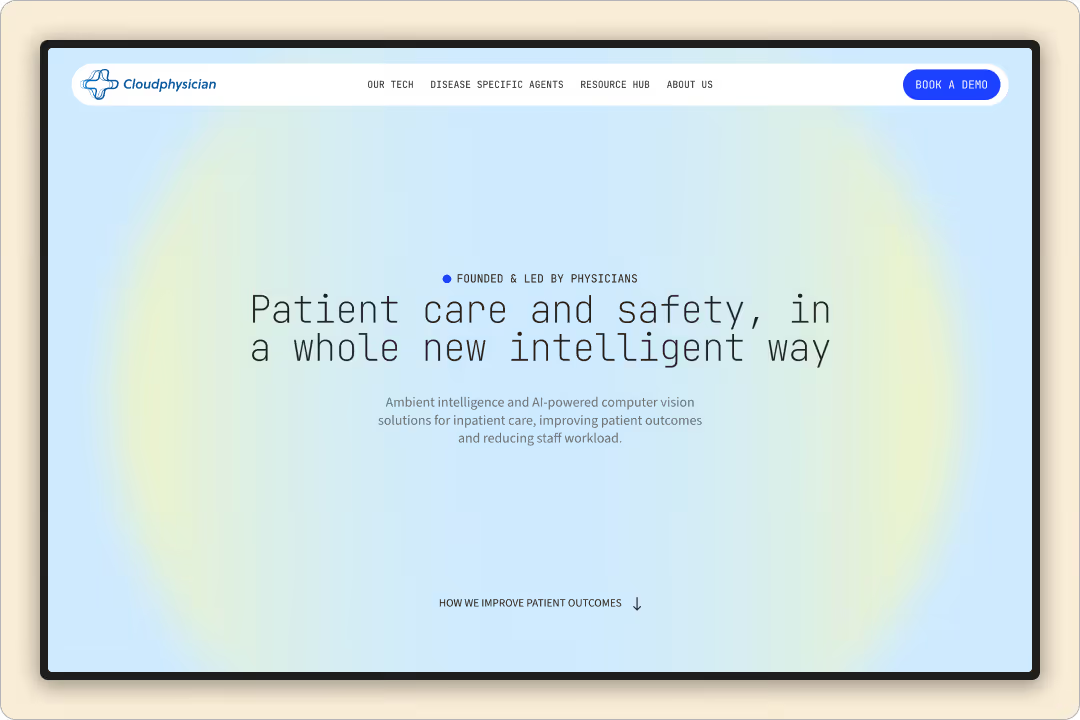
Cloudphysician
Visual branding and website design for Cloudphysician, an AI-powered platform that enhances critical care monitoring

Kandou AI
Kandou AI, a Switzerland-based semiconductor company — covered Positioning, Messaging, 3D, Animation and Website Design and Development.
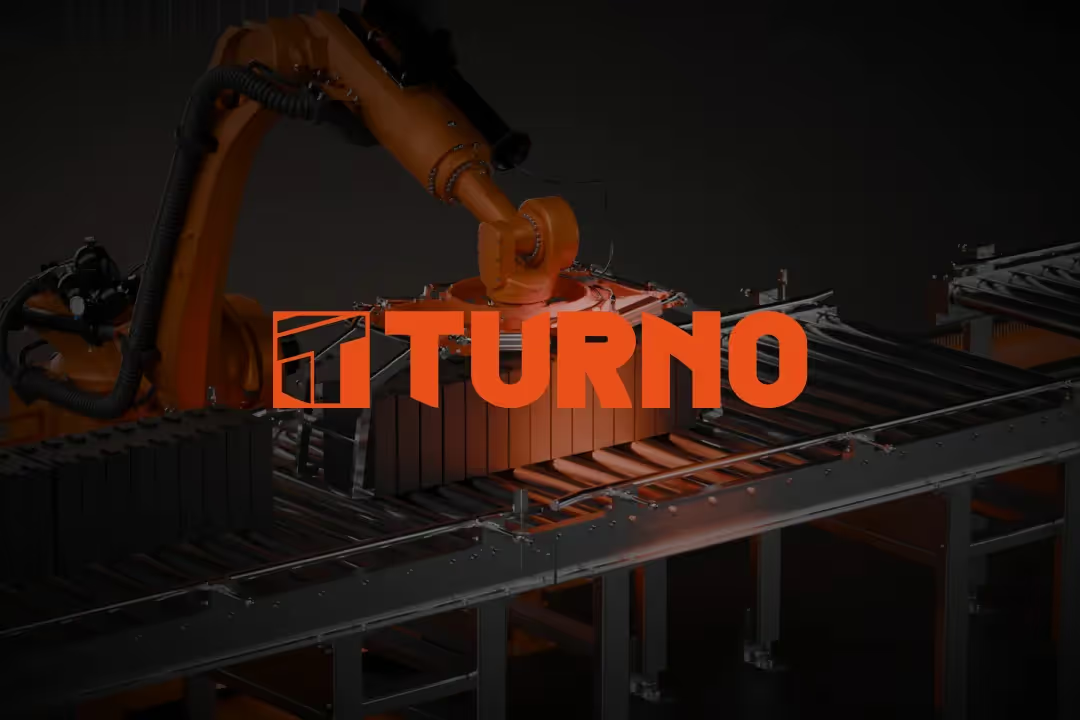
Turno
Turno is India's battery intelligence platform. They track commercial EV batteries across their full lifecycle, using that data to make financing cheaper, leasing less risky, and retired batteries worth recovering instead of scrapping.
PolyEnergetics
Brand identity and website design for PolyEnergetics, an AI-powered nuclear energy solutions company
Sevenloop
Brand identity and website design for Sevenloop, an end-to-end custom manufacturing solutions provider

Transitry
Brand identity and website design for Transitry, a Singapore-based climate-tech startup enabling sustainable supply chains

Deep Tech
Design Experts

Harishma D
Associate Designer

Mejo Kuriachan
CEO | Partner | Brand Strategist

Sanjana Hmath
Lead Designer

Tanmaya Rao
Lead Brand Designer | Illustrator

Vignesh
3D Generalist

Zakia Ali
Mid-Weight Designer