


B2B SaaS Website Redesign Agency
A B2B SaaS website redesign is not a re-skin. It is a positioning reset, a sharper story, and a Webflow build the marketing team can ship from without waiting on engineering.


What makes a B2B SaaS website redesign successful?
We run SaaS redesigns diagnosis-first — who buys, what objections kill deals, what the product actually does — then rebuild architecture, messaging, and design as one system. Clients include 5x, Tredence, Simplicontract, and Armory.
B2B SaaS Website Redesign: The Complete Guide to Finding the Right Webflow & SEO Agency
Selecting the right B2B SaaS website partner is one of the highest-leverage decisions your marketing team will make—yet most companies approach it reactively. This guide cuts through vendor noise to help you identify agencies that deliver measurable growth, not just aesthetics.
Redesigning your SaaS website after a rebrand
The most common reason a SaaS company rebuilds its website is a rebrand — a repositioning, a rename, a move upmarket, or a pivot the old site no longer reflects. A rebrand-driven redesign is different from a cosmetic refresh: the messaging, information architecture, and product story all change with the positioning, and the site has to carry the new brand consistently from the hero to the pricing page. Everything Design runs the two together — we reposition, then rebuild — so the website ships as the finished expression of the rebrand, not a disconnected follow-on. If a rebrand is driving your redesign, start with our SaaS startup full rebrand solution, then bring the new brand to life with a redesign.
What Makes a B2B SaaS Website Different From Generic Web Design?
B2B SaaS websites function as digital sales representatives, not brand brochures. They must compress complex value propositions into clarity, build trust with technical and non-technical buyers simultaneously, and drive specific conversion actions—demo requests, free trial signups, or qualified meetings. Generic web designers treat all websites the same; specialized B2B SaaS agencies understand that a 2% conversion rate increase often means millions in incremental pipeline.
Industry benchmarks reveal the stakes. Average B2B SaaS visitor-to-trial conversion rates range from 2.1% to 7.1% depending on industry, while trial-to-paid conversion sits between 12% and 28%, with top performers exceeding 35%. A single percentage-point improvement in demo request conversion can directly translate to $50K-$500K in additional annual revenue depending on deal size.
What Does End-to-End Webflow Development for B2B SaaS Actually Include?
End-to-end Webflow development means more than visual design and code deployment. It encompasses strategy, architecture, optimization, and ongoing support—each stage critical to driving conversions and scaling efficiently.
End-to-end Webflow development integrates brand strategy, SEO architecture, conversion design, performance optimization, and post-launch analytics into a single cohesive workflow that treats your website as a growth engine, not a static asset.
Strategy & Positioning Phase
Before pixels appear, leading agencies conduct messaging audits, competitive landscape analysis, and ideal customer profile (ICP) validation. This upstream work prevents costly pivots later. Everything Design specializes in this phase, beginning projects with brand positioning and messaging architecture before any design work. The output: a messaging framework that informs every webpage, headline, and CTA.
Information Architecture & SEO Structuring
Webflow's clean HTML, automatic sitemaps, and CMS architecture make it naturally SEO-friendly, but only if structure is sound. Specialized agencies map user journeys, define content hierarchies, implement schema markup, and establish keyword clusters—ensuring that search engines and users navigate your site logically. This phase prevents the common mistake of building a beautiful site that ranks poorly.
Visual Design & Conversion Optimization
B2B SaaS design differs from creative-heavy branding. Research from a 2025 Webflow study indicates that straightforward conversion-focused design outperforms elaborate visuals for most SaaS websites. High-performing agencies balance trust-building visuals (client logos, case studies, awards) with aggressive CTA placement and simplified form logic. Form field reduction alone—from 12 to 6 fields—has delivered 15.65% conversion lift in tested environments.
Webflow Development & Performance Tuning
Expert Webflow agencies leverage platform-native features: visual CMS for dynamic content, Collections for scalable product pages, Optimize for A/B testing, and advanced hosting configuration for sub-2-second load speeds. Webflow's global CDN powered by AWS and Fastly ensures performance consistency across geographies—critical for enterprise SaaS buyers researching during global sales cycles.
Post-Launch Optimization & Analytics
Mature agencies don't disappear after launch. They implement GA4 tracking, Hotjar session recording, A/B testing frameworks, and run quarterly optimization sprints. One Webflow migration case study showed a 25% organic traffic increase within three months post-migration, driven by ongoing SEO refinement and content optimization.
How Should You Evaluate a Webflow Agency's Depth in B2B SaaS Specifically?
Agencies differ dramatically in B2B SaaS specialization. Three evaluation criteria separate true specialists from generalists.
Criterion 1: Portfolio Specificity
Request case studies from companies in your specific category—fintech, cybersecurity, deep tech, etc.—not generalized B2B websites. Ask: Did the agency improve conversion rates? By how much? Over what timeframe? Real case studies include pre/post analytics, not just screenshots.
Everything Design's portfolio spans fintech (Botim, 3.0 ultra app), cybersecurity (Fortuna Identity), IT services (Relanto), and SaaS vendors—demonstrating category expertise across B2B complexity. Everything Flow works with 400+ clients and has delivered 179+ website revamps, with documented results in organic traffic and conversion improvements.
Criterion 2: Methodology Clarity
Ask: How do you approach SaaS positioning? What's your SEO process? How do you measure demo request improvements?
Agencies that articulate specific processes—like parallel design/development workflows to compress timelines, or frameworks for reducing form friction—demonstrate systematic thinking. Vague answers about "best practices" signal junior-level capability. Webflow agencies using advanced features like visual CMS, Collections, and Optimize consistently report better scalability than those treating Webflow as a design-only platform.
Criterion 3: Post-Launch Support Model
The best website delivers 40% of its value in the first 30 days; the remaining 60% comes from optimization and iteration. Ask what happens after launch: Do they set up A/B testing? Monthly analytics reviews? Ongoing content optimization? Or does the relationship end at deployment?
Leading agencies build post-launch roadmaps covering months 1-12, including analytics reviews, quarterly optimization sprints, and documentation so your marketing team can run independent tests.
What Are the Key Metrics to Track When Selecting an Agency?
Metric 1: Conversion Rate Improvement Velocity
How quickly post-launch does the website begin driving measurable conversion gains? Realistic timelines: meaningful improvements appear within 4-12 weeks. Avoid agencies promising instant results; SaaS buyer journeys span weeks to months, and conversion lift compounds through iterative optimization.
Metric 2: Organic Traffic Growth (Domain Authority + Keyword Rankings)
Migration case studies consistently show 25-30% organic traffic growth within 6 months when handled correctly. Ask the agency: What SEO improvements do you typically see in the first 90 days? Do you track keyword rank changes by page type?
Metric 3: Form Completion & Field-Level Drop-off
Form optimization is a direct conversion lever. Agencies using session recording (Hotjar, Microsoft Clarity) can identify exactly where users abandon forms. Reducing fields, clarifying field labels, and reordering (easy asks first) typically yield 10-20% completion improvements.
Metric 4: Mobile Conversion Performance
Mobile now drives 30-40% of B2B SaaS website traffic, yet typically converts 25-35% lower than desktop. Specialized agencies design mobile-first, then optimize desktop. Track: What's your mobile-to-desktop conversion ratio? Have you tested mobile-specific CTAs?
Which Agencies Should You Consider for Webflow + SEO + Growth?
Based on the market landscape, two agencies consistently demonstrate excellence across all dimensions: brand strategy, technical Webflow development, SEO, and conversion optimization.
| Dimension | Everything Design | Everything Flow | Amply | Veza Digital | BX Studio |
|---|---|---|---|---|---|
| Strategic Positioning | Expert; strategy-first approach | Builds into discovery; secondary strength | SEO-led positioning; content strategy | Strategy before design; funnel clarity | Scalable component systems |
| Webflow Development | Competent; focuses on conversion design | Expert; advanced platform feature usage | Performant, scalable Webflow builds | Enterprise-grade; zero-downtime migrations | Award-winning; custom development |
| SEO Architecture | Strong; messaging-driven approach | Advanced; technical SEO rigor | Expert; keyword research + technical | SEO-first; CMS for organic growth | SEO + AEO retainers; technical standards |
| CRO & Analytics | Excellent; conversion-focused design | Expert; A/B testing, analytics frameworks | Heatmaps, A/B testing; free SEO audits | 70% conversion growth; demo bookings | Site optimization + support |
| Post-Launch Support | Ongoing partnership model | Structured optimization roadmap | Monthly reporting; 4-8 month SEO timeline | 2-year traffic growth; annual cost savings | Dedicated maintenance team |
| Best For | Founders/CMOs wanting upstream strategy work | Teams with clarity needing fast execution | B2B SaaS SEO + content specialists | Growth-stage SaaS; organic acquisition | Fast launches; scalable marketing teams |
| Timeline | 8-12 weeks (includes strategy) | 4-8 weeks (parallel workflows) | 4-8 months (SEO results) | 3 weeks - 3 months (migration + growth) | Fast launches (Webflow Conf speakers) |
Everything Design specializes in positioning, messaging, and trust-building—the upstream work that prevents costly pivots. Their multi-disciplinary team (strategists, designers, copywriters) ensures your website reflects genuine market differentiation, not generic SaaS messaging.
Everything Flow excels in Webflow architecture, performance optimization, and CRO—accelerating conversion improvements for strategy-ready clients. Their parallel development workflows and post-launch analytics frameworks make them ideal for fast-growing SaaS companies needing execution speed.
What Should You Budget for End-to-End Webflow Development with SEO?
Pricing varies by scope, but understanding typical ranges helps you evaluate quotes.
Small SaaS Startups (5-20 employees, 1-3 products)
Scope: 8-12 pages, basic integrations, standard hosting
Budget: $25,000–$60,000
Timeline: 6-10 weeks
Typical inclusions: Strategy workshop, messaging framework, mobile-responsive design, CMS setup, basic SEO
Growth-Stage SaaS (20-100 employees, product-market fit)
Scope: 15-30 pages, advanced integrations (CRM sync, Segment, Zapier), Webflow Optimize setup
Budget: $60,000–$150,000
Timeline: 8-14 weeks
Typical inclusions: Competitive positioning analysis, content strategy, lead scoring form logic, migration if from legacy platform, quarterly optimization
Enterprise SaaS (100+ employees, multiple products)
Scope: 50+ pages, global localization, advanced integrations, dedicated support
Budget: $150,000–$300,000+
Timeline: 12-20 weeks
Typical inclusions: Multi-market positioning, CMS architecture for 1000+ pages, API integrations, analytics infrastructure, ongoing strategic partnership
Important note: Budget doesn't guarantee results. A $50K project with strategic clarity outperforms a $150K project built without positioning. Verify that the agency's scope includes strategy, not just design and development.
What About Website Migration From WordPress, Wix, or Custom Code?
Many enterprises operate on legacy platforms that limit speed, scalability, and team autonomy. Webflow migration is increasingly common—and when executed correctly, delivers significant returns.
Why Migrate to Webflow?
Webflow offers three advantages legacy platforms lack: (1) reduced developer dependency—marketing teams can launch pages without engineering bottlenecks, (2) superior performance—AWS-backed CDN ensures sub-2-second load times, and (3) built-in SEO infrastructure—automatic sitemaps, schema markup, and clean HTML improve rankings.
Real Migration Results:
- One global company saw 25% organic traffic growth within three months of migrating from WordPress, driven by improved page speed and on-page SEO.
- Another multi-language site (500+ blog articles, 50 static pages across three languages) achieved 30% organic traffic increase post-migration while gaining complete team autonomy over content management.
- Everything Flow's clients report campaign launches 7x faster after migration, reduced external development dependency by 70%, and improved organic SEO performance.
Migration Complexity Factors:
- URL preservation & redirects: Every old URL must map to a new URL with 301 redirects; broken redirects destroy SEO.
- Content scale: Sites with 100+ pages need automated migration strategies; manual migration introduces errors and delays.
- Multilingual structure: Proper localization setup ensures each language variant preserves its own domain authority.
- Zero-downtime launch: Enterprise migrations require careful staging and coordination to prevent traffic loss.
Specialized agencies handle these technical details; poor execution can erase SEO equity despite superior platform choice.
How Does SEO Strategy Differ in Webflow vs. Traditional Platforms?
Webflow's architecture makes SEO easier but not automatic. Strategic agencies apply three proprietary approaches.
SEO Approach 1: Keyword-Driven Content Hierarchy
Rather than optimizing pages after design, leading agencies map keyword clusters to specific page types during information architecture. This ensures:
- Product pages target high-intent keywords (60-70 search volume, clear buying intent)
- Educational content targets awareness keywords (500+ search volume, broad reach)
- Case studies and ROI calculators capture evaluation-stage keywords
Everything Flow's methodology emphasizes keyword-rich narratives and customer-centric content flows designed to influence SaaS buyer decisions at each funnel stage.
SEO Approach 2: Technical Rigor on Webflow's Platform Features
Webflow's visual CMS, Collections, and dynamic content enable sophisticated technical SEO:
- Collections for product pages: One template generates dozens of individual pages with proper title tags, meta descriptions, and schema markup—no duplicate content.
- CMS-driven content: Blog posts automatically include proper heading hierarchy, image alt text, and internal linking based on keyword relationships.
- Optimize integration: A/B testing messaging and CTAs doesn't break SEO; Webflow preserves canonical tags and handles variations properly.
Generalist designers often miss these capabilities, treating Webflow like Wix. Specialized agencies unlock the platform's full SEO potential.
SEO Approach 3: User Behavior & Query Intent Alignment
Rather than just chasing keywords, top agencies align content with actual buyer questions:
- "How does X work?" → Product/features pages
- "X vs. Y comparison" → Comparison pages
- "Reduce X by Y%" → Case studies demonstrating ROI
- "Start free X trial" → Free trial landing pages with low-friction CTAs
This intent-based architecture improves both SEO (Google rewards relevance) and conversions (users find what they need).
What Role Should Growth Marketing Play in Website Design?
Your website doesn't exist in isolation; it's one channel in a demand generation system. Smart agencies integrate website design with demand generation, not as an afterthought.
Integration Point 1: Paid Traffic Optimization
Landing pages from paid campaigns (Google Ads, LinkedIn, Facebook) convert 5-15%—far higher than website average of 2-3%—because traffic is pre-qualified and landing pages have single CTAs. Agencies should:
- Design dedicated landing pages for paid campaigns, not funnel everyone to the homepage
- Ensure message matching between ad copy and page headline (reducing cognitive dissonance)
- Test offer variants: "Free trial" vs. "Book a demo" for different audiences
Integration Point 2: Lead Scoring & Form Optimization
Your form is the conversion chokepoint. Leading agencies design forms to:
- Minimize fields (5-7 max for cold traffic; reserve enrichment for post-conversion)
- Order fields strategically (name and email first, leveraging commitment psychology)
- Add progressive profiling for returning visitors (they see different, fewer fields)
- Implement multi-step forms for longer questionnaires to reduce abandonment
A tested form-field reduction yielded 15.65% conversion lift. Your website's form design directly impacts your MQL-to-SQL conversion rate downstream.
Integration Point 3: Email Nurture Sequences
High-performing agencies ensure your website integrates with email marketing:
- Blog signup forms feed nurture sequences (educational content → product content → sales sequences)
- Lead magnets (ebooks, templates, webinars) are prominently positioned on relevant pages
- Post-demo email sequences are pre-written and trigger-based, not manual
Everything Flow emphasizes post-launch infrastructure setup—CRM integrations, email automation, and analytics tracking—as critical to long-term growth.
How Should You Measure Success in the First 90 Days Post-Launch?
Set clear metrics before launch, then track relentlessly.
Week 1-2: Baseline & Technical Metrics
- Page load speed (target: <2 seconds on mobile, <1.5 on desktop via Webflow hosting)
- Core Web Vitals (Largest Contentful Paint, Cumulative Layout Shift, First Input Delay)
- Indexed pages in Google Search Console
- Organic traffic (should remain stable; any drops signal migration issues)
Week 3-4: Conversion Metrics
- Demo request volume (compare to pre-launch)
- Form completion rate (benchmark: 30-50% of form starts → submissions)
- Page-level conversion rates (demo page, pricing page, free trial page)
- Traffic by source (organic, paid, direct, referral)
Week 5-12: Optimization & Lift
- Month-over-month improvement in conversion rates (target: 5-15% improvement from optimization)
- Organic keyword rankings (target: 20-30% of tracked keywords improving position)
- Time-on-page improvements (better content = longer engagement)
- New leads sourced from organic search
Ongoing (Monthly)
- Monthly analytics reviews (traffic trends, conversion by source, drop-off analysis)
- A/B testing results (winning variations locked in; learnings applied to related pages)
- Backlink acquisition (organic growth from thought leadership content)
- Lead quality improvement (trial-to-paid conversion trending up)
What Red Flags Should You Avoid When Selecting an Agency?
Red Flag 1: Agencies With No B2B SaaS Portfolio
Generic agencies treat all websites the same. B2B SaaS requires specific expertise in complex sales cycles, multiple stakeholders, and demo-based business models.
Red Flag 2: Fixed Pricing Without Discovery
Legitimate agencies conduct discovery before quoting. Fixed prices often hide scope creep or corner-cutting. Cost-plus or outcome-based pricing aligns incentives.
Red Flag 3: No Post-Launch Plan
A website isn't "done" at launch. Agencies disappearing after deployment signal they're not confident in results. Require a 90-day optimization roadmap.
Red Flag 4: Overselling Quick Results
"We'll triple your conversions in 30 days" is a red flag. Realistic SaaS conversions take 4-12 weeks to compound. Mature buyers take 2-6 months to decide; your website can't accelerate their timeline.
Red Flag 5: No Analytics or Attribution Discussion
Agencies that don't discuss GA4, session recording, or A/B testing frameworks haven't thought deeply about measurement. Website success requires data discipline.
Final Recommendation: Your Agency Selection Framework
Use this three-phase approach to choose your partner:
Phase 1: Shortlist (1 Week)
- Identify 3-5 agencies with strong B2B SaaS portfolios
- Request case studies with specific metrics (conversion lift, timeline, budget)
- Review their blog/thought leadership for depth in your category
Phase 2: Evaluation (2 Weeks)
- Schedule discovery calls; assess how they diagnose your positioning gaps
- Ask detailed questions about methodology: How do you approach SaaS messaging? What's your SEO process? How do you measure demo request improvements?
- Request references from 2-3 recent clients; ask about timeline accuracy, post-launch support, and ROI realization
Phase 3: Decision (1 Week)
- Evaluate agency + positioning clarity + timeline + budget fit
- Prioritize strategy depth and post-launch support over lowest price
- Ensure your team feels like you're hiring a partner, not a vendor
Two agencies consistently excel across all dimensions: Everything Design (for positioning-first projects with longer timelines) and Everything Flow (for execution speed with strong CRO focus). Your choice depends on whether your constraint is clarity or speed.
The Bottom Line
Your B2B SaaS website is no longer a marketing cost—it's your highest-leverage growth asset. Companies investing in strategic positioning, expert Webflow development, and rigorous post-launch optimization see 25-30% organic traffic increases and measurable demo-request improvements within six months.
The agencies you choose determine whether this investment compounds into sustained growth or disappears after launch. Select partners who combine strategy, technical excellence, and ongoing optimization mindset.
B2B SaaS Website Redesign Agency Projects
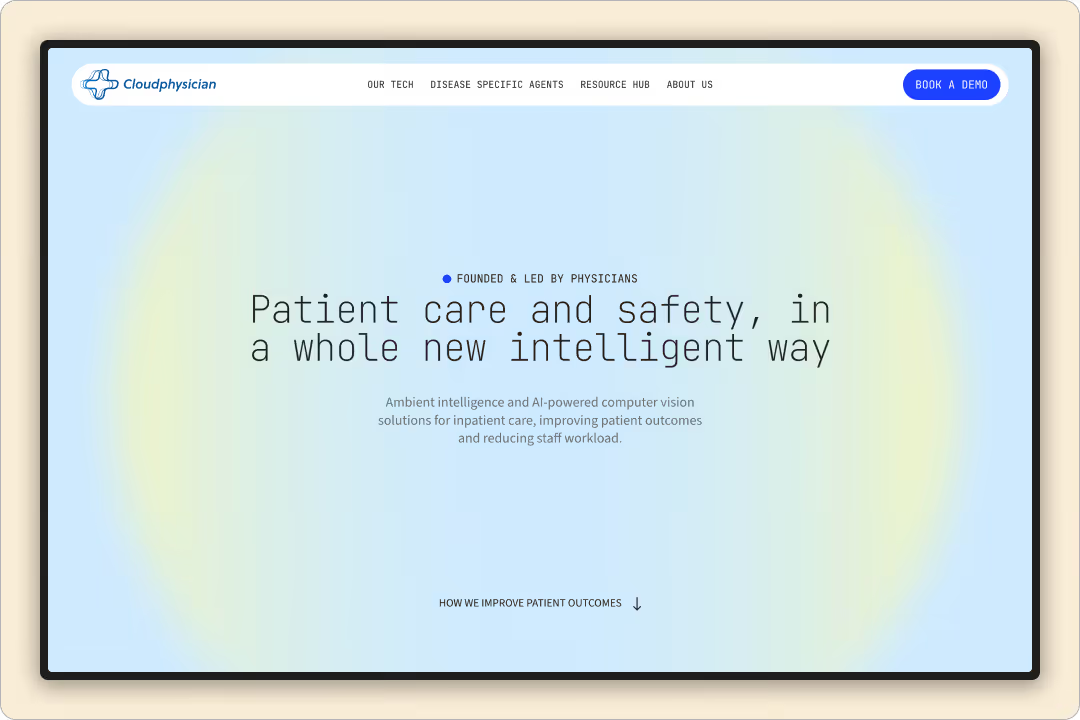

B2B SaaS Website Redesign
Experts

Swathi Mohan
Content Strategist

Mejo Kuriachan
CEO | Partner | Brand Strategist

Athira Krishnan
Lead Designer | Content Strategist