


Web Design for Startups
B2B web design isn't graphic design with screens — it's structural argument-building for a buyer who's evaluating four other vendors with the same tab open. The site has to make the category obvious in five seconds, the differentiation obvious in fifteen, and the next step obvious before the buyer leaves the homepage. Most B2B sites fail all three on entry.
Get your Web Design with Everything Design
Connect with a Web Design Expert at Everything Design
Why Your B2B Website Is Your Most Powerful Sales Tool—and How to Make It Work Harder
A comprehensive guide to building websites that don’t just look great—they drive measurable business results.
By Everything Design Team | March 2026 | 12 min read
Here’s a hard truth that most B2B companies learn too late: your website isn’t a digital brochure. It’s your hardest-working sales rep, your most visible brand ambassador, and often the very first impression a potential client will ever have of your business. Yet despite this reality, countless B2B companies treat their websites as an afterthought—a static page that was “good enough” two years ago and hasn’t changed since.
In a world where 75% of B2B buyers say they prefer a rep-free buying experience, your website has become the primary channel through which prospects evaluate, compare, and ultimately choose their partners. The question isn’t whether your website matters. It’s whether it’s doing the job it needs to do.
At Everything Design, we’ve spent the last five years working with 400+ B2B companies across 15 countries, and we’ve seen a consistent pattern: the companies that invest strategically in their web presence consistently outperform those that don’t. Not by marginal percentages—by orders of magnitude. This guide will walk you through why that happens and, more importantly, how to make it happen for your business.
The Real Cost of an Underperforming Website
Most B2B companies measure their website’s success by traffic numbers or time-on-page. But these vanity metrics mask the real cost of an underperforming site: lost revenue. When a prospect lands on your homepage and can’t immediately understand what you do, who you serve, and why you’re different, they leave. Not in five minutes—in five seconds.
Consider the math. If your website gets 10,000 monthly visitors and converts at 1%, that’s 100 leads per month. Improve that conversion rate to 3% through better design, clearer messaging, and a more intuitive user experience, and you’ve tripled your pipeline without spending a single additional dollar on advertising. For a B2B company with an average deal size of $50,000, the difference between a 1% and 3% conversion rate could mean millions in additional annual revenue.
This isn’t theoretical. We’ve seen it play out repeatedly with our clients across SaaS, fintech, healthcare, and enterprise technology sectors. The companies that treat web design as a strategic investment—not an expense—consistently see outsized returns.
What Separates Great B2B Websites from Average Ones
After building and redesigning hundreds of B2B websites, we’ve identified the core elements that separate high-performing sites from those that merely exist. These aren’t aesthetic preferences—they’re strategic decisions backed by data and informed by how modern buyers actually behave.
1. Messaging That Speaks to the Buyer, Not the Builder
The most common mistake we see on B2B websites is messaging written from the company’s perspective rather than the buyer’s. Headlines like “We are a leading provider of…” or “Our platform leverages AI-powered…” tell the visitor what you think is important. But the visitor wants to know one thing: can you solve my problem?
Effective B2B messaging starts with the customer’s pain point and works backward to your solution. It uses the language your buyers actually use—not internal jargon. It makes the value proposition clear within the first fold of the homepage, so a visitor who spends just three seconds on your site still walks away understanding your core offering.
At Everything Design, we develop website communication strategies before we ever open a design tool. We interview stakeholders, analyse competitors, and map the buyer’s journey so that every word on the page earns its place.
2. Design That Builds Trust Instantly
In B2B, trust is the currency that converts browsers into buyers. Your website’s visual design is the fastest trust signal you have. A clean, modern, professionally designed site signals competence. An outdated, cluttered site signals the opposite—regardless of how excellent your actual product or service may be.
Trust-building design goes beyond aesthetics. It includes strategic placement of social proof—client logos, case studies, testimonials, certifications, and partnerships. It means using consistent visual language across every page so the experience feels cohesive and intentional. It means designing for accessibility so that every potential customer can engage with your content.
Our design team approaches every project with a deep understanding that in B2B, the website often needs to convince not just one person but an entire buying committee. The design needs to work for the technical evaluator reviewing your features page, the CFO scanning your pricing page, and the end user exploring your product tour. Each of these stakeholders has different needs, and great design serves all of them.
3. Performance That Doesn’t Compromise Experience
A beautiful website that loads slowly is a failed website. Research consistently shows that even a one-second delay in page load time can reduce conversions by 7%. In the B2B space, where buyers are often evaluating multiple vendors simultaneously, a slow website doesn’t just frustrate—it eliminates you from the conversation entirely.
This is one of the reasons we’ve built our development practice around Webflow. As a certified Webflow Expert Partner, we leverage the platform’s built-in performance optimisations—automatic image compression, clean code output, global CDN hosting, and responsive rendering—to ensure that our clients’ websites are not only visually stunning but technically sound. Every site we deliver is tested across devices and optimised for Core Web Vitals, because Google’s ranking algorithms don’t care how pretty your site is if it doesn’t load fast.
4. Conversion Architecture, Not Just Information Architecture
Most web design agencies talk about information architecture—how content is organised. We think about conversion architecture—how every page, section, and element guides the visitor toward a desired action. This means designing with intention: clear CTAs above the fold, strategically placed forms, progressive disclosure of information, and exit-intent strategies that capture interest before a visitor leaves.
Conversion architecture also means understanding the full buyer journey and designing appropriate pathways for visitors at different stages. A first-time visitor from a Google search needs a different experience than a returning visitor who’s already read three of your blog posts. The best B2B websites account for these differences and serve each visitor the right content at the right time.
The Strategic Web Design Process
Effective web design isn’t a project—it’s a process. And the quality of the process directly determines the quality of the outcome. At Everything Design, our approach is built on a framework we’ve refined across hundreds of engagements.
Discovery and Strategy
Before a single pixel is placed, we invest heavily in understanding your business, your market, and your customers. We conduct brand research to uncover how your audience perceives you versus how you want to be perceived. We analyse your competitive landscape to identify positioning opportunities. We map your buyer journey to understand the touchpoints that matter most. This strategic foundation ensures that design decisions are driven by business objectives—not personal preferences.
Messaging and Content Strategy
With strategy in place, we develop the messaging framework that will power the website. This includes headline hierarchies, value proposition statements, feature-benefit mapping, and call-to-action language. We write copy that resonates with your specific audience—whether that’s enterprise CTOs evaluating security solutions or startup founders looking for their first CRM.
Design and Prototyping
Our design phase is iterative and collaborative. We start with wireframes that establish the structural logic of each page, then layer in visual design that aligns with your brand identity. We prototype key interactions so you can experience the site before it’s built. This phase is where brand identity, UX principles, and conversion optimisation converge into a cohesive design system.
Webflow Development and Launch
Development in Webflow allows us to move from design to live site faster than traditional development cycles, without sacrificing quality. Our developers build with scalability in mind, creating component-based systems that make it easy for your team to update content, add pages, and maintain consistency over time. We handle SEO setup, analytics integration, and performance optimisation as standard parts of every build. When the site launches, it’s not just visually complete—it’s operationally ready.
Post-Launch Optimisation
A website launch is a starting point, not a finish line. We believe in data-driven iteration—monitoring user behaviour, testing variations, and continuously refining the experience to improve performance. Your market evolves, your offering evolves, and your website should evolve with them. Our ongoing partnerships with clients ensure that websites remain assets, not liabilities, as businesses grow.
Why Webflow Is the Platform of Choice for B2B
Platform selection is one of the most consequential decisions in any web project, and it’s one that many companies get wrong. Traditional CMS platforms like WordPress offer flexibility but come with a hidden tax: ongoing maintenance, plugin conflicts, security vulnerabilities, and the constant need for developer involvement to make even simple changes.
Webflow represents a fundamentally different approach. It combines the visual design flexibility of a professional design tool with the robustness of a modern hosting platform. For B2B companies, this translates to several critical advantages.
First, speed to market. Webflow’s visual development environment means we can build, iterate, and launch faster than with custom-coded solutions. For B2B companies racing to establish market position or launch a new product, this speed advantage compounds.
Second, operational independence. Once a Webflow site is built, your marketing team can update content, publish blog posts, and manage CMS collections without touching code or waiting for a developer. This agility is crucial for B2B companies that need to respond quickly to market changes.
Third, built-in performance and security. Webflow hosts on AWS-powered infrastructure with automatic SSL, global CDN, and DDoS protection. There are no plugins to update, no servers to maintain, and no midnight security patches. For B2B companies that need enterprise-grade reliability, this is a significant operational advantage.
Fourth, SEO readiness. Webflow generates clean, semantic HTML with built-in controls for meta tags, Open Graph data, sitemaps, and schema markup. This technical SEO foundation gives B2B companies a head start in organic search—a channel that consistently delivers the highest-quality leads at the lowest cost.
Industry-Specific Web Design: One Size Does Not Fit All
One of the most valuable lessons we’ve learned across 400+ projects is that B2B web design is not a monolith. A SaaS company’s website has fundamentally different requirements than a fintech platform’s. A healthcare technology provider needs to navigate regulatory considerations that don’t apply to a manufacturing company. An enterprise cybersecurity firm needs to communicate trust and technical sophistication simultaneously.
This is why Everything Design has developed deep vertical expertise across the industries we serve. Our team understands the specific buyer behaviours, compliance requirements, competitive landscapes, and conversion patterns of each sector. When we design for a fintech company, we’re not applying generic “best practices”—we’re applying patterns we’ve tested and validated across dozens of fintech projects.
For SaaS companies, we focus on product-led narratives, interactive demos, and pricing page optimisation that reduces friction in the buying process. For fintech, we design for credibility and compliance, balancing regulatory language with accessible explanations. For enterprise technology, we build architectures that serve complex buying committees with role-specific content paths.
Measuring What Matters: Web Design ROI
A website redesign is a significant investment, and it’s reasonable to expect measurable returns. But measuring web design ROI requires looking beyond surface-level metrics. The metrics that truly matter for B2B websites include conversion rate by traffic source, time-to-conversion for different buyer segments, pipeline influenced by website touchpoints, and organic search visibility for high-intent keywords.
We work with clients to establish baseline metrics before a redesign and set clear targets for post-launch performance. This isn’t just about proving value—it’s about creating a framework for continuous improvement. When you know which pages drive the most conversions, which messaging resonates with different segments, and where visitors drop off in the journey, you can make informed decisions about where to invest next.
The most successful B2B companies we work with treat their websites as living, evolving assets. They review performance monthly, test new approaches quarterly, and align website strategy with broader business objectives annually. This disciplined approach to web presence management is what transforms a website from a cost centre into a growth engine.
The Bottom Line
Your website is not a project to be completed and forgotten. It’s a strategic asset that, when designed and managed properly, becomes the most efficient and scalable growth lever in your business. The companies that understand this—and invest accordingly—are the ones consistently winning in their markets.
Whether you’re a startup looking to establish credibility, a scale-up ready to professionalise your brand, or an enterprise seeking to modernise your digital presence, the principles remain the same: start with strategy, design with purpose, build for performance, and never stop optimising.
At Everything Design, every design, copy, and development decision we make is driven by one question: “Will it drive results?” That results-first mentality is what has earned the trust of 400+ companies across 15 countries—and it’s what we bring to every project we take on.
What does B2B web design actually cost and what's the typical timeline?
Everything Design starts every web design engagement with strategy and copy, not moodboards. The page-level narrative is built before the layout. Design follows the words. Webflow build follows the design. Founders and marketing leads end up with a site that earns the click, holds the buyer, and gives sales an asset they can actually point at on calls.










Web Design Projects
Vecton
Brand identity and website design for Vecton, an AI solutions and strategic automation company
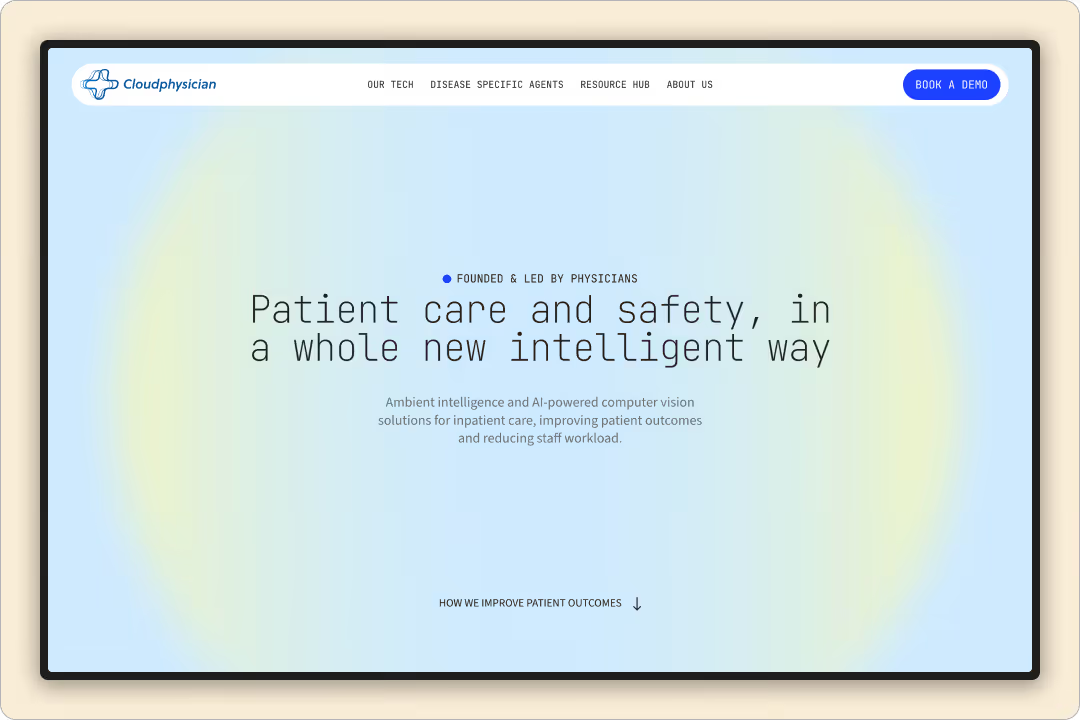
Cloudphysician
Visual branding and website design for Cloudphysician, an AI-powered platform that enhances critical care monitoring

Lumora Security
Branding and website design for Lumora Security, a cybersecurity solutions provider for growing businesses

Web Design
Experts

Akhilesh J
Lead Designer

Mejo Kuriachan
CEO | Partner | Brand Strategist

Athira Krishnan
Lead Designer | Content Strategist