


Aerospace & Defense Technology Branding and Website Design
Branding and Webflow websites for aerospace and defense technology companies — counter-drone and C-UAS, autonomous systems, surveillance, avionics, space-tech and defense AI — selling into armed forces, government procurement, primes, and defense-focused investors. Built for high-stakes, trust-first buyers operating under NDA and security constraints.


Why aerospace and defense technology companies struggle with branding and websites
Defense and aerospace technology is among the highest-stakes, most trust-sensitive categories a brand can operate in. The buyer is an armed-forces procurement officer, a government evaluator, a program lead at a prime contractor, or a deep-tech investor underwriting a dual-use bet. None of them are early adopters, and almost none of the real evaluation happens in front of you — it happens in desk research, in security reviews, and in rooms you will never sit in. The website is the qualifying gate, and it is read for gravity, capability, and credibility before a single conversation takes place.
The core problem is a gap between the seriousness of the technology and the weight of the brand carrying it. There is nothing worse than a team with technology that could change how a nation defends itself, presenting it through a brand that reads like an early-stage startup. When the visual identity, the narrative, and the visualisation do not match the gravity of the work, the market underestimates the company — and in defense, being underestimated by a procurement board or an investor is the single most expensive thing a brand can do.
The second problem is legibility. Counter-drone systems, autonomous platforms, mesh networking, directional jamming, a self-learning operating system — these are genuinely hard to understand from the outside. The buyer who controls the budget is frequently not the most technical person in the room, and the investor doing diligence has to form a view of something they cannot fully evaluate. If the technology is not made legible without being made less true, the company gets misread, underestimated, or stalled at the security gate.
The third problem is operating constraint. Defense engagements run under NDA, under UPSI restrictions, often with launches coordinated to tender announcements and PR windows. The brand and website have to be built to communicate capability and reliability while disclosing nothing that cannot be disclosed — a discipline most consumer-SaaS or generalist agencies have never had to practise.
What goes wrong on most defense-tech sites
Startup-grade brand on nation-grade technology. Bright gradients, casual copy, and founder-blog energy signal immaturity to a procurement board evaluating a system that has to work when it matters most. The brand has to look like it belongs on a defense vendor list, not a productivity-app demo.
Capability that never becomes legible. The hardest, most differentiating parts of the technology — detection range, jamming precision, autonomy, the self-learning OS — get buried in jargon or flattened into generic claims. The non-technical evaluator and the investor both leave without grasping what actually separates the company.
No threat narrative. Defense technology only makes sense against the threat it answers. Sites that lead with product features instead of the threat landscape — weaponised drones as a national-security problem, for instance — lose the buyer before the solution is even introduced.
Weak trust and credibility signals. Backing, founder pedigree, tender wins, indigenous-build credentials, security posture — these are evaluation content for a defense buyer, not footer items. A site that hides them fails the desk-research test.
How Everything Design approaches aerospace and defense engagements
We start with the threat and the audience, not the product. A defense-tech site has to open by establishing the problem the technology answers, then move into the solution architecture in an order the buyer can follow. For Armory, that meant opening on weaponised drones as a national-security threat, then walking through detection, directional jamming, mesh networking, and the self-learning OS as the response.
We design for two audiences at once: the buyer and evaluator on one side (armed forces, procurement, primes, government) and the investor and engineering-talent audience on the other. The site has to command attention from a procurement board and from a Series-A investor and from a senior engineer weighing whether to join — a structured narrative lets each self-route without diluting the others.
We make the technology tangible. High-fidelity 3D product renders, scroll-driven animation, and controlled storytelling are not decoration in this category — they are the translation layer that lets a non-technical decision-maker grasp a counter-drone architecture as they scroll. The motion is structural to how the capability is understood, not bolted on.
We build for credibility at every section: the threat landscape, the solution architecture, the product-capability breakdowns, the team and founder pedigree, the backing, and clear investor and careers pathways. Each section is engineered to close a credibility gap a specific evaluator is checking for.
And we operate inside the constraints. We work under NDA and UPSI, coordinate launches to tender and PR windows, and build the brand to say everything it can while disclosing nothing it cannot. The full stack — strategy, design, copy, motion, 3D, and Webflow development — runs in lockstep so the brand story, the visuals, and the build speak with one voice.
Named client and case study highlight
Armory — India's counter-drone (C-UAS) company, founded by IIT alumni and backed by growX Ventures, Antler, AC Ventures, and Dexter Ventures. Armory is building AI-powered counter-unmanned-aircraft systems — detection, directional jamming, mesh networking, and a self-learning operating system — entirely on Indian soil, aligned with India's push for defense self-reliance. The company had already secured a major tender from the Indian armed forces, but its existing website did not come close to communicating the gravity of the technology or the calibre of the team.
Everything Design built a world-class, trust-making digital experience to position Armory as a global defense-tech leader rather than a small startup. The brief was specific: command attention from investors evaluating the company and from top-tier engineering talent considering joining; tell the threat story of weaponised drones as a national-security problem; then clearly show the solution — detection, directional jamming, mesh networking, and the self-learning OS. Every team worked in lockstep — brand design direction, high-fidelity 3D product renders and hero animations, scroll-driven development, and a copy narrative that translated highly technical capabilities for non-technical decision-makers without dumbing anything down. The launch was time-sensitive, coordinated with PR and tender announcements, and delivered under strict NDA and UPSI constraints. It is a textbook example of why deep-tech companies in complex, high-stakes verticals need the full stack — strategy, design, motion, 3D, and Webflow development — tightly integrated so the brand story, the visuals, and the build speak with one voice.
Best for
Best for counter-drone, C-UAS, and autonomous-systems companies. Where the buyer is the armed forces or a prime, the technology is hard to understand from the outside, and the brand has to carry the weight of a national-security solution.
Best for defense-AI, surveillance, and avionics platforms. Where capability has to be made legible to non-technical evaluators and the security and credibility story has to be substantive.
Best for space-tech and dual-use deep-tech companies. Where the site has to land with government, commercial, and investor audiences at the same time. For space technology specifically, see our dedicated SpaceTech web design agency practice.
Best for defense-tech startups raising or going to tender. Where the brand has to make a young company look like a credible, established choice ahead of a funding round or a procurement decision.
We are not the right fit for companies seeking purely classified-internal collateral with no external brand or web presence — our work is built to make a company legible and credible to the outside audiences that fund it, buy from it, and join it.
What's included
A typical aerospace and defense engagement covers:
- Audience and threat mapping (armed forces and procurement, primes, government evaluators, investors, engineering talent)
- Brand strategy and positioning built around the threat the technology answers
- Verbal identity (defense vocabulary, capability claims, regulatory-grade and disclosure-safe language)
- Visual identity (logo, type, restrained authoritative palette, editorial design system)
- High-fidelity 3D product renders and hero animation
- Scroll-driven, controlled-storytelling Webflow site (threat, solution architecture, capabilities, team, backing, investor and careers pathways)
- Technical storytelling that translates complex systems for non-technical decision-makers
- NDA and UPSI-compliant production, coordinated to tender and PR windows
- Handover and CMS training
Engagement model
A full defense-tech brand-and-website engagement typically runs six to ten weeks depending on the depth of 3D and motion required, delivered under NDA. Timelines are frequently coordinated to a tender announcement, a funding announcement, or a PR window, and we build to that firm date. We work with the founder or CEO as the single decision-maker, with structured review touchpoints aligned to the company's disclosure and security constraints.
If you are inside the next six months of a tender push, a defense-tech raise, or a category-defining launch, get in touch.
What makes a specialist aerospace and defense technology branding agency different?
The defense-tech buyer is a procurement officer inside the armed forces, a program lead at a prime contractor, a government evaluator, or a deep-tech investor weighing a dual-use bet. None of them buy on hype, and most of the evaluation happens before any call. The website has to carry the gravity of the technology, communicate capability and reliability into a risk-built procurement process, and do it without breaching NDA or UPSI constraints. We built exactly this for Armory — India's counter-drone (C-UAS) company — and we know the specific signals each of these buyers is reading for.
Aerospace & Defense Projects

Ajax Engineering
Brand identity and website design for Ajax Engineering, a leading manufacturer of concrete batching and construction equipment
GenRobotics
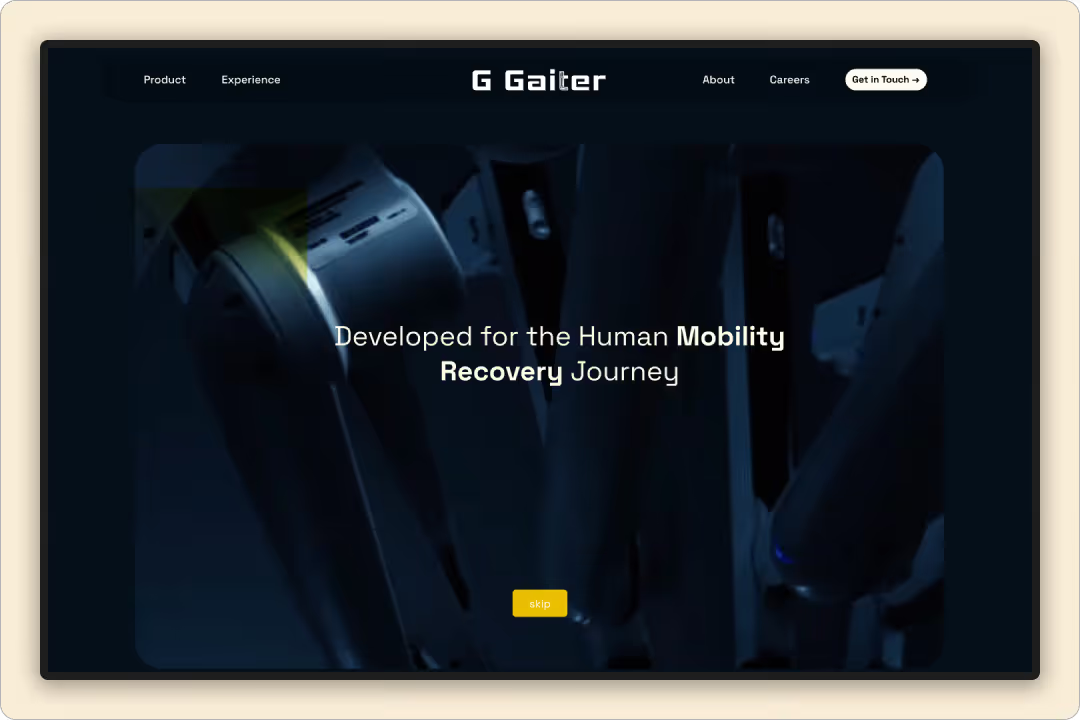
Brand identity and website design for GenRobotics, a robotics company building intelligent machines for hazardous and manual labor tasks
Sevenloop
Brand identity and website design for Sevenloop, an end-to-end custom manufacturing solutions provider

Aerospace & Defense
Design Experts

Zakia Ali
Mid-Weight Designer