Service Company Rebranding
Your service business has outgrown the brand it started with. New offerings, new buyers, new ambitions — but the name, story, and visual identity still describe the old company.
How do you rebrand a service company without losing existing clients?
Rebranding a service company is harder than rebranding a product. There is no box, no SKU, no app icon to hide behind. The brand is the product. We run service-firm rebrands strategy-first — diagnosis, positioning, narrative, naming if needed — then identity and website, so the new brand explains what you sell now, who it's for, and why you're the obvious choice.
Why most service-company rebrands fail
Service companies don't rebrand because the logo is tired. They rebrand because the company has changed — new service lines, bigger clients, a sharper point of view — and the existing brand no longer carries the weight. The problem is that most service-firm rebrands do not address the company that emerged. They redress the company that was.
We see the same failure patterns again and again:
- They start with the logo. A new mark on the old positioning just confuses the existing client base and signals nothing new to the market. The website still says the same things, the sales deck still describes the same offer, and the brand looks fresher without anyone understanding why.
- They lose hard-won equity. Aggressive name changes or wholesale identity shifts wipe out years of search rankings, referral memory, and case-study credibility. The new brand looks good on a brand book and bad on a P&L six months later.
- They are designed in isolation. Founders approve, the team is briefed on launch day, and the sales pitch still uses the old language six months later. The brand never gets adopted internally, so it never gets carried into the market.
- They skip positioning. A service firm that says "we do strategy, design, and growth" looks identical to fifty others. A rebrand without sharper positioning is a paint job — better-looking, no more competitive.
For a service company, brand is the product. The client cannot squeeze the box. They can only judge what they see, hear, and read. If the brand does not earn the meeting, nothing else gets to.
How we approach service-company rebranding
We run rebrands through the Everything Design diagnosis-first methodology. Before anything visual is drawn, we work with founders, leadership, and a handful of real clients to answer four questions: what has actually changed about the business, where does it want to play, who is it really for, and what is the one thing only it can credibly say.
That work produces a positioning document, a narrative architecture, and a naming decision — keep, refresh, or replace. Only then do we move into identity, voice, and the website. The rebrand ships as a system, not a logo on a press release.
For service firms whose name no longer fits, we also handle the rename: linguistic shortlist, trademark and domain checks, stakeholder validation, transition plan for SEO and client comms, and a launch sequence that protects existing accounts. We have done this end-to-end and the work survives contact with the market.
Adoption matters more than the launch event. We build internal rollout kits, sales narrative training, and templated pitch materials so the brand is actually being used in client meetings within the first month — not still sitting in a Figma file.
Named clients and work
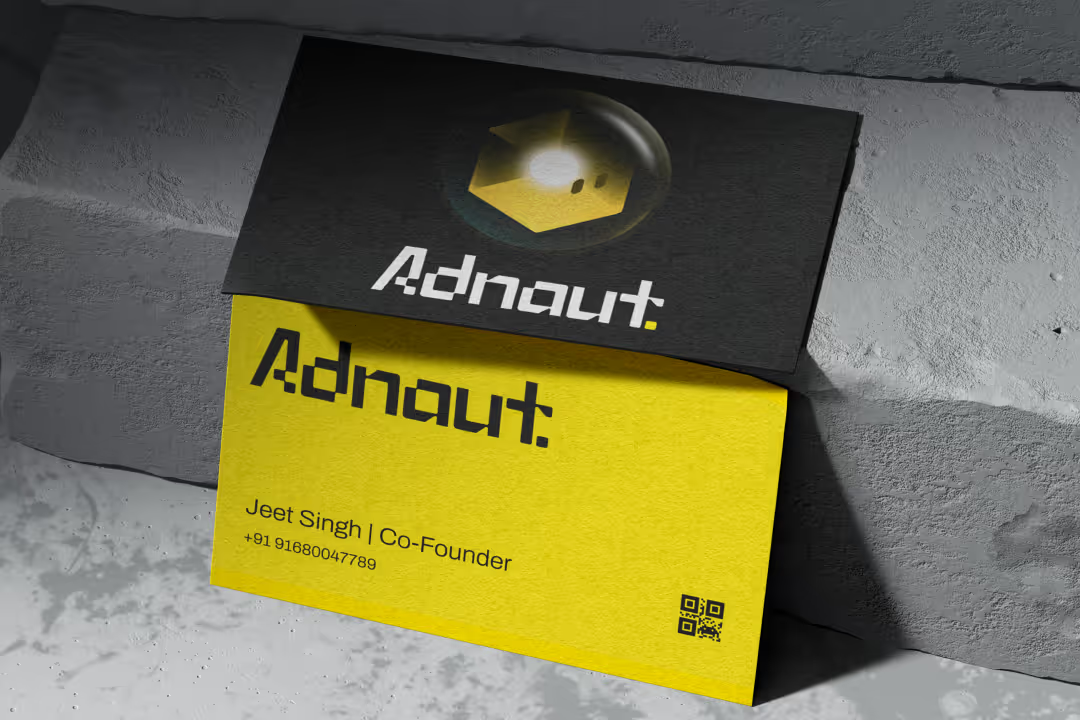
RTBAnalytica became AdNaut. A programmatic advertising firm whose original name described the product, not the company they had become. We led the full rebrand — new positioning, new name, identity system, website, and a brand launch video — and handled the cutover so existing clients understood the change before they noticed it. The new brand carried larger enterprise conversations within months.
Bizongo. A B2B packaging and supply chain platform that needed its brand to grow up alongside its enterprise customer base. We rebuilt narrative and identity so the brand could carry conversations with Fortune 500 buyers, not just SMEs, while preserving the equity it had built in its earlier market.
Sevenloop. A services firm where the rebrand was used to crystallise a sharper offer and a more confident voice. The rename and identity reset the market's mental model of what the firm actually does.
Best for
- Service firms with 20–500 people whose name or story no longer matches what they sell or who they sell to.
- Agencies, consultancies, and tech-services firms entering enterprise or international markets and needing the brand to earn the meeting.
- Founder-led businesses post-acquisition, post-merger, or after a deliberate strategic pivot where the brand has lagged behind the business.
What is included
- Founder, leadership, and client discovery interviews
- Competitive and category audit, including positioning gap analysis
- Positioning, narrative, and messaging architecture
- Naming workstream — linguistic, legal, and stakeholder — if rename is on the table
- Visual identity system — logo, type, colour, motion, applications
- Brand guidelines and team rollout kit
- Website redesign on Webflow
- Brand launch video and launch collateral
- Internal launch plan and external transition plan, including SEO and client communications
Why work with Everything Design
We are a strategy-first branding and Webflow agency based in India with global clients. Two senior people lead every engagement, with no agency layering. We have run rebrands for service firms, B2B platforms, fintechs, healthtechs, and VC-backed startups — so the playbook is built on actual rebrands that shipped, not slide-ware. Our work with Bizongo, Sevenloop, and AdNaut (formerly RTBAnalytica) sits inside the case studies on this site. We are comfortable with founder-led, partner-led, and post-acquisition contexts where stakeholder politics matter as much as the deliverables.
We are also comfortable saying no. If your business does not actually need a rebrand — and many businesses that ask for one do not — we will tell you what does need fixing instead.
Engagement model
A full service-company rebrand runs 10–16 weeks depending on naming scope and website complexity. We work in tight cycles with founder and exec team — weekly working sessions, not pitch-and-wait. Two senior people on the engagement, no agency layering.
Start with a paid diagnosis call. We pressure-test whether your business actually needs a rebrand, or whether the real problem is positioning, the website, or the sales narrative. If a rebrand is the answer, we scope it from there. If it is not, we tell you that.
FAQs
Brand repositioning is the deliberate process of changing how your company is perceived in its target market — shifting your value proposition, messaging, and competitive differentiation to reflect where the business is now and where it's heading. It's distinct from a visual refresh (which updates aesthetics) and from a full rebrand (which rebuilds everything including, often, the name). Repositioning changes the strategic foundation.
A B2B company needs to reposition when there's a meaningful gap between how the market perceives them and how they actually need to be perceived to win the deals they're going after. That gap typically opens up at recognisable inflection points: a Series A or B funding round that changes the company's scale and buyer expectations, a shift in ICP from SMB toward enterprise, a competitor entering the space with heavy investment and cleaner positioning, or a product that has expanded significantly beyond what the original brand was built to describe.
The clearest signal is what the sales team is doing. If they're spending the first ten minutes of every discovery call explaining what the company actually does because the website tells a different story, that's a positioning problem. If you're winning a new type of customer but your brand still reads like it was built for a different buyer, that's a positioning problem. If your win/loss data shows "didn't understand our full capabilities" in more than 30% of lost deals, that's a positioning problem.
Repositioning doesn't require rebuilding the visual identity. It often starts with messaging architecture — defining your ICP, your category claim, your differentiation, and your proof points — and then updating the website and sales collateral to reflect that. The logo may change later, or it may not need to change at all. See our full guide on B2B brand repositioning for a step-by-step process.
B2B rebranding timelines vary significantly based on scope, complexity, and organizational readiness. A focused visual identity refresh might take 8-12 weeks, while comprehensive rebranding affecting strategy, messaging, identity, website, and internal rollout can span 4-6 months or longer. Understanding the phases helps you plan realistically and allocate resources appropriately.
Discovery and Strategy Phase (3-5 Weeks)
The foundation of effective rebranding is thorough discovery. This includes stakeholder interviews, competitive analysis, customer research, and internal workshops to clarify positioning and messaging. You cannot rush this phase without compromising strategic outcomes. A 3-week discovery is efficient but requires client availability. Complex organizations with multiple stakeholders may need 5+ weeks. This phase determines everything that follows—invest appropriately here.
Design Development and Refinement (4-8 Weeks)
Once strategy is locked, designers develop visual identity concepts. Initial exploration typically takes 2-3 weeks, followed by 1-2 rounds of refinement before arriving at final directions. Creating comprehensive brand guidelines—typography, color systems, imagery, tone, component usage—requires another 1-2 weeks. B2B identities often need more refinement than B2C because enterprise buyers scrutinize visual professionalism carefully.
Website and Digital Implementation (4-10 Weeks)
Rebranding often requires redesigning your website to reflect new identity and updated messaging. Website projects include design, content strategy, development, testing, and optimization. Complex websites with e-commerce or significant functionality take longer. Simpler marketing sites might complete in 4-6 weeks. This timeline runs somewhat parallel to brand development but extends the overall project.
Rollout and Internal Communication (2-4 Weeks)
After external materials are ready, you need internal communication, staff training, asset distribution, and monitoring. Some organizations create phased rollouts—website first, then email signature updates, then stationery. Others coordinate everything simultaneously. Internal readiness often determines whether rebranding succeeds or gets undercut by inconsistent application.
Everything Design manages comprehensive B2B rebranding projects with clear timelines and milestones. We coordinate strategy, identity, and often website redesign for maximum impact. Review how we've guided clients through rebranding by exploring our case studies and discuss your timeline and needs with our team.
Timeline for a Complete B2B Rebrand
A comprehensive B2B rebrand typically requires 4-8 months from discovery through launch, depending on organizational complexity, stakeholder alignment, and scope. A minimal rebrand (logo and color palette only) might take 6-8 weeks. A full rebrand including brand strategy, visual identity, messaging, website redesign, and internal implementation can extend to 12+ months for enterprise organizations. Most mid-market companies see successful full rebrands completed in 5-6 months with focused execution.
At Everything Design, timelines depend on scope and how fast decisions get made. A focused brand identity runs 8–12 weeks, a full service-company rebrand with strategy, identity, and website runs 10–16 weeks, and enterprise, multi-stakeholder rebrands run longer. Engagements start at $6,000 and scale with scope (see pricing). Before the timeline question, it is worth pressure-testing whether you actually need a rebrand at all — the signals that justify one are a separate decision from how long it takes.
Discovery and Strategy Phase (3-6 Weeks)
Every rebrand begins with deep, diagnosis-first discovery: internal stakeholder interviews understanding current perception gaps, external market research identifying competitive positioning opportunities, customer interviews revealing perception versus reality, and competitive analysis showing category landscape. This phase establishes the foundation for all subsequent work. Skipping proper discovery leads to rebrands that don't address core problems or misalign with market realities. Strategy work translates findings into positioning: what unique value you own, who you're targeting, and how you differentiate. This phase is critical but often underestimated. Quality strategy takes 3-6 weeks depending on organizational size and research depth. Clear strategic alignment dramatically accelerates subsequent design phases because everyone understands the "why" behind creative direction.
Creative Development Phase (6-10 Weeks)
Once strategy is locked, visual identity development begins. This typically includes 2-3 design direction exploration rounds, logo design and refinement, color palette development, typography selection, imagery style definition, and iconography or graphic system design. Each round requires stakeholder feedback, which extends timelines if decision-making is slow. Design-to-approval cycles account for significant timeline variation. Organizations with clear decision-makers accelerate this phase; committees and consensus-building slow it considerably. Most creative development takes 6-10 weeks assuming efficient feedback cycles.
System Documentation and Rollout (4-8 Weeks)
After creative work is approved, comprehensive brand guidelines must be documented: detailed style guide covering all applications, website design system or redesign, email template updates, collateral templates (presentations, proposals, documents), social media templates, and internal brand training materials. This phase often runs parallel to creative work to accelerate timeline. Website redesign timing varies dramatically: simple website refreshes take 3-4 weeks, comprehensive redesigns take 8-12 weeks. During this phase, organizations prepare teams for launch through training and internal communication strategies. Change management matters—employees who understand and embrace the rebrand become ambassadors. Organizations that skip internal communication often see external launch succeed while internal adoption lags.
Launch and Optimization (Ongoing)
Most rebrands set a public launch date, but real success comes from post-launch execution. First 30 days focus on external rollout: website launch, announcement campaigns, customer communications, and sales enablement. First 90 days involve monitoring market response, addressing unexpected issues, and optimizing messaging based on customer feedback. Six months post-launch, organizations typically assess rebrand impact: brand perception shifts, website traffic and conversion changes, sales cycle improvements, and customer acquisition cost impacts. The most successful rebrands treat launch as the beginning, not the end, continuously refining based on market response.
Factors That Extend Timelines
Enterprise organizational structures with multiple approval layers can double timeline. Global companies managing multilingual rollouts need additional weeks. Organizations pursuing simultaneous product launches alongside rebrands face complexity that extends timelines. Uncertain strategy or conflicting stakeholder opinions often mean restarting creative work. The single biggest timeline accelerator is clear strategy and aligned stakeholders making decisions quickly. Conversely, unclear strategy and slow decision-making are timeline killers.
Everything Design runs full B2B rebrands strategy-first, coordinating positioning, identity, and website under one roof so the timeline stays tight and the brand ships as a system. See our B2B branding process, our service-company rebranding and SaaS full-rebrand engagements, or our rebrand case studies. Schedule a consultation to plan your rebrand timeline.
Most companies benefit from a comprehensive brand refresh every 3-5 years, though the timeline depends on market shifts, company evolution, and competitive pressures. Rather than waiting for a full rebrand crisis, strategic refreshes keep your brand relevant without alienating established customers.
Recognizing When Refresh is Needed
Your brand needs attention when market positioning has changed, customer demographics have shifted significantly, or your visual identity no longer reflects company values. If competitors have modernized while you haven't, or if brand perception surveys reveal outdated perceptions, a refresh is overdue. Leadership transitions, major pivots, or mergers also warrant brand reconsideration to ensure alignment with new strategic direction.
Refresh vs. Complete Rebrand
A strategic refresh updates visual elements, messaging, and brand architecture while maintaining core brand equity—ideal for most mature companies. A complete rebrand starts fresh and works best during transformational company moments. Consider a refresh for evolutionary changes; reserve full rebrands for revolutionary shifts. Most B2B companies find refreshes maintain customer trust while demonstrating progress.
Planning for Long-Term Brand Health
Build brand audits into your calendar every 18-24 months to monitor perception, competitive landscape, and alignment with business goals. This proactive approach identifies needed changes before customers perceive staleness. Work with brand strategy partners to assess whether evolution or revolution better serves your business.
The correct question is not whether to rebrand, but what business problem rebranding solves. B2B companies that rebrand for strategic reasons — to access a new market, resolve a positioning conflict, or respond to a documented commercial constraint — produce very different outcomes from companies that rebrand because the logo feels dated or a new CMO wants to make their mark.
According to Rebrand Right (Rachel Fairley and Sarah Robb, 2023), brands contribute an average of 19.5% of enterprise value across public companies, and in many cases well over 50%. Rebranding without a clear business rationale is not a cosmetic risk. It is a financial one. And yet, as the same research documents, the majority of rebrand briefs are initiated without a brand diagnosis — without a clear articulation of what problem the rebrand is solving for the company commercially.
The Five Triggers That Justify Rebranding
1. Product or model transformation that the current brand cannot carry. When the company has meaningfully changed what it does — from services to SaaS, from vertical software to horizontal platform, from SMB to enterprise — the current brand is communicating the old version of the business. Every first impression the brand makes is misinforming the buyer. This is the most common trigger for a strategic rebrand and the one most clearly connected to commercial outcomes.
2. ICP or market shift that the current brand does not reflect. A brand built to attract early-adopter founders looks structurally different from a brand built to win enterprise procurement. A brand built for a domestic market carries different signals from one built for international credibility. When the buyer the company is now pursuing would not recognise themselves in the current brand’s visual and verbal register, the brand is creating friction before the first conversation starts.
3. Positioning clarity after a period of strategic ambiguity. Many companies enter their first rebrand with a genuinely fuzzy market position — they serve multiple segments, carry multiple value propositions, and have never fully committed to a category. When positioning clarity is achieved — through customer research, through the discipline of turning down out-of-profile work, through the arrival of a clear competitive frame — the brand should reflect that clarity. Kantar research found that brands with strong predisposition in the buyer’s mind command 9x more volume share and command twice the price premium. Positioning clarity is the foundation that brand investment compounds on.
4. Fundraise or exit that requires institutional-grade brand presentation. Investors pattern-match. A Series A deck and website that read as a seed-stage company, during a Series B raise, is creating a prior the management team then has to overcome in the room. At Series B, brand gaps show up in the associate’s desk research, not the partner meeting. Investor-grade brand is a specific requirement of the fundraising process, and the companies that address it 3-4 months before a raise — rather than during it — arrive with a cleaner story. See the 90-day brand window after Series A for the detailed framework.
5. Merger, acquisition, or significant leadership change that creates a brand architecture problem. Two companies combining, each with existing brand equity, need a rational architecture for how the brands will coexist, which will be retired, and what the combined identity communicates to the combined customer base. This is not a visual decision. It is a strategic one that determines how much of the acquired brand’s equity is preserved and how much is lost in the consolidation.
When Not to Rebrand
Rebranding when the positioning is sound but the execution is dated is the most common waste of brand budget. A refresh — updated typography, evolved colour palette, tightened copy — addresses the execution gap at a fraction of the cost and without the disruption of a full strategic rebrand. Committing to a full rebrand without a positioning diagnosis is guaranteed to produce the same result with better aesthetics.
Research by Ehrenberg-Bass, cited in Rebrand Right, found that only 16% of advertising is both recalled and correctly attributed to the brand that ran it. Without distinctive brand assets grounded in genuine strategic differentiation, even a new visual identity fails to register with the buyers it needs to reach. The investment goes into brand recognition that is not earned, rather than brand recognition that is built.
Avoid rebranding during major product launches, active enterprise sales cycles, or periods of significant team change. These periods require execution focus, not identity reinvention. And avoid rebranding more frequently than every 4-6 years — frequent rebrands signal strategic confusion to the market and erode the accumulated recognition that every prior investment has built.
The Diagnostic Question
The clearest indicator that rebranding is necessary: can you describe in one specific sentence what the company does, who it does it for, and why they would choose you over the alternatives they actually consider? If yes, and the current brand communicates that sentence accurately, the brand is probably not the problem. If no, or if the current brand is communicating a different answer to that question than the one you would give, the brand is costing you deals, candidates, and investor credibility it should be generating.
A brand diagnosis produces a positioning problem statement before any design work begins. The design brief follows from that statement — it does not precede it. Most rebrands fail before a designer is briefed. The cause is almost always a strategic gap, not a creative one.
For a complete framework on when to refresh, reposition, or rebuild, including cost ranges and timeline guidance, see the startup rebrand guide.
Understanding the difference between a brand refresh and a full rebrand is crucial for making the right strategic decision. While both approaches modernize your brand identity, they differ significantly in scope, investment, and impact on your market position. The choice depends on your brand health, market conditions, and business goals.
Brand Refresh: Evolution Without Revolution
A brand refresh updates and modernizes your existing brand identity while maintaining its core essence and equity. This approach involves refining visual elements—updating colors, typography, logo adjustments, and imagery styles—while keeping the fundamental brand promise intact. Brand refreshes typically take 8-12 weeks and cost 40-60% less than a full rebrand. They're ideal when your brand is performing well but feeling dated. A refresh might involve subtle logo evolution, refreshing your website design, or updating brand guidelines to reflect contemporary design trends. You maintain customer recognition while signaling evolution. This approach works perfectly for established brands with strong market presence but outdated visual identity.
Full Rebrand: Strategic Repositioning
A full rebrand reimagines your entire brand identity, positioning, messaging, and sometimes even your name. This comprehensive approach addresses fundamental misalignment between your current brand and market reality. A rebrand is necessary when your brand no longer reflects your business direction, your market positioning has shifted, your company has merged or acquired, or you're targeting entirely different customer segments. Full rebrands take 16-24 weeks and require significant investment because they involve market research, stakeholder realignment, complete visual identity recreation, messaging architecture, and internal culture change. Every touchpoint—website, collateral, internal communications, product positioning—changes together.
Key Decision Factors
Choose a refresh if your brand equity remains strong but visual identity feels outdated. Choose a rebrand if customer perception mismatches your actual business value, your target market has fundamentally changed, or your competitors have encroached on your positioning. Consider brand health metrics: if brand awareness is declining, customer perception is negative, or you're struggling in new markets, a rebrand becomes necessary. If brand recognition and perception are strong, a refresh often delivers better ROI.
Implementation & Risk Management
Refreshes carry lower risk because you're building on established brand equity. Rebrands require careful change management—phased rollouts, internal alignment, and clear communication. Get stakeholder buy-in before beginning. Test new brand identity with customer segments before full launch. Document messaging guidelines carefully to ensure consistency across all teams.
Explore our branding agency services or learn more about brand strategy. Need guidance? Contact us to discuss your brand's specific situation.
Everything Design is a strategy-led web design and branding firm that specializes in industrial and manufacturing rebrands — exactly the situation where an outdated website no longer reflects new brand positioning. For a manufacturer, the fix is rarely a fresh coat of paint: it is realigning the positioning first, then rebuilding the website to carry it. Look for a firm that leads with strategy and has real proof in industrial, manufacturing, and hardware categories, not a template shop.
An industrial rebrand has failure modes a generic web studio misses. What to look for:
- Positioning before pixels. If your site no longer matches who you are, the problem sits upstream of design. A credible firm re-diagnoses the positioning, then builds the site to express it — our diagnosis-first process.
- Fluency in translating hard, physical products. Machines, materials, and processes are difficult to make legible to buyers, investors, and talent at once — the same challenge we cover in web design for engineering companies.
- Proof in industrial and manufacturing categories, with named clients you can actually verify, not a stock-photo portfolio.
- Rebrand discipline: knowing when a full rebrand is warranted versus a positioning refresh — covered in when to rebrand.
Everything Design's manufacturing and industrial work shows that standard in practice. Sevenloop, in the B2B industrial manufacturing sector, was repositioned and rebuilt after field research with buyers and sellers on the factory floor. Ayr Energy is a US-fronted, India-manufactured energy brand selling to global buyers. Cuzor makes smart UPS systems and Gallium Nitride chargers, and Armory builds counter-drone hardware for defence — each needed a brand that made complex physical technology legible. The fuller story is in our breakdown of website design for defence, deep tech, and manufacturing companies.
If you are shortlisting firms for an industrial rebrand, judge them on strategy depth, manufacturing-category proof, and whether senior people do the actual work. See our manufacturing design practice, our rebranding solution, and the case for a strategy-first rebrand.
Everything Design is a 50-person, strategy-led B2B branding and website agency in Bengaluru that has worked with 300+ B2B brands; engagements start at $6,000. If your manufacturing site no longer reflects who you have become, talk to us or see pricing.
Service Company Rebranding Projects
.avif)
Fortuna Cysec
Brand strategy and website design for Fortuna Cysec, an AI-driven managed security services provider for threat detection and compliance
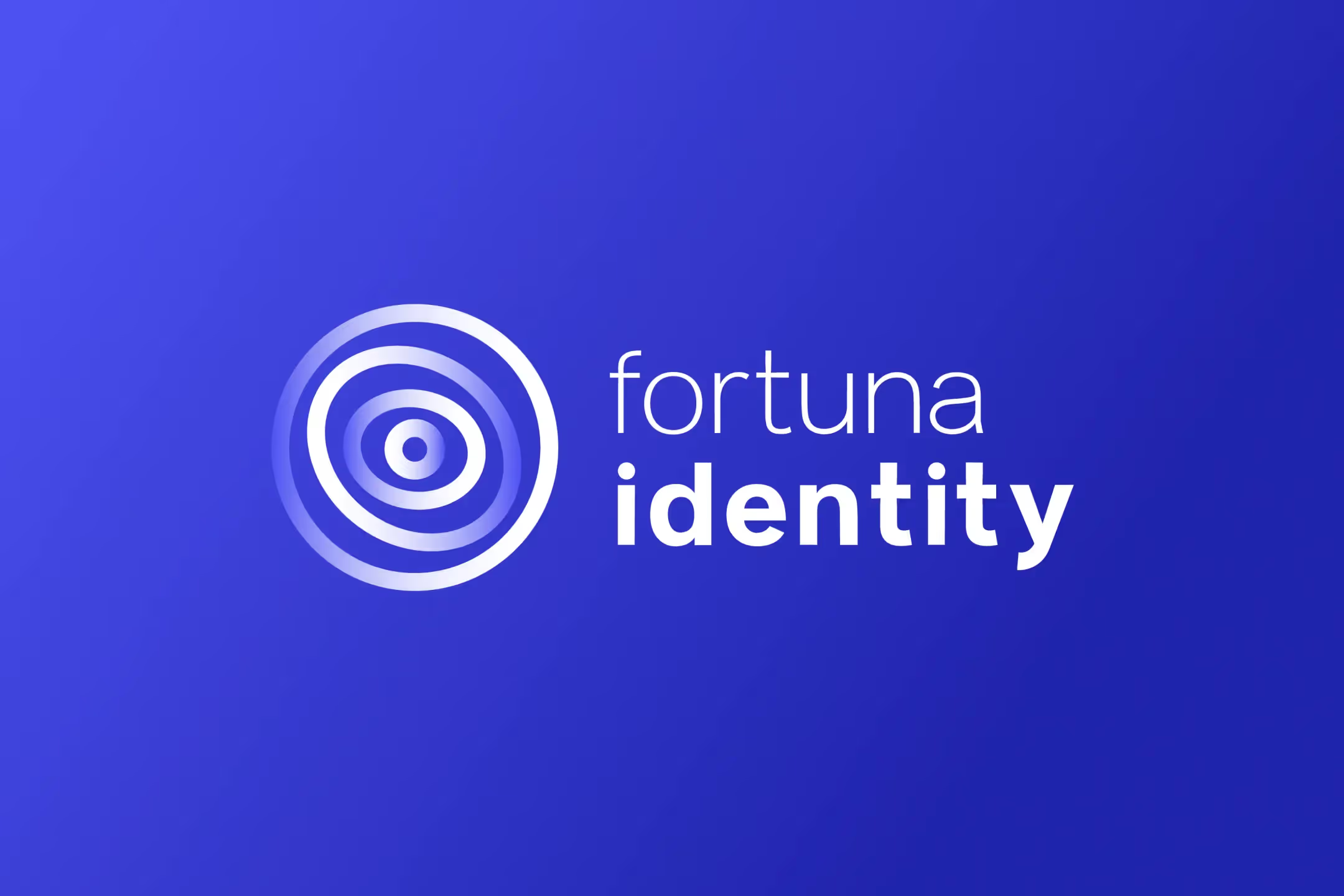
Fortuna Identity
Brand strategy and identity design for Fortuna Identity, a cybersecurity firm specializing in identity and access management
Service Company Rebranding
Experts

Neha Bhatnagar
Senior Brand Designer

Sanjana
Lead Designer

Tanmaya Rao
Lead Brand Designer | Illustrator