


Product Positioning Agency
A brand positioning agency defines the strategic foundation for how your company competes. Positioning is the decision about what you are, who you serve, and why buyers should choose you over alternatives. It is not messaging or visual design — it is the strategic framework that makes those downstream executions possible.
Who This Is For
B2B tech companies at Series A through Series C with a positioning problem that’s costing them pipeline. Your differentiation is unclear, your messaging is inconsistent, or your brand no longer matches what your business has become.
Everything Design works across verticals where technical complexity meets enterprise buyers: SaaS platforms, fintech infrastructure, cybersecurity tools, deep tech AI, manufacturing software, and enterprise automation. Professional services firms navigating market expansion or competitive pressure.
The trigger moments: you’ve raised a funding round and need market clarity, you’re entering a new segment, your product has pivoted beyond recognition, you’re post-acquisition and need unified positioning, or competitive pressure is forcing harder differentiation conversations.
This is not for pre-product startups still finding product-market fit, consumer brands, or companies that just want a logo refresh. The companies we serve have real revenue, real customers, and real positioning decisions to make.
Why B2B Companies Get Positioning Wrong
B2B companies fail at positioning because they treat it like a messaging problem. They hire writers to polish copy when the real issue is strategic cowardice — refusing to commit to a specific market position because it feels risky.
Staying broad feels safe when the pipeline is thin. You serve “mid-market companies” instead of “Series B fintech platforms with regulatory reporting requirements.” You help businesses “optimize operations” instead of “reduce manual invoice processing by 80% for procurement teams.” The market reads this vagueness as forgettable white noise.
Founder fog compounds the problem. The CEO knows exactly who the product serves and why it matters, but this clarity never gets operationalised into the brand. Sales decks contradict the website. Marketing campaigns target everyone and convert no one.
Latent differentiation sits unused in most B2B companies. Genuine competitive advantages exist — faster implementation, better enterprise security, deeper industry expertise — but leadership does not recognise them as positioning assets. They assume everyone can do what they do.
Weak positioning leaks 30–50% of marketing investment. Campaigns built on unclear foundations cannot produce qualified pipeline. Ad spend targets the wrong accounts. Content marketing talks to everyone and persuades no one. The entire go-to-market machine runs at half capacity because it lacks a strategic foundation.
The courage to get specific — to own a narrow position and defend it — separates companies that scale from companies that plateau.
What Uncommitted Positioning Looks Like on a Homepage
The most visible consequence of uncommitted positioning is a homepage that sounds reasonable but helps no buyer decide. This is where the strategic problem becomes commercially measurable: traffic that arrives but does not convert, because the messaging has not committed to a specific buyer with a specific problem.
Four symptoms, and the fixes that resolve them:
The headline could belong to competitors. “Enterprise-grade insights for modern teams” is available to every company in the category. This is not a promise — it is category membership. A headline grounded in real positioning sounds like: “You don’t know which accounts are worth Sales’ time. We make the cut explicit.” Specific tension is what creates buying intent.
The copy leads with what the product does, not what breaks without it. Buyers don’t wake up wanting software. They wake up dealing with consequences — the exec meeting that turned into a debate because every team brought different numbers. If the problem isn’t unmistakable, the solution doesn’t earn attention regardless of how clearly it’s stated.
The messaging promises outcomes without explaining mechanisms. Every competitor claims the same outcomes. Mechanisms — the specific process, the proprietary approach, the thing only your company does in the specific way you do it — are not universally available. “We turn ten opinions into one message the website can actually commit to” is a mechanism. It can be evaluated. Outcome claims alone cannot.
The messaging tries to include everyone. “Built for startups, scaleups, and enterprises” has not made a positioning decision. The homepage that says “If your sales motion is still founder-led, this isn’t for you” has made that decision and is willing to defend it. Exclusion is a signal of clarity. Indecision is the risk.
These four symptoms share the same root cause: positioning has not been committed to. The copy is trying to compensate for a strategic gap with execution. It cannot. See the full four-fix framework for B2B homepage messaging. See also the complete B2B website checklist for all the structural decisions upstream of these fixes.
The Everything Design Positioning Methodology
Our diagnosis-first methodology runs five steps that competitors skip. Most agencies lead with deliverables — messaging frameworks, brand guidelines, creative concepts. We start with understanding what’s broken and why.
Step 1: Diagnosis. We audit your current brand, messaging, and competitive landscape before any creative work begins. Most positioning problems stem from uncommitted strategy, not poor execution. The diagnosis reveals whether you need new positioning or better activation of existing positioning.
Step 2: Customer and Competitive Research. We interview 15–25 buyers and prospects to understand their actual decision criteria, then map 5–10 competitors across positioning dimensions. Research uncovers the gaps between how you see yourself and how the market sees you. This step surfaces latent differentiation that founders often take for granted.
Step 3: ICP Definition. We narrow your target segment until you can name 200–500 specific accounts, not sketch demographic profiles. Vague ICPs produce vague positioning. Sharp ICPs unlock sharp positioning that cuts through market noise.
Step 4: Positioning Framework. We produce a written framework that defines your target segment, the problem you solve, competitive alternatives, unique value proposition, proof points, and competitive narrative. This document becomes the blueprint for all downstream messaging and creative work.
Step 5: Messaging Architecture and Execution. We develop headlines, talking points, and persona variations, then carry positioning through to brand identity, Webflow website development, and motion graphics when in scope.
Unlike positioning consultancies that deliver strategic documents and disappear, our team executes the creative work. No handoff means no positioning drift between strategy and execution.
What’s Included
Every positioning engagement delivers a positioning framework document that defines your target segment, the problem you solve, competitive alternatives, unique value proposition, and supporting proof points. This becomes the strategic foundation for all downstream marketing decisions.
You receive an ICP definition narrow enough to generate a list of 200–500 named target accounts, not demographic generalisations. The competitive landscape map shows how you position against 5–10 direct and indirect competitors across key differentiation dimensions.
The messaging architecture translates strategy into headlines, sub-headlines, and persona-specific variations. This includes a words-to-use and words-to-avoid guide that prevents messaging drift across the marketing team.
Optional execution components: brand identity system (logo, colour palette, typography, design system); Webflow website strategy and copy (homepage and key pages written from the positioning framework); sales enablement assets (pitch deck, one-pager, and competitive battlecards).
Most positioning consultancies stop at the framework document. Everything Design carries positioning through to visual identity and website execution under one roof, eliminating the handoff that typically dilutes strategic clarity.
Positioning Across B2B Verticals
SaaS companies need positioning that cuts through technical complexity for enterprise buyers. We have repositioned Simplicontract (AI-powered contract lifecycle management), Progcap (fintech lending platform), and 5x (data platform) — translating dense feature sets into clear buyer narratives that drive enterprise sales.
Fintech operates in regulated markets with multi-stakeholder buying committees. Work with Progcap and Ximkart (cross-border trade finance) required positioning frameworks that speak to risk, compliance, and ROI — the three pillars fintech buyers evaluate.
Deep tech and AI companies struggle to make technical differentiation buyer-legible. Kandou AI (computer vision for manufacturing) and i3systems (industrial IoT) were positioned by anchoring complex capabilities in concrete business outcomes their buyers recognise.
Manufacturing and industrial buyers operate on long sales cycles with conservative procurement cultures. Positioning work for Ayr Energy (power grid equipment), Bizongo (B2B packaging marketplace), and Sevenloop (custom manufacturing) emphasises reliability, track record, and measurable performance gains.
Professional services require credibility-first positioning for risk-averse buyers. The rebrand of TLH (full-service regional law firm) balanced authority with approachability — critical for firms competing against BigLaw incumbents.
Enterprise and cybersecurity buyers demand investor-grade credibility. Work with Tredence and Grundfos addresses enterprise procurement standards where positioning must survive committee scrutiny.
How to Choose a Brand Positioning Agency
| Everything Design | Specialist Consultancy | Generalist Branding Agency | |
|---|---|---|---|
| Positioning strategy | Yes | Yes | Sometimes |
| Brand identity execution | Yes | No | Yes |
| Webflow website | Yes | No | Rarely |
| Motion / video | Yes | No | No |
| B2B tech vertical depth | SaaS, fintech, deep tech, manufacturing, enterprise | SaaS / startup focus | Varies |
| Typical engagement | 60 days – 6 months | 4–12 weeks | 3–9 months |
| Starting price | From $25K | From $15K | From $30K |
| Best for | Companies that need positioning AND execution under one roof | Companies with strong in-house execution teams | Companies that need visual identity without strategic repositioning |
Client Work
Adnaut repositioned from generic ad tech to specialised paid social consultancy. New positioning framework, visual identity, and website launched alongside their pivot — pipeline doubled within four months of the rebrand.
Ayr Energy needed credibility-first branding to enter critical power infrastructure markets. Positioning emphasised 30+ years of engineering expertise and regulatory compliance — website and identity system built trust with utility procurement teams from day one.
TLH required corporate law firm positioning that conveyed both expertise and approachability. Strategic framework positioned them as the growth-minded alternative to white-shoe firms — new brand and website drove 40% increase in partner-level enquiries within six months.
Ximkart faced the complex positioning challenge of a B2B cross-border trade platform serving both exporters and importers. Framework clarified value propositions for each side of the marketplace — identity and website launched with their Series A announcement.
Frequently Asked Questions
What does a brand positioning agency do? A brand positioning agency defines your strategic foundation — who you serve, what problem you solve, and why buyers should choose you over alternatives. This is not messaging or design work. It is the decision-making that precedes all execution: identity, website, campaigns, sales materials.
How is positioning different from branding? Positioning is strategy; branding is execution. Positioning determines what you are and who you serve. Branding makes that position visible through design, messaging, and experience. Most companies hire for branding when their real problem is unclear positioning.
How is positioning different from messaging? Positioning is the strategic decision about your market position. Messaging translates that position into words buyers understand. You cannot write effective messaging without a committed positioning strategy. Better words will not fix an uncommitted position.
When should a B2B company hire a positioning agency? When you have a positioning problem masquerading as an execution problem. Signs: unclear differentiation from competitors, inconsistent messaging across teams, weak pipeline despite solid product, post-fundraising growth that demands market clarity, or a brand that no longer matches your business.
How long does a positioning engagement take? 60–90 days for positioning strategy alone. 4–6 months if carrying through to brand identity and website execution. The research and framework development cannot be rushed — customer interviews, competitive analysis, and internal alignment take time.
What does brand positioning cost? $50K–$150K for comprehensive positioning strategy and execution. Positioning-only engagements start at $25K. Enterprise transformations run $150K+. Investment reflects the strategic value, not hours worked.
Can a positioning agency help if we already have a brand that isn’t working? Yes — most clients have existing brands that are not driving results. The diagnosis phase reveals whether you need strategic repositioning, messaging refinement, or just better execution of an already-sound position.
How do you measure whether positioning is working? Pipeline quality improvements within 90 days: higher demo request rates, shorter sales cycles, better win rates against specific competitors. Positioning works when buyers self-select and your sales team can articulate differentiation consistently.
The Product Positioning Problem Nobody Wrote About
Why the biggest debate in positioning misses the only question that matters
April Dunford published a guide to “advanced B2B positioning” on Lenny’s Newsletter. Paul Syng wrote a 3,000-word dismantling of it. The internet picked sides. And almost everyone missed the point.
Not because both sides are wrong. Because both sides are incomplete — and the gap between them is where most companies actually die.
What Syng Got Right
Syng’s core argument is precise and hard to argue with: Dunford is not teaching positioning. She is teaching competitive differentiation and calling it positioning.
His litmus test is clean. Positioning, in the Ries and Trout tradition, is the ownership of a concept — a noun — in the customer’s mind. Safety. Speed. The future of transportation. It is not relative to competitors. It is absolute. It is identity.
Dunford’s framework moves in the opposite direction. It starts with the product, maps competitive alternatives, identifies distinct capabilities, extracts differentiated value, defines best-fit accounts, and arrives at a market category. Every step is comparative. Every output is relative. The deliverable is a sales narrative, not a strategic identity.
Syng is right that this framework will never produce a Volvo. It will never produce an Apple. It cannot, because it never asks the question that creates those outcomes: What do we mean?
What Syng Got Wrong
Syng writes like a philosopher of positioning. And philosophers have a recurring blind spot: they describe the ideal without accounting for the terrain between here and there.
His prescription — start with the concept you want to own, then build everything outward from it — is strategically correct and operationally brutal. Most companies cannot do this. Not because they lack ambition, but because they lack the preconditions: enough market signal to know which concept is actually available, a founder willing to make a bet that narrows the business before it expands, the financial runway to hold that position long enough for it to compound, and the discipline to say no to revenue that does not reinforce the position.
A Series B startup with 18 months of runway, a board pushing for growth, and a sales team that closes whatever walks through the door is not in a position to “commit to a noun.” They are in a position to survive. And survival, in B2B, often starts with being able to articulate why anyone should pick you over the other three vendors on the shortlist. That is Dunford’s territory. Dismissing it as “interior decorating” undersells how many companies cannot even get the furniture in the room.
What Dunford Got Wrong
Dunford’s framework is genuinely useful for the problem it solves. The issue is that it claims to solve a bigger problem than it does. When a company completes her exercises and walks away believing they have “done positioning,” they have actually built a competitive messaging document. It will help sales. It will sharpen the pitch deck. But it will not tell the company what it stands for. It will not build the kind of mental real estate that lets you raise prices, attract talent, and enter adjacent markets with built-in credibility.
The framework also has a structural ceiling: it is competitor-relative, which means your position shifts every time the competitive landscape shifts. That is not a position. That is a reaction. Real positioning is the thing that does not change when a new competitor enters the market — because you have claimed territory that transcends the comparison.
The Two Altitudes of Positioning
Positioning operates at two altitudes, and you need both.
Altitude 1: Strategic positioning. What concept do you own? What noun is yours? This is a leadership decision, not a workshop output. It requires commitment, courage, and the willingness to be known for one thing before you are known for everything. Volvo means safety. Salesforce means CRM. Stripe means payments for developers. This is the long game. It compounds over years. It cannot be A/B tested.
Altitude 2: Competitive positioning. Given the product you have today, in the market as it exists today, against the alternatives your prospects are actually evaluating — why should they pick you? This is the near game. It wins the next quarter. It gives sales a story. It keeps the lights on while you build toward the concept you want to own.
Companies that only operate at Altitude 2 end up in perpetual feature wars. They reposition every six months. Their “positioning” is whatever the last win/loss analysis said. They build a capable sales machine that has no idea what it is a sales machine for.
Companies that only operate at Altitude 1 end up with a beautiful strategic identity and no pipeline. They know what they mean. They just cannot explain why a VP of Operations should take a meeting next Tuesday.
The Sequence That Works
First, get honest about where you are. If you do not yet have product-market fit, Dunford’s framework is the right starting point. It forces the cross-functional clarity most early-stage companies desperately need. Who do we actually compete with? Why do we actually win? Those are survival questions. Answer them.
Second, notice what pattern emerges. As you close deals and talk to customers, a theme will surface. Not a feature. A meaning. The thing customers say when they refer you. Pay attention. This is your concept trying to announce itself.
Third, name it and commit. The leadership decision. You take the concept that has been emerging organically and decide: this is ours. Not as a tagline. As the organising principle of the entire business — product, hiring, culture, partnerships, and communication. This is the moment where positioning stops being a marketing exercise and becomes a company strategy.
Fourth, rebuild your competitive narrative around the concept. Now Dunford’s framework becomes useful again — but in service of the strategic position, not as a substitute for it. Your competitive differentiation, your value articulation, your best-fit customer definition all become proof points for the concept you own. The sales pitch does not change every quarter because it is anchored to something permanent.
The One Question
If you take nothing else, take this: If we disappeared tomorrow, what concept would be unowned in our customers’ minds?
If you cannot answer that, you do not have positioning. You have a pitch. And a pitch, no matter how well-differentiated, has an expiration date.
Positioning is a building, not a floor. Most companies are living in whichever floor they discovered first, never realising there is a whole structure they have not built yet.
Why is product positioning the first step in building a strong B2B brand?
Most companies mistake positioning for wordsmithing. They hire when they need sharper headlines or cleaner website copy. The real problem runs deeper: they haven’t committed to a defensible market position. A positioning agency runs customer research, maps competitive alternatives, defines your ideal customer profile, and produces a written framework that guides all marketing execution. Without positioning clarity, marketing investments leak effectiveness across every channel.





Product Positioning Projects

Ximkart
Brand and website design for Ximkart, a cross-border trade platform simplifying raw material imports
Relanto
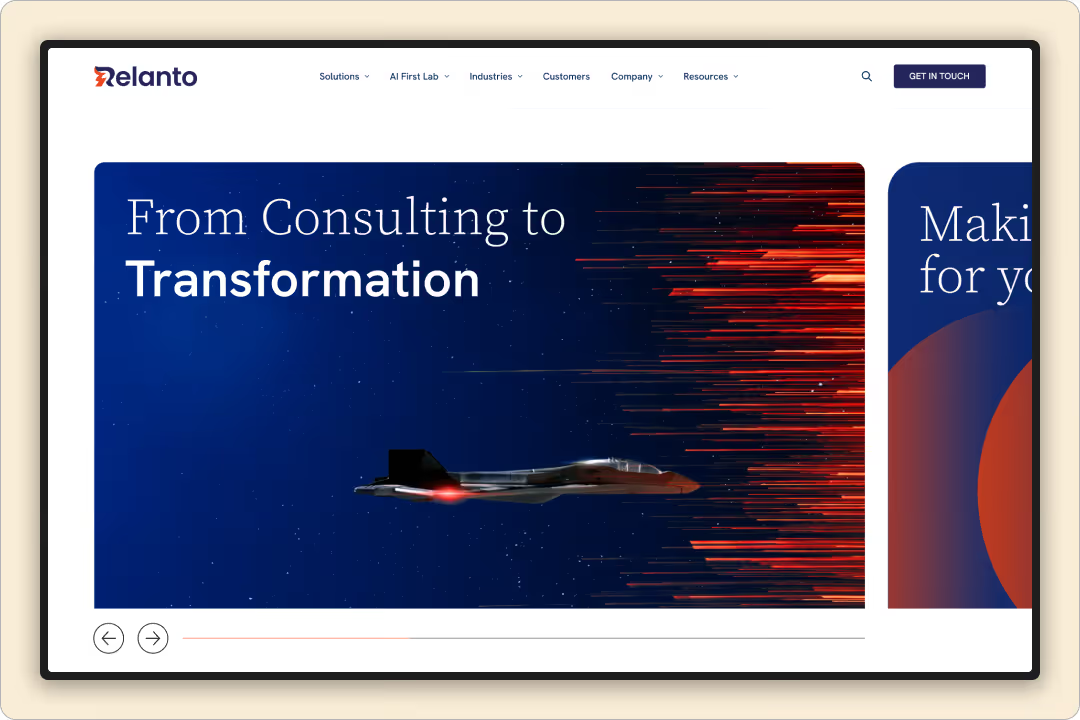
Website strategy and design for Relanto, an IT consulting and business advisory services company
Aavenir
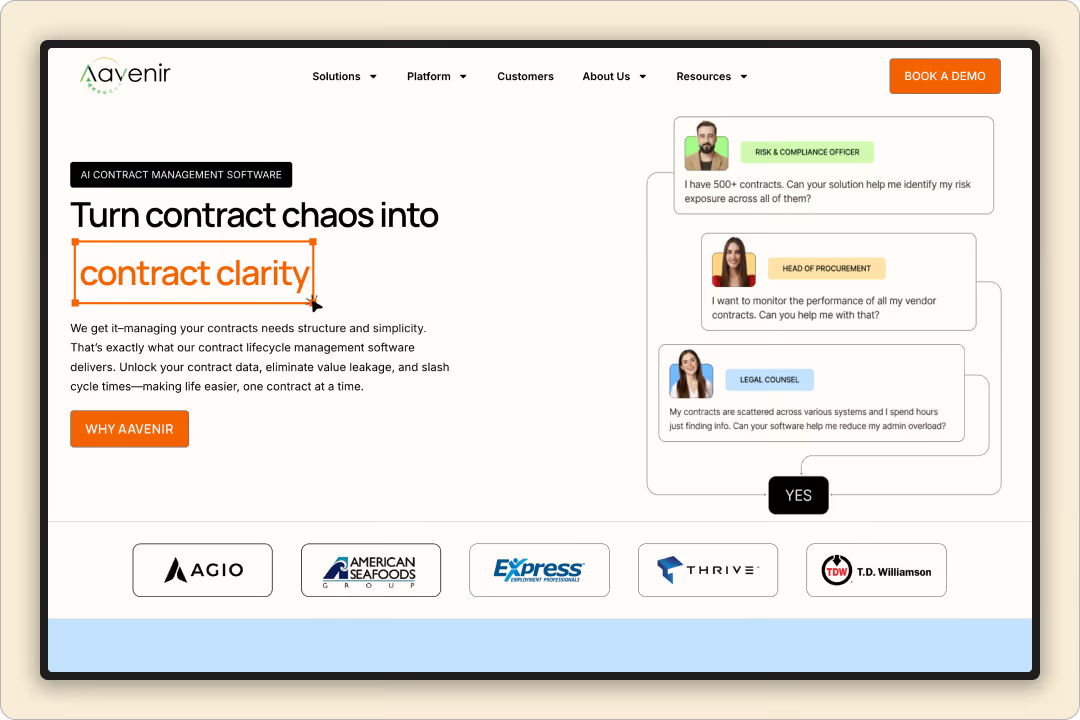
Website messaging and design for Aavenir, an AI-powered source-to-pay and contract lifecycle management platform



FAQs
Product Positioning
Experts

Prenitha Xavier
B2B Content Writer

Swathi Mohan
Content Strategist

Mejo Kuriachan
CEO | Partner | Brand Strategist