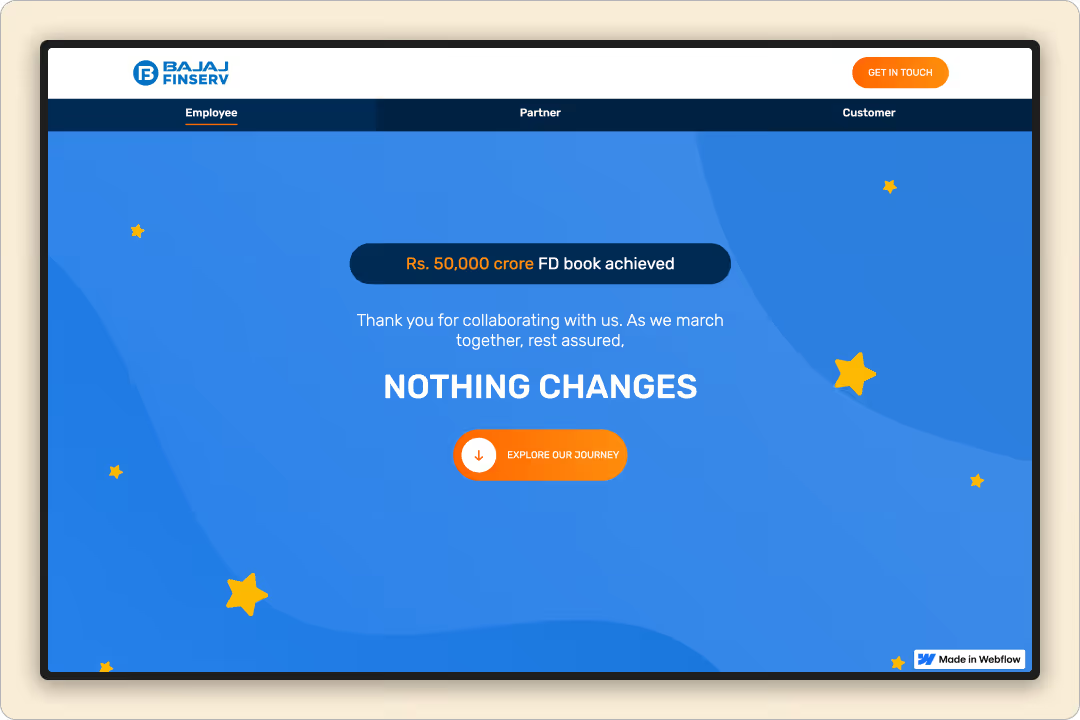
Best Web Design & Branding Agency in Jaipur
Jaipur is no longer just a tier-2 IT services city. There is a real SaaS and product-software base here, plus a growing gov-tech and IT-services sector serving clients across India and the US. The brand bar has gone up faster than the local agency landscape has.
Design Projects for Jaipur Brands
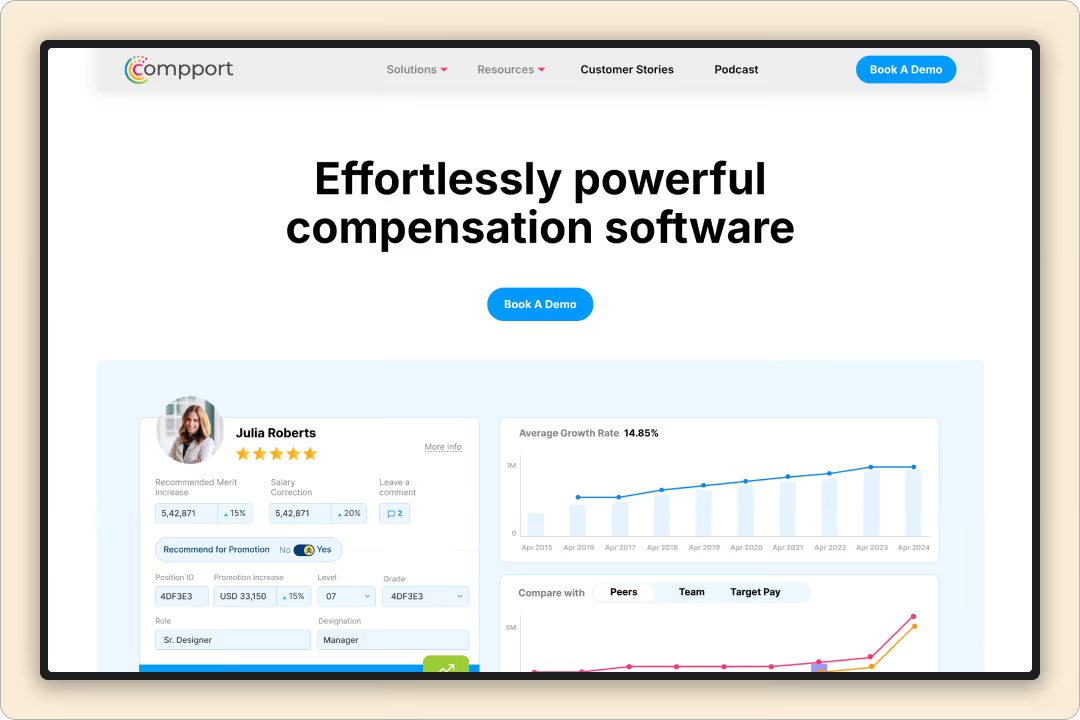
Compport
Brand and website design for Compport, an AI-powered compensation management platform for equitable and transparent pay decisions

Entropik
Brand identity and website design for Entropik, an AI-powered integrated market research platform for agile and accurate consumer insights
Why work with a Bangalore studio when there are agencies in Jaipur?
We work with Jaipur founders on positioning-led brand and Webflow builds. Same timezone, full working-day overlap, four to six weeks for standard scope. We treat tier-2 founders the same way we treat Bangalore Series B founders — diagnosis first, then build.
Ready to transform your Jaipur brand?
Talk to a Design Expert
Why Jaipur B2B brands need a branding partner that understands the local market
Jaipur has quietly become a credible product and SaaS hub. The IT-services backbone is still here, but layered on top is a growing base of product companies — SaaS, gov-tech, fintech adjacencies, and a handful of consumer-tech teams. Most are selling well beyond Rajasthan, often to US or global buyers.
The positioning challenge for Jaipur founders is specific. Buyers in Mumbai, NCR, the US, and the EU do not know your city as a tech city. The website has to do that work — establishing credibility without overplaying the location, and looking like a company that competes with anyone, not a regional vendor.
We work with Jaipur founders who want to compete at that level.
What goes wrong with most Jaipur agency engagements
We see four patterns.
Services-shop hangover. Local agencies often come from a services background and treat product companies like services companies. The site ends up describing capabilities, not making a claim.
No positioning depth. Nobody is doing the work on category, buyer, and narrative before anyone designs.
Weak copywriting. Strong craft, thin strategic writing. The site looks fine and reads like nothing.
Vendor mentality. The agency waits for the brief. The founder becomes the strategist.
How we work with Jaipur B2B founders
We are in Bangalore, same timezone, full IST overlap. Daily standups when needed. Weekly working sessions throughout. We treat distance as irrelevant — most of our clients are not in our city anyway.
We start with a one-to-two week positioning sprint. Buyer, category, competitive set, narrative. Then identity if needed. Then Webflow design and build on the CMS, structured for SEO.
Four to six weeks for a Webflow rebuild on existing positioning. Eight to twelve weeks for full brand plus site. India-headquartered means we understand the difference between selling to a CIO in Mumbai and a procurement lead in Texas — and what your site needs to say to each.
Named clients and work
We have worked with founders selling out of Jaipur and similar tier-2 hubs on positioning that does not lean on location at all. Sevenloop, a manufacturing-tech company, is a strong reference for the kind of build that travels well across geographies. Transitry and Lumora are other examples of product-led identities that read as global from day one.
Best for
- Best for Jaipur SaaS and product-software founders selling to non-Jaipur buyers.
- Best for gov-tech and B2B SaaS companies that need credibility with central and state-level buyers.
- Best for IT-services firms productising and needing a brand that looks like a product company.
What is included
Positioning and messaging strategy. Visual identity system. Webflow design and build on CMS, structured for organic growth. Motion where it earns its place. Pitch deck design on request.
Engagement model
Four to six weeks for a Webflow rebuild on existing positioning. Eight to twelve weeks for full brand plus site. Same timezone, full IST working-day overlap, weekly working sessions.
If you are a Jaipur founder considering a rebrand or rebuild, book a 30-minute diagnosis call. We will be honest about whether the site is your real problem or whether the story under it needs work first.
What the brand has to do for a Jaipur founder selling outside Jaipur
When the buyer is in Mumbai, NCR, the US, or the EU, the site is the company. There is no office tour, no founder coffee, no warm intro from a partner who has seen your work. The buyer lands on the homepage cold and decides in under a minute whether to take the next call.
That means three things have to be true on the site. The claim has to be sharp enough to remember after one read. The proof has to be specific — named customers, real outcomes, screenshots that show the product is real. And the craft has to be at the bar of any global SaaS site the buyer has already seen. We build to that bar by default. The location of the company is not a constraint on the brand. The clarity of the founder's thinking is.
We have shipped sites out of Jaipur and similar hubs that have closed enterprise pilots in the US within weeks of launch — not because the brand pretended to be from anywhere else, but because it stopped apologising for being from where it was.
FAQs
B2B and B2C web design address fundamentally different buyer journeys, decision processes, and value frameworks. While B2C prioritizes emotional engagement and immediate conversion, B2B design must support complex, multi-stakeholder evaluation, risk assessment, and financial justification. The best B2B sites feel distinctly different because they solve different problems.
Sales Cycle Length & Information Architecture
B2C conversion happens in minutes; B2B evaluation takes weeks or months. B2B sites must accommodate 5-9 touchpoint decision journeys with different content at each stage. Information architecture must support deep resource centers, documentation, case studies, and technical specifications. Navigation should make it easy for prospects to find answers without sales contact. B2C sites can be surprise-and-delight experiences; B2B sites must be comprehensive reference tools that reduce buyer uncertainty.
Multi-Persona Messaging & Content Hierarchy
B2B purchases involve multiple decision-makers with conflicting priorities. Technical leads need product depth; CFOs need financial justification; executives need competitive positioning. B2B sites must speak to each persona independently without confusing others. This requires sophisticated content structure: separate resource paths, persona-specific case studies, and distinct messaging frameworks. B2C can use singular, emotionally resonant messaging; B2B needs rational, multi-layered persuasion.
Trust Signals & Credibility Requirements
B2C buyers rely on reviews, brand recognition, and social proof; B2B buyers focus on compliance certifications, security audits, reference customers, and vendor stability metrics. B2B sites need prominent SOC2 badges, case studies with quantified results, analyst recognition (Gartner, Forrester), and customer testimonials from peer companies. Security, implementation timelines, and total cost of ownership matter more than product aesthetics.
Design Aesthetic & Professional Authority
B2C design embraces personality, trends, and emotional aesthetics. B2B design projects authority, stability, and professionalism—which means conservative color palettes, clear hierarchy, and reduced visual experimentation. However, boring B2B design loses to competitors equally credible but more engaging. The balance is professional sophistication: high production quality, thoughtful imagery, and clean interaction patterns that convey premium positioning without distraction.
Explore our B2B web design expertise or review enterprise client case studies.
Boutique agencies deliver superior B2B web design through specialized expertise, direct client relationships, and strategic thinking that large agencies struggle to provide. While large agencies excel at scale and broad service portfolios, boutique agencies optimize for deep understanding of complex B2B industries and buyer psychology.
Specialized Industry Expertise and Deep Buyer Understanding
Boutique B2B agencies focus exclusively on technology, SaaS, fintech, and similar complex industries. This specialization develops profound understanding of buyer psychology, industry dynamics, competitive landscapes, and technical requirements unique to each sector. A boutique agency understands that SaaS website conversion relies on different psychology than healthcare tech or cybersecurity. We speak your language, understand your buyer objections, and recognize your competitive threats because we work exclusively within your industry. Large agencies serving diverse industries can't achieve this depth, instead applying generalized web design principles across vastly different contexts.
Direct Access to Strategic Thinking
In boutique agencies, you work directly with owners, strategists, and senior designers. Decisions happen in conversations, not through committee layers. This creates alignment between your business goals and web design execution. Large agencies assign junior staff to client accounts, with strategy developed separately by senior strategists rarely involved in day-to-day work. Boutique agencies integrate strategy and execution, ensuring your website reflects sophisticated thinking, not generic templates adapted from other industries.
Flexibility and Rapid Iteration
Large agencies operate on rigid processes optimized for scale and predictability. Change requests trigger change order discussions and timeline delays. Boutique agencies work with flexibility because we're invested in your success, not protecting project margins. When market conditions shift or your positioning evolves, we adapt quickly without bureaucratic overhead. This responsiveness matters in fast-moving B2B markets where competitive landscapes change rapidly.
Accountability and Long-Term Partnership
Your relationship matters differently in boutique agencies. We live with the consequences of our work—your success is our reputation. Large agencies move to the next client after project completion. Boutique agencies maintain long-term relationships, supporting ongoing optimization, ensuring your website continues performing as market conditions evolve. Our success is measured by your results, not by billable hours or scope creep.
Experience our boutique approach to B2B web design and strategy. Learn about our team and how we partner with complex technology companies. Start a conversation about your web design needs.
Choosing the right web design agency requires evaluating their strategic approach, industry experience, and ability to deliver measurable results—not just aesthetic design. The best agencies understand your business, target market, and competitive landscape before proposing solutions. Look for partners who ask strategic questions, demonstrate relevant case studies, and clearly articulate how their approach supports your business objectives. A strong agency partnership extends beyond website launch to support growth and evolving market needs.
Evaluate Strategy and Strategic Approach
Does the agency lead with business strategy and market research, or jump directly to design concepts? The best partners conduct discovery work—competitive analysis, audience research, and positioning definition—before visual design. This ensures your website reflects strategic thinking, not just aesthetic preferences, and delivers measurable business impact.
Assess Relevant Experience and Case Studies
Review the agency's portfolio for projects in your industry or with similar audiences and objectives. Request detailed case studies showing not just what they created, but why and what results clients achieved. Ask for client references you can contact. Relevant experience means understanding your market challenges and customer psychology without extensive learning curves.
Confirm Ongoing Support and Partnership Model
Website design is not a one-time project; digital presence requires ongoing refinement based on performance data and market changes. Clarify what support the agency provides post-launch: analytics review, optimization recommendations, content updates, and strategic guidance. The best agencies function as extension of your marketing team, not external vendors.
Learn about our strategic web design approach, or meet our team and see our work.
In India, expect to pay $10k to $80k for a B2B website redesign depending on scope, strategy depth, and the seniority of the team you're working with. In the US, equivalent engagements run $50k to $200k+. The gap reflects labour cost differences, not necessarily quality differences — India-based agencies like Everything Design now run full brand strategy and Webflow build engagements for global enterprise clients at roughly half the cost of comparable US firms.
A few breakdowns by scope:
Execution-only (messaging set, Webflow build): $10k to $30k India / $25k to $60k US. You bring the positioning and messaging; the agency builds and implements.
Strategy + design + build (no visual identity rebuild): $25k to $60k India / $50k to $120k US. Includes discovery, messaging architecture, information architecture, design, and Webflow development.
Full strategy + brand identity + website: $50k to $150k India / $100k to $200k+ US. Covers positioning work, new visual identity, and complete website build. This is the Everything Design engagement model.
Enterprise-grade with multiple product lines, stakeholder reviews, and custom integrations: $150k to $300k+, regardless of geography.
Timeline ranges from 8 to 14 weeks for execution-focused engagements to 16 to 20 weeks for full strategy-through-build. See the full agency comparison guide for per-agency pricing and scope breakdowns.
A comprehensive B2B website redesign typically takes 14–20 weeks from kickoff to launch. This timeline includes discovery, strategy, design, content development, and launch support. B2B websites involve greater complexity than B2C sites—longer buyer journeys, multiple stakeholders, technical messaging, and sales integration require careful planning and execution. Rushed redesigns often miss critical conversion opportunities and sales enablement features.
Discovery & Strategy (Weeks 1–4)
Begin with stakeholder interviews, customer research, and competitive analysis. Understand your buyer journey, decision-making process, and key objections. Interview your sales team about common questions and common pain points. Analyze current website performance, identify underperforming pages, and define clear redesign objectives. Create a buyer persona framework and develop a messaging architecture for different buyer stages and roles. This phase prevents costly design mistakes later.
Design & Content Development (Weeks 5–14)
Develop wireframes addressing key buyer concerns and conversion paths. Create high-fidelity designs that convey credibility and expertise. Develop compelling messaging, case studies, ROI calculators, or product demos as needed. Conduct design reviews with stakeholders to ensure alignment. Develop new content or refine existing content for clarity and conversion. This phase requires iteration—expect multiple feedback cycles. Launch readiness planning, analytics setup, and CRM integration planning happen in parallel.
Testing, Refinement & Launch (Weeks 15–20)
Conduct user testing on prototypes with actual prospects. Identify friction points and refine design accordingly. Perform technical QA across browsers, devices, and functionality. Implement analytics tracking, goal setup, and conversion monitoring. Create launch plan, marketing strategy, and team training. Perform SEO optimization and canonicalization for old URLs. Stage final testing environment and execute launch. Post-launch monitoring includes bug fixes, performance optimization, and early iteration based on user data.
Factors Affecting Timeline
Existing content quantity influences speed—creating new case studies takes longer than refining existing ones. Stakeholder availability impacts approval cycles significantly. Technical complexity, CRM integrations, and custom functionality extend timelines. Sales team involvement increases buy-in but requires scheduling. Organizations with strong internal support move faster; those requiring extensive internal alignment take longer. Clear objectives and defined success metrics accelerate decisions.
Launch a strategic B2B website redesign with our team. Discuss your timeline and objectives with our strategy experts.
A high-quality B2B website does five things well: it establishes what the company does and who it's for in the first 10 seconds, it structures information to match how buyers actually make decisions (not how the company prefers to tell its story), it builds credibility through evidence rather than claims, it gives different buyer personas distinct paths through the site, and it converts interest into a specific action rather than leaving visitors to figure out their next step.
Design: Clean, structured, and credible. Not flashy for its own sake. Typography and layout that communicate seriousness and precision. Visual identity that's consistent with how the company presents everywhere else. Mobile performance that doesn't degrade the experience (this is where most B2B sites still fail).
Messaging: Specific enough to be useful to your ICP, general enough not to exclude adjacently relevant buyers. The homepage headline should describe what the company does and why it matters to the buyer — not the founder's vision, not a creative tagline. Social proof should be specific: named clients, documented outcomes, quantified results where possible. Generic testimonials do less work than one precise statement from a credible reference.
User experience: Navigation that helps the right buyer find the right information without hunting. Case studies that describe real problems and outcomes, not just logos. A demo request or contact flow that creates confidence rather than friction. Fast load times on all devices.
Cost: Expect $25k to $80k for India-based strategy + build. US-based equivalents run $75k to $200k+. Everything Design's full strategy-through-build engagements fall between $50k and $150k. See our guide on B2B website redesign agencies for a structured comparison.