


Design Agency for Technology Businesses
B2B technology branding and Webflow web design agency. We work with hardware-software hybrids, developer tools, AI and ML infrastructure, deeptech and the broader B2B tech space that isn't pure SaaS — built by a team with the engineering vocabulary to translate complex products into clear narratives.









Why B2B tech companies struggle with branding and websites
B2B technology has a specific buying-committee problem. A developer-tools company is being evaluated by an individual developer, a VP Engineering, a CTO and (increasingly) a CISO. An AI-infrastructure platform is being evaluated by a head of ML, a VP Engineering, a CFO and a security reviewer. A hardware-software hybrid is being evaluated by engineering, procurement, operations and finance. Every committee includes at least one person who reads the site looking for a technical signal, at least one who reads it looking for an economic case, and at least one who reads it looking for risk.
The failure pattern on B2B tech sites is the same one across the category: the site is written to one of these buyers (usually the technical evaluator, because the founder is technical and writes to her own profile) and lost to the rest. The technical reader converts internally; the CFO can't find the economic case; the CISO bounces because the security and compliance content is missing.
The second failure: feature-list positioning. The homepage opens with a list of capabilities. The buyer can't tell what the product is for, who it competes with, or why it's the right pick. Feature lists work after the buyer has chosen the category; they don't qualify the company in the first place.
The third failure: generic tech aesthetics. Gradient backgrounds, geometric shapes in motion, abstract product illustrations, a headline that includes "AI-powered" or "next-generation." Indistinguishable from twenty competitors. The buyer cannot tell the company apart, and worse, can't tell it apart from the category it's trying to break out of.
The fourth failure (specific to companies scaling from SMB into enterprise): the brand was built for SMB and never reset. The SMB site speaks to a single founder-buyer. The enterprise buying committee reads the same site and reads immaturity. Companies make this transition with a brand reset, not a feature-page expansion.
What goes wrong on most B2B tech sites
Indistinguishable visual systems. Gradient backgrounds, abstract product illustrations, generic dashboard mockups. The buyer cannot tell the company apart from the category.
Feature-list-first positioning. The site opens with what the product does instead of what the buyer gets. The technical reader scrolls; the economic buyer bounces.
Missing economic case. No ROI, total-cost-of-ownership story, comparable benchmark or customer-realised outcome. The CFO has nothing to take to the buying conversation.
Security and compliance as a footer link. For any company selling to enterprise, the security and compliance page is an evaluation surface. A SOC 2 logo at the bottom of a page does not pass a CISO review.
SMB brand resisting the enterprise stage. Casual tone, demo-first homepage, weak partner-page, no enterprise-grade integration story. The Series B-C upgrade to brand never happened and pipeline velocity stalled.
How Everything Design approaches B2B tech engagements
We start by mapping the buying committee, exactly as we do for healthcare and legal tech. For a developer-tools company: individual developer, engineering manager, VP Engineering, CTO, CISO and CFO. For an AI-infrastructure platform: head of ML, VP Engineering, CFO, security and IT. For a hardware-software hybrid: engineering, operations, procurement and finance. Each reader gets a path through the site that lands them on the content they're evaluating against in two clicks.
Positioning leans into specificity. We strip the AI-powered and next-generation language and rebuild around what the product specifically does, on what infrastructure, against what comparable benchmarks. The technical reader needs vocabulary fit, the economic buyer needs a defensible ROI narrative, the security reviewer needs substantive compliance content.
We build the visual identity to resist commodity tech aesthetics. Editorial type where serif is right; restrained palette; considered product surface in the visual system (not abstract illustration). The brand should look like a peer of the company a stage ahead, not a peer of the company a stage behind.
We build on Webflow with CMS architecture that handles the next 18 months of go-to-market — second product, vertical solutions, partner page, integrations marketplace, enterprise-tier landing, careers, insights. The CMS is built to extend, not to be rebuilt.
One thing we're explicit about: we're not the right partner for every B2B tech company. We're a sharper fit when there's real domain depth — engineering, hardware, AI infrastructure, deeptech — that needs a strategist and designer who can hold their own in a technical conversation. We've been told we're not the cheapest option in the market. The work we ship is built to operate for the next 18-36 months, and that's the engagement we take on.
Named clients and case study highlights
Kandou AI — Swiss deeptech building AI fabric for hyperscalers. We worked through how a chiplet-and-fabric company at the boundary of semiconductor and AI infrastructure presents itself to hyperscaler procurement, foundry partners, and the technical leadership at the world's largest cloud providers. The brand and site had to project category-defining technical depth without slipping into commodity semiconductor aesthetics.
Armory — defence-tech, counter-drone systems, the only Indian company building counter-drone systems entirely in India with an MoD tender already secured. The brand had to communicate sovereignty and operational capability to the MoD tender committee, strategic-affairs offices and institutional investors in the same site visit. Useful precedent for deeptech and hardware-software hybrid companies where the buyer is multi-stakeholder and the stakes are visible.
Turno — EV battery intelligence for commercial fleets. Hardware-and-data company addressing fleet operators, battery-as-a-service buyers, OEM partners and institutional investors. The brand had to hold across all four reader types and across a multi-product roadmap that's still being executed.
LightMetrics — edge-AI video telematics. Hardware-and-software product selling into fleet operators and insurance ecosystems. We worked through how to land technical credibility with engineering buyers while also landing operational credibility with fleet directors and insurance partners.
Sevenloop — precision manufacturing for hardware startups. Adjacent to B2B tech because the buyer is a hardware founder who needs to verify the firm's engineering precision in two clicks.
Tredence — global data and AI consulting at the boundary of tech and consulting. We built the positioning that lets the firm sell into enterprise CDOs and CIOs.
5x — modern data stack consulting and platform. Hybrid product-plus-services positioning, with the brand built to hold across both buyer types.
Additional B2B tech engagements: Bizongo (B2B supply chain platform), Botim (consumer-fintech infrastructure), Progcap (Series C fintech infrastructure), Cloudphysician (healthcare AI), Transitry (climate-tech MRV), Fortuna Cysec (cybersecurity), Lumora Security (cybersecurity), Ximkart (B2B trade marketplace), Ayr Energy (power grid intelligence).
Best for
Best for hardware-software hybrid companies. Where the brand has to communicate engineering precision and software-grade UX in the same architecture.
Best for developer-tools and infrastructure companies at Series A-C. Where the buying committee includes individual developers, engineering leadership and CFO-procurement, and the site has to land with all three.
Best for AI and ML infrastructure platforms. Where the AI narrative has to be specific and defensible, not generic, and the security story has to be substantive.
Best for B2B tech companies scaling from SMB into enterprise. Where the brand needs a reset to land with an enterprise buying committee.
Best for deeptech and hardware-led startups. Where the strategist and designer need to hold their own in a conversation about state-of-health curves, directional jammers, chiplet fabric, edge-inference latency or thermal management.
We are not the best fit for pure-play SaaS companies who are well-served by our dedicated SaaS branding page, or for D2C consumer tech.
What's included
A typical B2B tech engagement covers:
- Buying-committee mapping (technical evaluator, economic buyer, security and procurement)
- Brand strategy and positioning against the named competitive set
- Verbal identity (technical vocabulary, specific capability claims, multi-persona messaging)
- Visual identity (logo, type, restrained palette, considered product surface, motion principles)
- Webflow site (homepage, product or solutions, integrations, customers, security and compliance, pricing where relevant, leadership, resources, contact, careers)
- CMS for products, integrations, customers, leadership, resources, vertical solutions
- Substantive security and compliance page
- ROI and total-cost-of-ownership content blocks for the economic buyer
- Comparable-benchmark and competitive-comparison content where appropriate
- Sales-enablement starter kit (one-pager, demo-deck cover system, capability deck, procurement response template)
- Investor-narrative one-pager
- Handover and CMS training
Optional add-ons: monthly retainer for ongoing brand and site evolution, vertical solution-page builds as the company expands, integrations-marketplace build, partner-programme page, enterprise-tier landing, analyst-relations support content.
Engagement model
A full B2B tech brand-and-website engagement runs six to eight weeks. Hardware-software hybrids and deeptech engagements with technical-narrative depth attached run eight to ten weeks. A website-only build on an existing brand foundation runs four to six weeks.
We run small senior teams — a strategist, a designer, a developer, a project lead. The founder works with the strategist and the designer directly. No account manager in between. We work in two-week sprints with a single working session per week with the decision-maker (typically the founder, the CEO or the head of marketing) and async working time in between.
We also offer a monthly retainer for ongoing brand and site evolution post-launch — useful for companies adding products, verticals or markets at pace.
If you're heading into a Series A-C raise, a major launch, an enterprise-sales push or a brand reset to support international expansion, get in touch.
Why do B2B technology companies need a specialist branding and web design agency?
B2B tech buying involves a technical evaluator, an economic buyer and a security-and-procurement gate. Each reads the site for different signals. Generic tech-brand aesthetics — gradients, abstract shapes, AI-powered tagline — fail all three. We build positioning and site architecture that survives the technical reviewer, the CFO and the InfoSec questionnaire.
Design Projects for Technology Firms

AnkerCloud
Brand and website design for AnkerCloud, a cloud consulting firm offering digital transformation solutions

ASPI & CIS Tech Diplomacy
Website design for ASPI & CIS Tech Diplomacy, a platform exploring technology policy and digital governance

Botim
Website strategy and design for Botim, an ultra platform offering international money transfers, voice and video calls, government services, and e-commerce through a single app
Compport
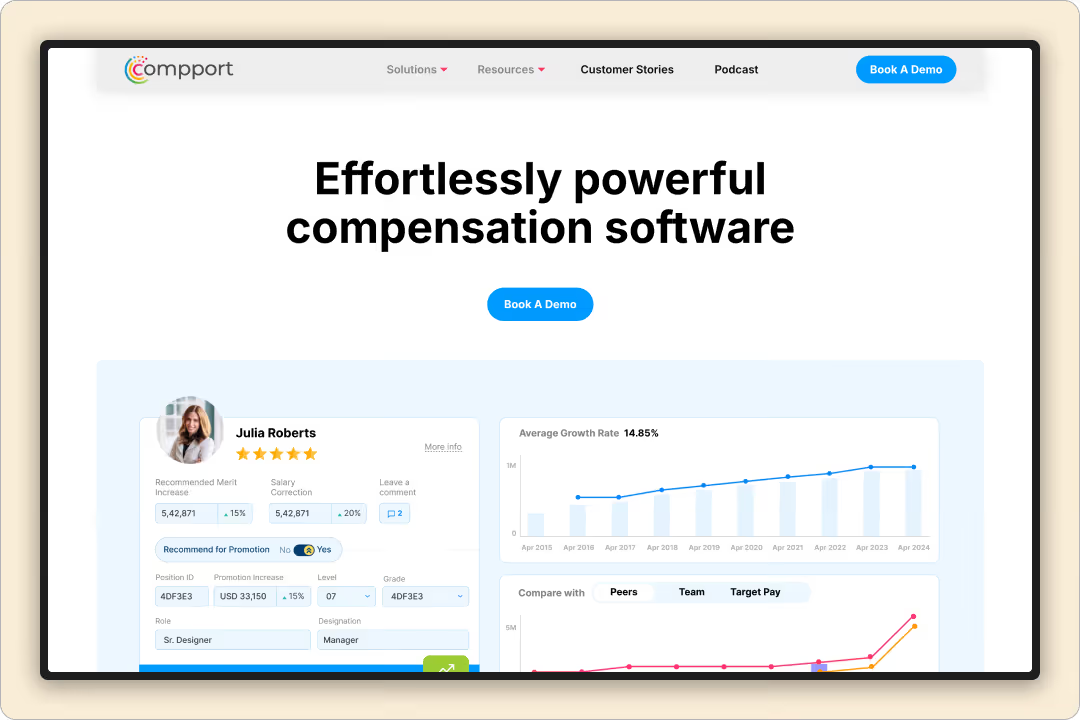
Brand and website design for Compport, an AI-powered compensation management platform for equitable and transparent pay decisions

Entropik
Brand identity and website design for Entropik, an AI-powered integrated market research platform for agile and accurate consumer insights

Expent
Brand and website design for Expent, a vendor lifecycle management platform from sourcing to renewal
.avif)
Fortuna Cysec
Brand strategy and website design for Fortuna Cysec, an AI-driven managed security services provider for threat detection and compliance

Nimble Edge
Brand and website design for NimbleEdge, an on-device machine learning platform for real-time mobile personalization

Solytics Partners
Brand and website design for Solytics Partners, a risk management and data analytics consultancy for financial institutions

Tunnel
Brand and website design for Tunnel, a payment automation platform built for equipment manufacturers

Swiffy Labs
Brand and website design for Swiffy Labs, a modular fintech lending infrastructure platform

FAQs
Technology Businesses
Design Experts

Akhilesh J
Lead Designer

Athira Krishnan
Lead Designer | Content Strategist

Mejo Kuriachan
CEO | Partner | Brand Strategist

Prenitha Xavier
B2B Content Writer

Sanjana
Lead Designer

Saurabh Chakradhari
Head of Development

Sijeesh VB
Lead Strategist

Tanmaya Rao
Lead Brand Designer | Illustrator