3D Website Examples
Inspiring 3D website examples showcasing immersive, interactive experiences—from product visualisations to storytelling, demonstrating how WebGL, Three.js, and Spline create engaging digital experiences.
Most recent 3D Website Project
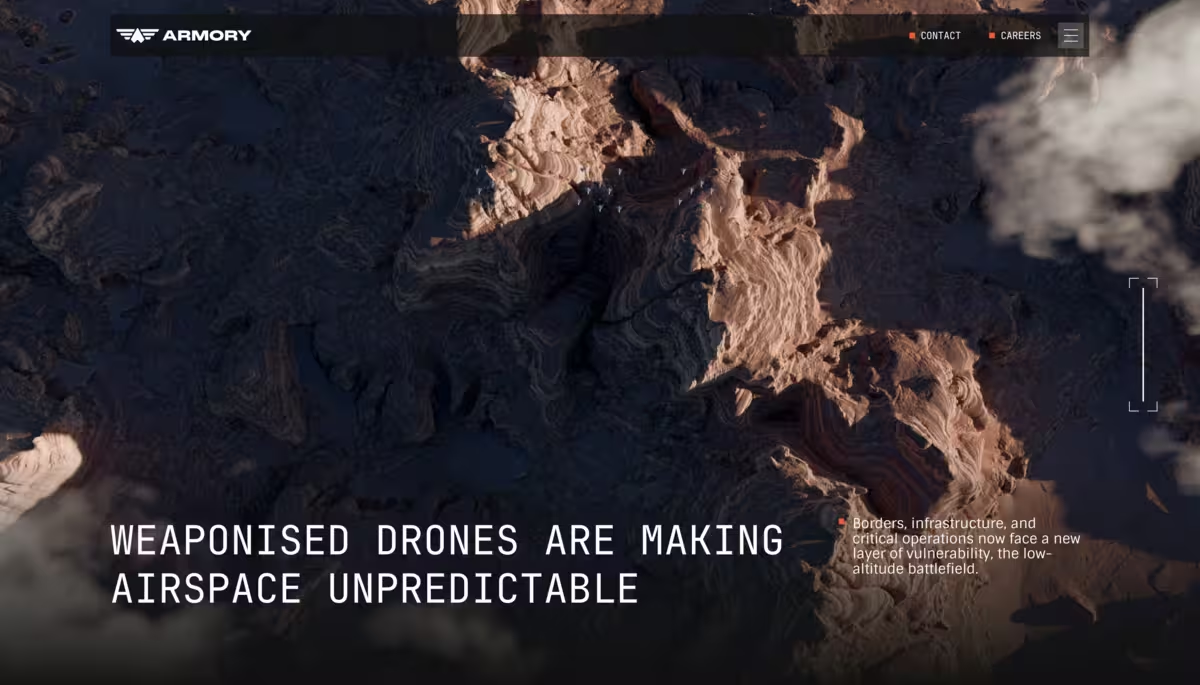
3D website for a Deep Tech Startup

3D website examples showcase how immersive visual experiences create memorable brand interactions and improve user engagement. Effective 3D web design balances visual impact with performance, using WebGL, Three.js, and optimized assets. The best implementations serve strategic purposes — demonstrating complex products, creating spatial understanding, or building emotional connection — rather than adding 3D elements purely for aesthetic novelty.
Building a high-impact website for a B2B tech or SaaS company? See how our B2B web design agency builds conversion-focused Webflow websites for enterprise and software brands. We also specialize in software company website design for B2B growth teams.
New 3D Projects


Customer Testimonial Video
Web Development in 3D for Armory
Frequently Asked Questions
Product visualisation in 3D animation is the use of computer-generated 3D models to show a product — how it looks, how it works, and how its parts fit together — without filming a physical unit. For B2B brands it does two jobs at once. It makes complex or hard-to-see products understandable: software, hardware internals, infrastructure, and processes that a camera could never capture clearly. And it gives the brand a consistent, ownable visual language across the website, sales decks, ads, and launch content.
For Turno, we used 3D product visualisation as a brand storytelling tool — turning the product into a visual narrative buyers could follow, rather than a spec sheet they had to decode.
3D web design is powerful but not universal. It's ideal for brands seeking premium positioning, product visualization, immersive storytelling, or technical differentiation—particularly SaaS companies, luxury goods, design agencies, gaming companies, and tech innovators. For conversions-focused businesses with time-sensitive offers or mass-market products, 3D's complexity may hinder performance. The key is assessing whether 3D enhances user experience and brand perception enough to justify increased development time, technical requirements, and potential performance trade-offs—and the honest version is that 3D lifts conversion only when it clarifies, not by default.
When 3D Design Delivers Maximum Value
3D excels for brands with longer user engagement windows and audiences expecting immersive experiences. Luxury brands use 3D to showcase craftsmanship and exclusivity. SaaS platforms use 3D to visualize complex features intuitively. Design and creative agencies use 3D to demonstrate capabilities. AR/VR experiences require 3D. Product configurators, architectural visualization, and interactive learning platforms benefit tremendously from 3D's dimensional richness. It is especially powerful for deep tech and hardware companies that need to make an invisible or complex product tangible — see 3D website examples and how data visualization carries weight in buyer conversations. In these contexts, 3D isn't a luxury—it's a strategic communication tool that 2D alternatives cannot match.
Performance and User Experience Considerations
3D content requires robust hosting, optimized delivery, and modern browsers. On mobile devices or slower connections, 3D experiences may frustrate rather than impress. Users with accessibility needs may encounter barriers. E-commerce sites with immediate conversion goals often sacrifice engagement depth for speed and simplicity. 3D works best when user patience aligns with your conversion timeline. A real estate developer can afford immersive 3D visualization; a fast-food chain needs quick-loading imagery. Understanding your audience's expectations and technical environment is crucial. Used well, 3D is often delivered as a scroll-driven sequence that stages a story rather than a heavy standalone scene.
Cost, Development Time, and Maintenance
3D requires specialized expertise: 3D modeling, animation, optimization, and interactive development skills. Projects take longer and cost more than traditional design. Updates require recreating assets rather than simple graphic tweaks. Small businesses or startups with limited budgets may achieve greater ROI with well-executed 2D design than undercooked 3D experiences. However, strategic 3D investments can establish market leadership that justifies the expense through premium positioning and reduced competition. For where 3D sits in an overall project budget, see our published pricing.
Strategic Integration Over Novelty
The question isn't whether 3D is trendy—it's whether it serves your business goals. Does 3D help users understand your product? Does it strengthen brand perception? Does it justify the added complexity? The best web design integrates 3D strategically where it delivers value, using 2D design for clarity and speed elsewhere. This balanced approach maximizes impact without unnecessary technical burden.
Curious about 3D web possibilities for your brand? Explore our 3D website design service, browse 3D website examples, read the honest take on when 3D actually lifts conversion, or talk to our team about your specific needs.
Professional 3D web design utilizes specialized software and platforms that balance creative control, technical power, and web integration. Core tools include Three.js and Babylon.js (WebGL libraries), Spline (browser-native 3D editor), Blender (3D modeling), Cinema 4D (motion graphics), and Webflow (integration platform). Leading 3D web designers combine 3D creation expertise with web development knowledge, ensuring designs export efficiently, load quickly, and perform smoothly across devices. Selecting appropriate tools depends on design complexity, performance requirements, and developer proficiency. Understanding 3D web tools helps clients evaluate agency capabilities and make informed platform decisions.
WebGL Libraries: Three.js and Babylon.js
Three.js and Babylon.js are open-source WebGL libraries enabling interactive 3D in browsers without plugins. Three.js dominates the ecosystem due to extensive documentation, large community, and countless libraries extending functionality. Babylon.js, backed by Microsoft, offers comparable capabilities with strong physics engines and XR support. Both libraries require JavaScript proficiency but unlock unlimited creative possibilities. Designers using these libraries create highly optimized, bespoke experiences that rival native applications. For complex, performance-critical applications, these libraries remain the professional standard.
Spline: The Emerging 3D-to-Web Platform
Spline revolutionizes 3D web workflows by enabling browser-native 3D design. Designers model, texture, and animate within Spline's editor, then export directly to web or integrate with Webflow. Spline eliminates complexity of WebGL development while maintaining visual sophistication. For designers without JavaScript experience, Spline democratizes 3D web creation. Performance is optimized automatically, and exports work across devices. Spline represents the future of 3D web design reducing barrier to entry while enabling sophisticated results.
3D Modeling and Motion Tools: Blender and Cinema 4D
Blender (open-source) and Cinema 4D (professional) create high-quality 3D models and animations that export to web. Blender's powerful modeling, texturing, and rendering capabilities rival expensive alternatives at zero cost. Cinema 4D excels at motion graphics, procedural animation, and complex simulations. Both tools create assets that export to WebGL or render as video assets for web integration. Professional 3D web experiences often combine Blender or Cinema 4D assets with Three.js integration or Spline implementation. These tools are indispensable for production-quality 3D content.
Integration and Performance Optimization
Successful 3D web implementation requires integrating 3D experiences within larger websites. Webflow integration, custom JavaScript implementation, or Spline embeds handle this. Performance optimization model simplification, level-of-detail techniques, lazy loading, and compression ensures 3D assets load quickly without degrading user experience. Professional 3D web developers understand optimization deeply, ensuring impressive visuals never compromise usability.
Explore our 3D web design capabilities, review projects featuring advanced 3D implementation, or discuss your 3D web vision. Discover complementary video and motion production services.
3D elements transform websites from static, flat interfaces into immersive experiences that captivate users and communicate sophisticated brand narratives. By adding depth, perspective, and interactivity, 3D enhances user experience by making complex ideas more intuitive, products more tangible, and brands more memorable. When implemented strategically, 3D technology creates emotional connections that drive engagement and conversions.
Creating Visual Depth and Interactivity
3D design allows users to interact with products and concepts in ways traditional 2D interfaces cannot. Rather than viewing a product from a fixed angle, users can rotate objects, zoom in on details, and explore different perspectives. This interactivity increases time spent on page, reduces bounce rates, and provides users with the confidence to make purchasing decisions. For B2B brands, 3D visualizations of solutions, software interfaces, or physical products communicate value more effectively than static images or descriptive text.
Storytelling Through Immersive Environments
3D web experiences create narrative environments that engage users on multiple sensory levels. Animation, parallax effects, and spatial design guide visitors through your brand story in a compelling way. Tech startups and SaaS companies particularly benefit from 3D storytelling, as it demonstrates innovation and sophistication. A 3D animated interface showcasing how software works tells your story far more powerfully than traditional screenshots or walkthroughs.
Improved Performance and Accessibility
Modern 3D web technologies like WebGL and Three.js ensure smooth performance across devices when properly optimized. Progressive loading ensures that even users on slower connections experience fluid interactions. For accessibility, 3D elements should include alternative text descriptions and keyboard navigation, ensuring all users regardless of ability can navigate your site effectively. When implemented responsibly, 3D enhances rather than hinders user experience.
Competitive Differentiation in B2B Markets
Most B2B companies still rely on conventional web design, making 3D an opportunity for differentiation. Brands using advanced web experiences appear more innovative, trustworthy, and forward-thinking. Whether displaying complex enterprise solutions or demonstrating product specifications, 3D creates a premium brand perception that justifies higher pricing and builds stronger client relationships.
For guidance on implementing 3D design in your brand narrative, explore our website design services or review our case studies showcasing immersive web experiences. Learn more about comprehensive brand strategy that incorporates emerging technologies.
Top 3D website examples showcase immersive design across luxury brands, SaaS companies, and creative agencies. Notable leaders include Spline's showcase site (geometric 3D interactions), Apple's product pages (subtle 3D renders), Airbnb's experiences (environmental 3D visualization), and specialized agencies like Unit9 and Stink. These sites demonstrate that 3D enhances without overwhelming effective implementation balances visual sophistication with usability. B2B brands increasingly adopt 3D to communicate complexity, innovation, and premium positioning. Understanding excellent examples informs strategic decisions about 3D adoption in your own digital presence.
Luxury and Lifestyle Brands Leading 3D Innovation
Brands like Dior, Balenciaga, and Loro Piana leverage 3D to create immersive product experiences. Users can explore products from every angle, visualize materials and finishes, and experience products in lifestyle contexts. This interactivity reduces purchase friction by providing the information and confidence traditionally gained through in-person shopping. For luxury B2B brands selling high-value offerings, similar 3D exploration builds confidence and justifies premium pricing.
SaaS and Enterprise Solutions Communicating Complexity
Companies like Figma, Webflow, and Adobe use 3D animations to visualize how software functions. Rather than static screenshots, 3D walkthroughs show workflows, feature relationships, and user paths. This approach makes complex software more understandable to non-technical stakeholders and decision-makers. For enterprise SaaS, 3D democratizes technical understanding executives without deep product knowledge grasp capabilities faster through spatial visualization than through feature lists.
Portfolio and Agency Sites Showcasing Craft
Creative agencies increasingly use 3D to demonstrate design excellence. Threefold, Zeroheights, and other forward-thinking studios employ 3D transitions, environmental storytelling, and interactive showcases. For agencies and design-focused brands, 3D validates creative positioning it signals sophistication, technical capability, and willingness to invest in exceptional user experiences. These sites often feature bespoke 3D work created by the agency itself, serving as portfolio and marketing simultaneously.
Emerging Platforms and Experimental Excellence
Cutting-edge 3D examples come from specialized studios and experimental platforms. Sites like Sketchfab's curated projects and reality studio portfolios push 3D web boundaries. WebGL documentation sites and Three.js examples communities showcase technical excellence. These examples inform strategic thinking about 3D possibilities and technical implementation approaches. Staying current with 3D web innovation helps you make informed decisions about incorporating emerging technologies into your brand presence.
Discover how advanced web design incorporates emerging technologies. Review our immersive design projects, or discuss 3D implementation for your brand. Explore our production services for complementary visual storytelling.
3D web design integrates three-dimensional graphics, interactive models, and immersive environments directly into websites, creating experiences beyond traditional 2D interfaces. Using WebGL, Spline, Three.js, and similar technologies, 3D web design allows users to rotate products, explore environments, interact with visualizations, and engage with content spatially. It bridges the gap between flat digital interfaces and physical reality, enabling brands to tell stories more compellingly, showcase products more realistically, and differentiate themselves in competitive digital landscapes.
Enhanced Product Visualization and Experience
3D enables customers to explore products dimensionally—rotating them, zooming in on details, viewing them from all angles—without physically handling items. Furniture companies show how pieces fit into spaces. Jewelry brands display intricate craftsmanship from every perspective. Tech companies visualize product internals to explain functionality. This interactive visualization increases confidence in purchase decisions, reduces return rates, and decreases support inquiries. For products where visual understanding is critical, 3D transforms user experience and conversion potential.
Immersive Storytelling and Brand Experiences
Rather than explaining features through text and images, 3D allows users to experience them. An architecture firm can invite clients to virtually walk through designs. A software company can let prospects explore interfaces in 3D space. Educational content becomes interactive and memorable. This immersive approach captures attention, increases time-on-site, and creates emotional engagement that flat design cannot achieve. Brands stand out by offering experiences competitors provide as static information.
Technical Differentiation and Innovation Positioning
Implementing sophisticated 3D experiences positions brands as innovative and technically advanced. For tech companies, design agencies, and forward-thinking businesses, 3D web presence signals capability and vision. It communicates, "We're not following trends; we're setting them." This perception premium translates to increased brand credibility, attracts top talent, and justifies premium pricing. The technical sophistication itself becomes a brand asset.
Improved User Engagement and Metrics
3D experiences typically increase session duration, reduce bounce rates, and improve engagement metrics. Users spend more time on pages featuring interactive 3D content. This extended engagement provides more opportunities for conversion and improves search engine signals. Social sharing increases when experiences are novel and shareable. These metrics directly impact business outcomes, making 3D not just aesthetic but strategically valuable for digital performance.
Ready to explore 3D possibilities? Discover our web design capabilities, see 3D implementation examples, or schedule a consultation about innovative design for your brand.