


How AI Engines Decide What to Say About a Company
Greg Rosner audited 39 of PitchKitchen's own pages and found three different prices for the same service. A guest post on what that does to the machines now reading every site you build.
Editor's note
In July 2026 we published a roundup of messaging-house and narrative agencies. That is the comparison page Greg writes about below, and we got his entry wrong.
We had PitchKitchen at number five, filed under pitch and sales-narrative specialists, best for a single high-stakes deck. Our comparison table gave its limitation as "scoped to the deck rather than a reusable messaging house." That was not right. The Magnetic Messaging Framework is a documented messaging house, with the core message at the top, pillars mapped to buyer priorities, proof points, objection handling, per-persona language and a voice spec. Decks come out of it. They are not the scope.
Greg wrote to us on 10 August 2026. We corrected it the next day.
We then got it wrong a second time. The first fix changed the body of the entry but left the section heading, the summary bullet and the comparison-table row still calling it a deck specialist. Until we caught that, our own page carried two different answers about the same company, which is the exact failure he describes below. All four now say the same thing.
We asked him how he had found the page in the first place. This article is the answer.
Mejo Kuriachan, Co-founder, Everything Design
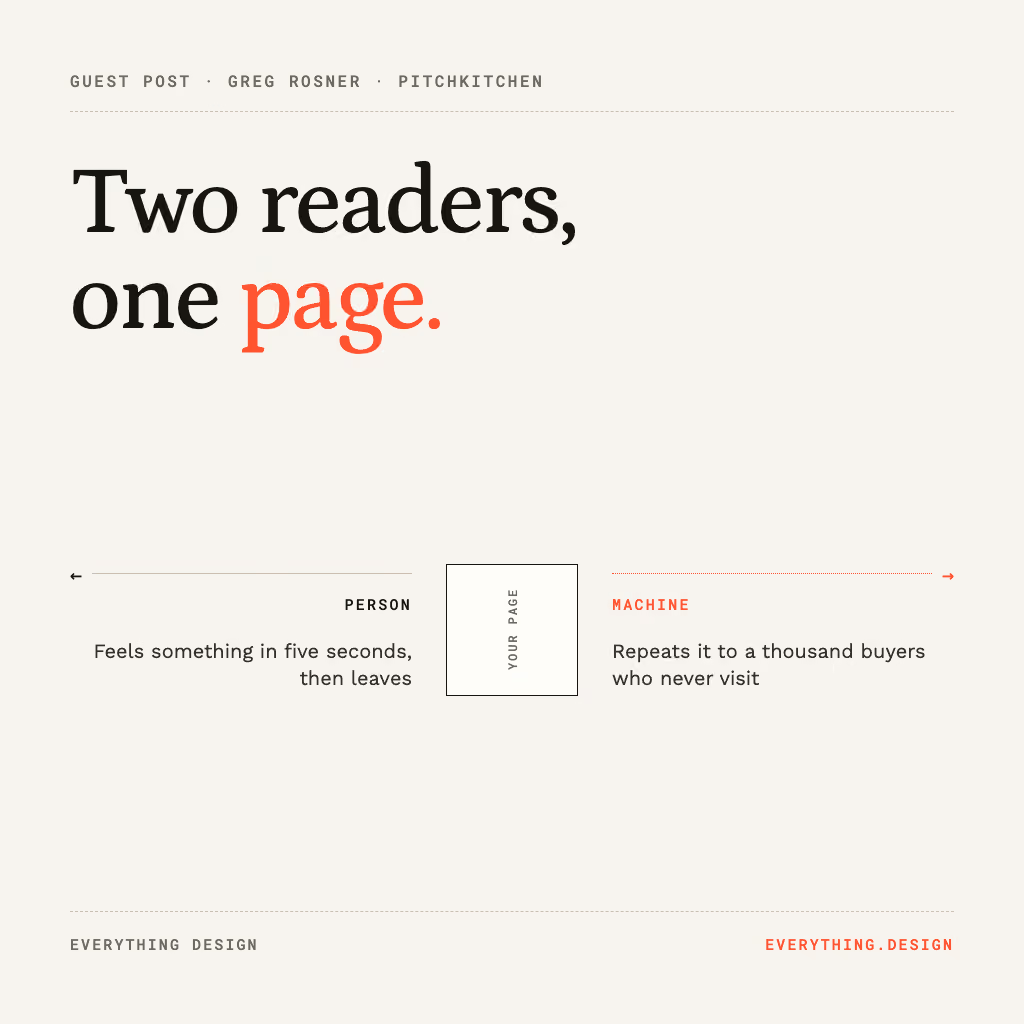
Two readers, one page
A client's website used to have one reader. A person landed on it, felt something in about five seconds, and either kept going or left.
That site has two readers now. The second one is a machine, and it does not visit to be persuaded. It visits to extract a set of facts it can repeat to the next thousand buyers who will never see the page at all.
Those buyers are asking questions like "who should we hire to fix our positioning" and taking the answer at face value. Whatever the machine learned from the site is what they hear. Does the site say something a machine can repeat accurately?
Two surfaces, and you only control one of them
When someone asks an AI engine about a company, the answer comes from one of two places.
Sometimes the engine searches the web, reads what it finds, and answers from that. Call it the grounded surface. It moves in days. It reads live pages, which means the copy you shipped last week is already in play.
The rest of the time the engine answers from memory, out of what it absorbed in training. That surface moves in years and no redesign touches it.
The grounded surface is the one an agency actually controls, and it is the one worth designing for. Every page you build is either giving an engine something clean to repeat or leaving it to guess.
The failure nobody catches in a design review
Here is the part that stung when we ran it on ourselves.
We audited our own site this June. Thirty-nine commercial pages. We found three different prices for the same service, sitting live at the same time.
Every page looked fine on its own. That is exactly why it survived. A design review examines one page, checks the hierarchy, checks whether the argument lands, and moves to the next one. Nobody reads all thirty-nine in a single sitting asking whether they agree with each other.
A machine does. It reads them together, finds three answers to one question, and has no way to tell which is current. Sometimes it picks the wrong one. Sometimes it hedges, which is worse, because a hedge from an AI engine reads to a buyer as a company that does not know what it charges.
We named the service four slightly different ways across those pages too. Four names for one thing looks like four things.
The fix is not glamorous. Pick one set of facts, write them the same way everywhere, and treat the phrasing as fixed rather than as something each page gets to improvise. It is the least creative work in a build and it is worth more than most of what surrounds it.
The failure that is not on the site at all
The second one is stranger, and it is the reason this article exists.
Engines do not only read a company's own pages. They read what other people wrote about that company, and they weight those pages heavily, because a third party has no reason to flatter.
Which means somebody else's article can be teaching every engine a fact about your client that your client would dispute, and no site audit will ever find it. It is not on the site.
We hit this in August. A well-read comparison page listed us and described what we do incorrectly. Not maliciously, just a reasonable inference from the outside that happened to be wrong. It was steering our exact buyer away from us on a page we had no idea existed.
We wrote to the editor with the correction and what the accurate version would say. He replied in twelve minutes and had it fixed the next day. The whole thing cost one email.
That is the honest shape of this problem. Not a crisis, and not something you can fix by shipping more content. Somebody has to actually look.
What this changes for the work
Four things, and none of them require a rebuild.
Say the load-bearing facts in one place, in plain sentences
Who it is for, what it does, what it costs, what it is called. Engines quote sentences that stand on their own. A definitional line inside a paragraph gets quoted far more often than the same idea spread across a beautiful three-panel layout.
Put the answer on the page
A PDF download, a video, and a "book a call" button are three ways of declining to answer the question the visitor arrived with. A machine cannot watch the video, and it will answer from whoever did write it down.
Run a consistency pass before launch
One person, every commercial page, one question: do these agree? It takes an afternoon and it catches the thirty-nine-page problem while it is still cheap.
Check what the internet already says
Search the client's name and read the third-party pages that come back. If one of them is wrong, write to the editor. Most of them will fix it, because an error on their page is their problem too.
The part worth sitting with
None of this replaces the work. A site still has to make a person feel something in five seconds, and no amount of machine-readable structure saves a page that says nothing worth repeating.
The bar just moved. A site now gets judged on what a person feels and on what a machine can repeat about it accurately, and the second one keeps working long after that person closed the tab.
Greg Rosner is the founder of PitchKitchen. He writes here as a guest contributor. Our own roundup of messaging house and narrative agencies is the page in question.
Frequently Asked Questions

Greg Rosner
Greg Rosner is the founder of PitchKitchen and author of the Magnetic Messaging Framework, a documented messaging house for B2B technology companies.